












- 22nd January 2026
Table of Contents
Are You Getting the Most Out of Your "Healthy" Food?
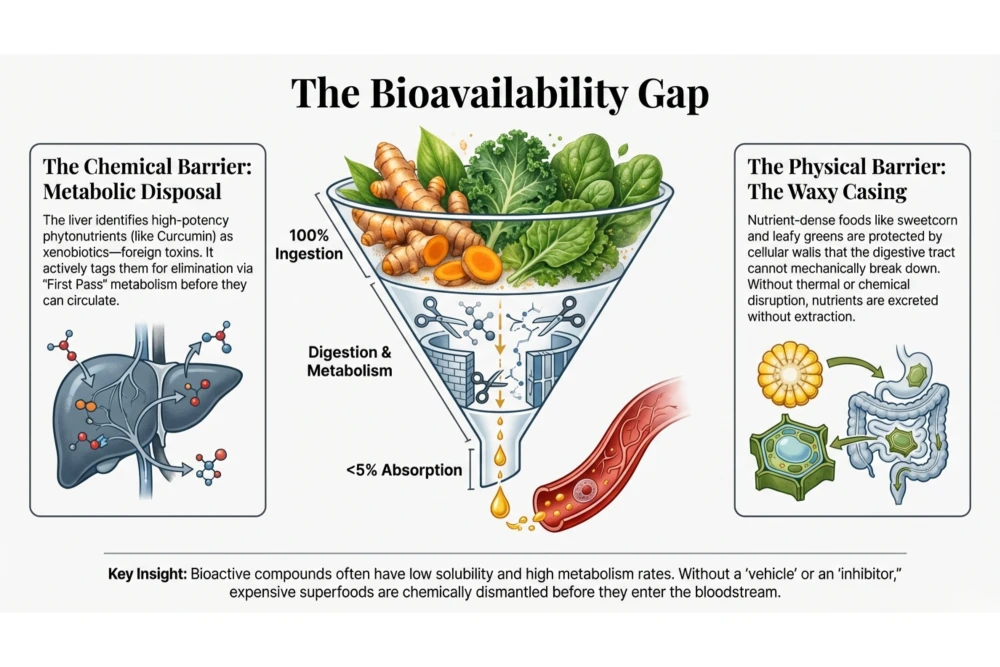
You make a conscious effort to eat nutrient-rich foods, but is your body actually absorbing all that goodness? One of the challenges with even the healthiest diet is that our bodies don't always extract the full nutritional value from what we consume. Consider sweetcorn, for example. Its kernels are packed with fiber, protein, and vitamins, but the waxy outer casing is difficult for our bodies to break down, meaning much of that nourishment can pass through our system unabsorbed.
This highlights a crucial concept in nutrition: the combination of foods is often more important than the individual ingredients. Certain pairings can either block or enable the absorption of vital compounds. The good news is that many of the most powerful nutritional boosters are already in your kitchen. Common ingredients we think of as simple flavorings—like a dash of black pepper or a drizzle of olive oil—can act as powerful enhancers, unlocking the full potential of the nutrients, vitamins, and even drugs we consume.
This article explores the potent science of "bioenhancers"—a concept that explains the powerful synergy in certain food combinations. Here are five surprising takeaways that will change the way you look at your plate.
It's Not Just Flavor—It's a "Bioenhancer"
The scientific term for these nutritional boosters is "bioenhancer." A bioenhancer is a substance that increases the bioavailability and efficacy of other active compounds (like vitamins, nutrients, and drugs) without having any pharmacological effect of its own at the dose used.
This concept boils down to two key effects:
- Increased Bioavailability: This means a higher level of a substance successfully enters the bloodstream, making it available for your body to use.
- Increased Bio efficacy: This means the substance becomes more effective, either due to its increased availability or through other supporting mechanisms.
This idea is transformative because it reframes common spices, herbs, and condiments. They are not just passive additions for taste; they are active, functional ingredients that play a direct role in how your body processes and benefits from the food you eat.
The Power Couple: Black Pepper and Turmeric
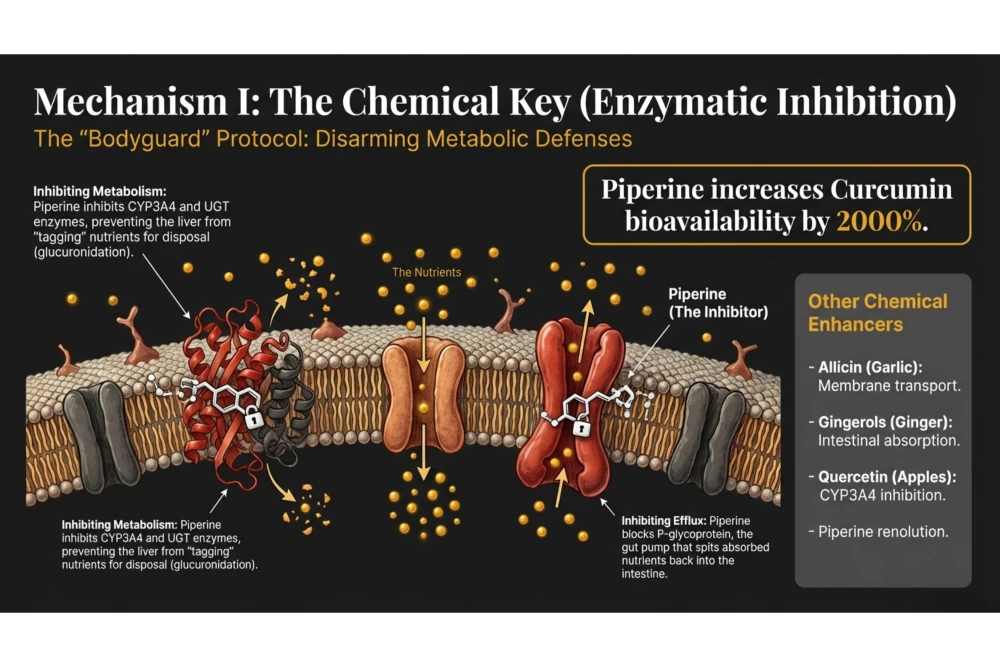
One of the most well-documented examples of this effect is the combination of turmeric and black pepper. Turmeric's potent anti-inflammatory and antioxidant benefits are largely attributed to its active ingredient, curcumin. However, curcumin only makes up about 5% of the turmeric spice and is not easily absorbed by the body on its own.
This is where black pepper comes in. Its active ingredient, piperine, dramatically enhances curcumin's effects. The mechanism is fascinating: when you consume a substance like curcumin, your liver works to make it water-soluble so it can be quickly flushed from your system. Piperine inhibits this process. Specifically, piperine inhibits key drug-metabolizing enzymes, such as CYP3A4, slowing down this process and giving curcumin the time it needs to enter the bloodstream.
The effect is incredibly potent. Research shows that as little as 1/20th of a teaspoon of black pepper can significantly improve the bioavailability of the curcumin in turmeric, supercharging its health benefits.
Healthy Fat Is Your Best Friend for Nutrient Absorption
Consuming certain nutrients with a source of dietary fat isn't just a good idea—it's essential for proper absorption. Many vitamins and plant compounds are "fat-soluble," meaning they need fat to be transported into the bloodstream.
Here are a few key examples from scientific research:
- Salads and Olive Oil: Adding olive oil to a salad significantly boosts the absorption of carotenoids, the beneficial compounds found in vegetables like carrots and leafy greens.
- Vitamin A: This crucial vitamin is best absorbed when consumed with healthy fats, such as those found in avocados and nuts.
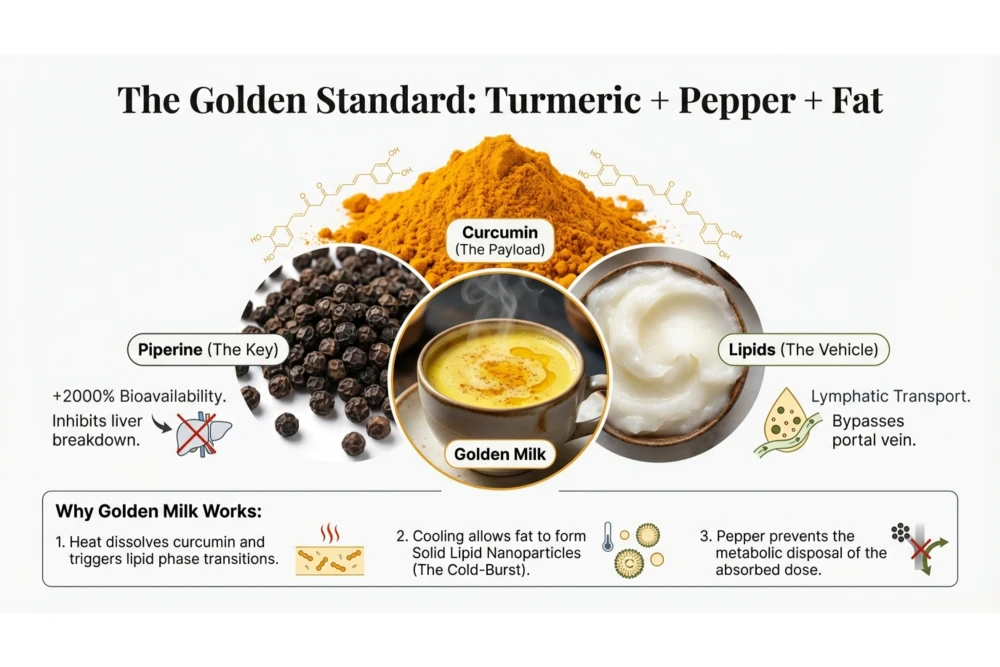
- Turmeric, Again: The piperine-turmeric pairing isn't the only way to boost curcumin. Consuming it with fat offers an entirely different pathway for absorption. Fat allows curcumin to be absorbed through the lymphatic system, which lets it bypass initial liver metabolism and enter the bloodstream directly.
Furthermore, studies show that fats rich in unsaturated fatty acids (like olive oil) are more effective at improving carotenoid bioavailability than fats high in saturated fatty acids.
This Isn't Just a "Health Hack"—It's a Life-Saving Medical Breakthrough
The principle of bioenhancement extends far beyond dietary tips and has profound implications in modern medicine. Using bioenhancers with medications offers significant advantages, including reducing the required drug dose, which in turn lowers treatment costs, minimizes side effects, and reduces the risk of developing drug resistance.
A powerful real-world example is in the treatment of tuberculosis. The primary drug, Rifampicin, is expensive, toxic, and requires prolonged use. In India, a government-approved drug called Risorine combines Rifampicin with the bioenhancer piperine. This allows the required dose of Rifampicin to be reduced by up to 60%, meaning patients may only need 40% of the original amount. This makes the treatment cheaper, safer, and far more tolerable.
As researchers noted in the International Journal of Applied & Basic Medical Research, the global importance of this application cannot be overstated:
"Billions of dollars are wasted globally in various countries due to poor bioavailability of drugs, which is a huge financial burden on any nation, particularly poor developing countries. This is particularly relevant in serious and dreaded diseases on mankind like tuberculosis for which treatment is expensive, toxic and prolonged..."
This "New" Science Is Rooted in Ancient Wisdom
While the scientific validation of bioenhancers is relatively modern, the concept itself is ancient. The first documented observation dates back to 1929, when a scientist named Bose noted the increased antiasthmatic activity of vasaka leaves (a traditional medicinal plant) when pepper was added to the preparation.
However, this observation remained unexplained for 50 years. The breakthrough came in 1979, when Indian scientist Dr. C. K. Atal began to scientifically research the phenomenon. It was Dr. Atal who coined the term "bioavailability enhancers" and whose research team discovered and scientifically validated piperine as the world's first bioenhancer.
This modern scientific field serves as a powerful validation of traditional medicine and culinary practices. Dr. Atal's work was conducted at the Indian Institute of Integrative Medicine, and the very name of the institute encapsulates this story: the successful integration of traditional observations with modern scientific validation, explaining the wisdom that has existed for thousands of years.
A New Way to Look at Your Plate
The simple act of seasoning your food is more powerful than you might think. Bioenhancement is not a fad; it is a scientifically-backed principle demonstrating that the whole is often greater than the sum of its parts. Ingredients we often overlook—a pinch of pepper, a splash of healthy oil—can be the key to unlocking the full power of our meals. This knowledge transforms our view of the kitchen pantry from a collection of flavorings into a toolkit for functional nutrition.
You can book a consultation here: Book Appointment
Written by Dr. Pankaj Kumar, General & Lifestyle Physician, Dwarka, New Delhi