

















- 21st September 2026
Table of Contents
- Are Semaglutide and Tirzepatide the Same Medicine?
- What Actually Counts as Constipation?
- Why Can Semaglutide or Tirzepatide Cause Constipation?
- Appetite Suppression Can Also Reduce Fibre Intake
- You May Also Be Drinking Less
- Does Semaglutide “Paralyse the Stomach”?
- Who Is More Likely to Develop Constipation?
- Why Dose Escalation Matters
- Eight Practical Ways to Manage Constipation on Semaglutide or Tirzepatide
- 1. Check Whether You Are Drinking Enough
- 2. Increase Fibre Gradually—Not Overnight
- Which Fibre-Rich Foods Can Help?
- 3. Consider Soluble Fibre Such as Psyllium When Appropriate
- 4. Keep Moving
- 5. Establish a Regular Toilet Routine
- 6. Improve Your Toilet Position
- 7. Review Your Overall Food Intake
- 8. Use Constipation Medicines When Necessary—But Choose Them Appropriately
- Do Not Use “Detox” or Herbal Laxative Teas as Your Main Strategy
- A Practical Summary of the Eight Strategies
- When Is Constipation on Semaglutide More Than a Minor Side Effect?
- Should You Stop Semaglutide or Tirzepatide Because of Constipation?
- How Much Fibre Do You Actually Need?
- Soluble Versus Insoluble Fibre: Does the Difference Matter?
- Psyllium, Chia or Flaxseed: Which Is Better?
- Can Psyllium Make Constipation Worse?
- Which Indian Foods Can Help With Constipation?
- Raw Salad Is Not Compulsory
- Can Kiwi Help With Constipation?
- What About Prunes?
- Does Papaya Treat Constipation?
- Do You Need More Fat to Pass Stool?
- Protein Becomes Especially Important During GLP-1 Treatment
- Does Whey Protein Cause Constipation?
- What if Fibre and Fluids Are Not Enough?
- Polyethylene Glycol: A Commonly Used Osmotic Option
- What About Lactulose?
- Are Stool Softeners Useful?
- What About Bisacodyl or Other Stimulant Laxatives?
- Is Senna an Option?
- Should You Take Magnesium for Constipation?
- Do Probiotics Help GLP-1 Constipation?
- What About Isabgol?
- Should You Take a Laxative Every Day While Using Semaglutide?
- What Happens When Constipation Appears After a Dose Increase?
- Should You Skip the Next Injection if You Are Constipated?
- A Step-by-Step Plan for Mild GLP-1 Constipation
- What if You Have Not Passed Stool for Three Days?
- When Fibre Is the Wrong Next Step
- Could Constipation Mean Gastroparesis?
- Could Severe Constipation Become Faecal Impaction?
- Constipation Should Not Be the Price of Successful Weight Loss
- When Does Constipation on Semaglutide Need Medical Attention?
- Warning Signs That Should Not Be Ignored
- Could Severe Constipation Represent Bowel Obstruction?
- What Is Faecal Impaction?
- Severe Abdominal Pain Is Not Always Constipation
- What About Pancreatitis?
- Gallbladder Disease Is Another Important Consideration
- When Should You Contact the Prescriber?
- Should the Next Dose Increase Be Delayed?
- Should You Stop Semaglutide or Tirzepatide?
- Do Not Forget Dehydration During Vomiting or Diarrhoea
- A Practical One-Day Eating Pattern for Someone With Mild GLP-1 Constipation
- What Should You Do on Injection Day?
- Do You Need to Avoid Roti or Rice?
- Do Bananas Cause Constipation?
- Should You Drink Warm Water Every Morning?
- Does Coffee Help?
- Should You Use Castor Oil?
- Does “Colon Cleansing” Help?
- Common Mistakes When Treating GLP-1 Constipation
- Common Myths About Constipation on Semaglutide or Tirzepatide
- Myth 1: If I Am Not Passing Stool Every Day, I Am Constipated
- Myth 2: The More Fibre I Eat, the Faster Constipation Will Resolve
- Myth 3: Severe Constipation Means I Need an Even Stronger Laxative
- Myth 4: Ghee Will Lubricate the Intestine
- Myth 5: Isabgol Is Completely Harmless Because It Is Natural
- Myth 6: Constipation Means Semaglutide Has Damaged My Stomach
- Myth 7: Stronger Appetite Suppression Always Means Better Weight Loss Treatment
- Myth 8: I Should Stop the Injection Immediately if I Become Constipated
- A Practical Constipation Checklist for Patients Taking GLP-1 Medicines
- Key Takeaways
- References
Constipation on Semaglutide or Tirzepatide: 8 Practical Ways to Manage It
You start semaglutide or tirzepatide and notice something unexpected.
Your appetite is considerably lower. Portions have become smaller. You may be losing weight and feeling less interested in snacks—but your bowel movements have also become less frequent.
Perhaps you previously passed stool every morning and now go only once every two or three days. The stool may feel harder, you may need to strain, or you may develop uncomfortable bloating and a sense that the bowel has not emptied completely.
Constipation on semaglutide and constipation during tirzepatide treatment are recognised gastrointestinal adverse effects. They can occur during treatment for obesity or diabetes and may become particularly noticeable during dose escalation.
Fortunately, mild constipation can often be improved with relatively simple measures. The solution, however, is not always to consume enormous amounts of fibre or force several litres of water every day.
Effective management starts by understanding why bowel habits have changed.
Are Semaglutide and Tirzepatide the Same Medicine?
No.
Semaglutide is a GLP-1 receptor agonist. Tirzepatide acts at both glucose-dependent insulinotropic polypeptide (GIP) and GLP-1 receptors.
Both medicines can substantially reduce appetite and food intake, improve glycaemic control and produce clinically meaningful weight loss in appropriately selected patients.
Both can also produce gastrointestinal adverse effects.
Constipation Is Not the Only Gastrointestinal Effect
Depending on the medicine, dose and individual response, gastrointestinal symptoms can include nausea, vomiting, diarrhoea, abdominal discomfort, dyspepsia and constipation.
Symptoms are often most noticeable when treatment begins or the dose is increased, although the pattern varies considerably between individuals.
What Actually Counts as Constipation?
Constipation does not simply mean that you failed to pass stool today.
Normal bowel frequency varies between individuals. Some healthy people pass stool more than once a day, while others normally go several times per week.
Constipation is better understood through the combination of stool frequency and difficulty passing stool.
It may involve:
- Fewer bowel movements than usual.
- Hard or dry stools.
- Straining.
- A feeling of incomplete evacuation.
- Difficulty passing stool despite the urge.
- A sensation of blockage.
Do You Need to Pass Stool Every Day?
No.
Daily bowel movements are not medically necessary for everyone.
If you previously passed stool twice daily and now comfortably go once daily, that is not necessarily constipation. Similarly, going every other day without hard stool, straining or discomfort may be normal for some people.
The change from your usual pattern and the presence of symptoms matter more than achieving a compulsory daily bowel movement.
Why Can Semaglutide or Tirzepatide Cause Constipation?
There is rarely one single explanation.
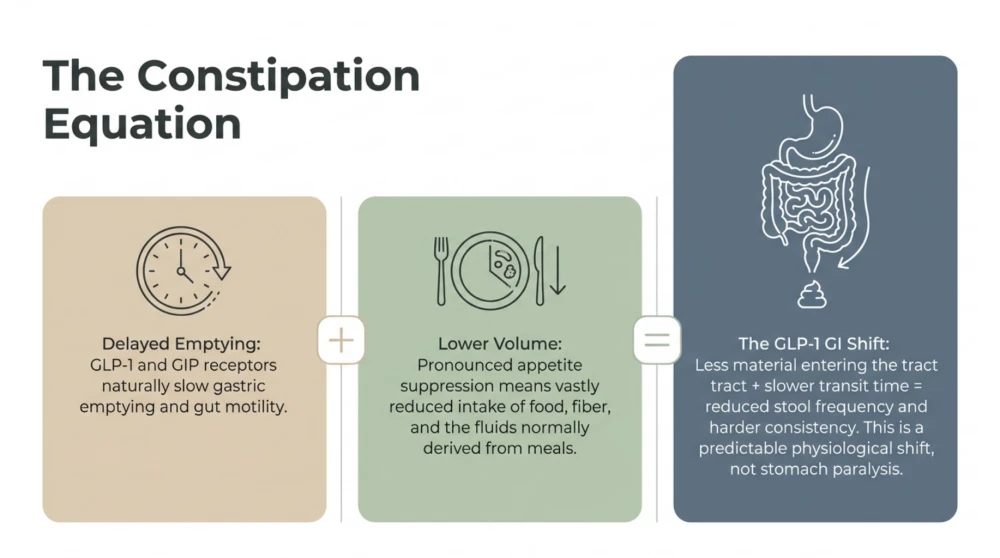
GLP-1-based medicines affect gastrointestinal function, including gastric emptying and gut motility. At the same time, people frequently make major changes in how much they eat and drink after starting treatment.
These factors can occur together.
You May Simply Be Eating Much Less Food
Before treatment, someone may consume three large meals and several snacks every day.
After starting semaglutide or tirzepatide, the same person may struggle to finish half of each meal.
Less food entering the gastrointestinal tract means less material available to form stool.
This alone can reduce bowel frequency without necessarily representing severe bowel dysfunction.
Appetite Suppression Can Also Reduce Fibre Intake
When appetite falls substantially, people often prioritise whichever foods are easiest to tolerate.
Vegetable portions may shrink. Fruit may disappear. Dal and legumes may be avoided because they feel too filling. Someone who previously ate several fibre-containing foods may end up consuming very little.
Over time, lower fibre intake can contribute to harder and less frequent stools.
You May Also Be Drinking Less
This is frequently overlooked.
People often obtain some fluid from meals, fruit, vegetables, soups and other foods. When total food intake falls, fluid obtained through food can fall as well.
Nausea or early fullness can further reduce drinking.
Less Food Plus Less Fluid Can Be a Difficult Combination
Reduced stool bulk together with inadequate hydration can make stools harder and more difficult to pass.
This is why constipation management during GLP-1 treatment should consider the entire dietary pattern rather than fibre alone.
Does Semaglutide “Paralyse the Stomach”?
This phrase is commonly used on social media, but it oversimplifies the pharmacology.
Semaglutide and tirzepatide can delay gastric emptying, particularly during parts of treatment, and gastrointestinal motility is affected by GLP-1 signalling.
That is not the same as saying every patient taking these medicines develops gastroparesis or intestinal paralysis.
But Severe Gastrointestinal Symptoms Should Not Be Ignored
Persistent vomiting, severe abdominal pain, progressive abdominal distension or inability to tolerate food or fluids requires medical assessment.
Similarly, severe constipation accompanied by vomiting, marked abdominal swelling or inability to pass stool or gas should not simply be managed by adding more fibre at home.
Who Is More Likely to Develop Constipation?
There is no perfect way to predict who will develop constipation on semaglutide or tirzepatide.
However, problems may be more noticeable in people who already had constipation before treatment or whose food and fluid intake falls substantially after starting medication.
Other contributors can include low physical activity, inadequate fibre intake and other constipation-promoting medicines.
Review Other Medicines Too
Constipation may be worsened by medications such as certain opioid painkillers, iron supplements, some anticholinergic medicines and several other drugs.
Do not assume the injection is responsible for every change in bowel habits simply because the timing overlaps.
Why Dose Escalation Matters
Semaglutide and tirzepatide are generally started at lower doses and increased gradually according to the specific product, indication, tolerability and prescribing schedule.
The escalation process is partly designed to improve gastrointestinal tolerability.
Do Not Rush to the Highest Dose
A higher dose is not automatically better if gastrointestinal adverse effects become difficult to manage.
If significant constipation, nausea or other symptoms develop during escalation, discuss them with the prescriber before the next increase.
Patients should not independently accelerate the dosing schedule in an attempt to lose weight faster.
Eight Practical Ways to Manage Constipation on Semaglutide or Tirzepatide
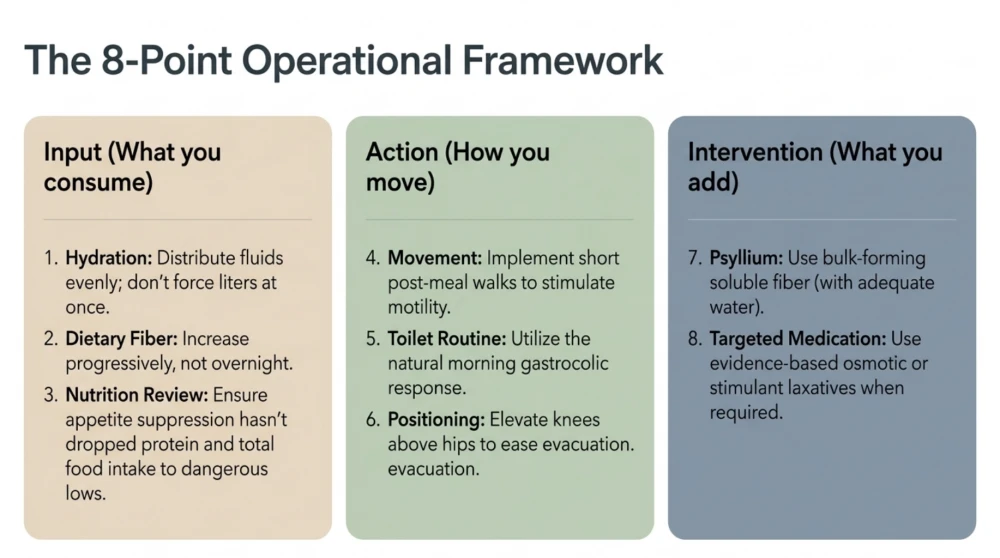
The following strategies address the most common modifiable contributors.
1. Check Whether You Are Drinking Enough
Hydration is one of the first areas worth reviewing.
Water helps maintain stool softness and is particularly important when dietary fibre is being increased.
But hydration advice should be individualised rather than reduced to a rule that everyone must drink three, four or five litres daily.
Use Practical Hydration Clues
Instead of forcing huge quantities of water at once, distribute fluids across the day.
Water, unsweetened beverages, soups and water-rich foods can all contribute to fluid intake.
Needs vary with body size, climate, physical activity, pregnancy, illness and medical conditions.
Some People Should Not Aggressively Increase Fluids
People with heart failure, advanced kidney disease or certain electrolyte disorders may have specific fluid recommendations.
If you have been prescribed a fluid restriction, do not increase intake simply because you are constipated without discussing it with your treating clinician.
2. Increase Fibre Gradually—Not Overnight
Fibre can improve stool bulk and consistency, but suddenly increasing it from very little to a large amount can cause bloating, gas and abdominal discomfort.
This is particularly relevant during GLP-1 treatment because early satiety and gastrointestinal symptoms may already be present.
More Fibre Is Not Always Better
Someone who becomes constipated may suddenly start consuming large quantities of bran, raw salad, chia seeds, flaxseed and psyllium simultaneously.
Instead of improving symptoms, this can produce substantial bloating and fullness.
A better strategy is to increase fibre progressively while maintaining appropriate fluid intake.
Which Fibre-Rich Foods Can Help?
Useful choices can include vegetables, whole fruit, legumes, oats, whole grains, nuts and seeds according to individual tolerance and nutritional requirements.
For Indian diets, dal, chana, rajma, lobia, vegetables, whole fruit and suitable whole-grain foods can contribute meaningfully to fibre intake.
But Remember That GLP-1 Medicines Reduce Meal Capacity
A patient who becomes full after a small amount of food cannot realistically eat enormous bowls of salad and still consume adequate protein and other essential nutrients.
Meal planning therefore requires balance.
Fibre matters, but it should not displace the protein and overall nutrition needed during substantial weight loss.
3. Consider Soluble Fibre Such as Psyllium When Appropriate
Psyllium is a bulk-forming soluble fibre that can improve stool consistency and bowel regularity in many people with constipation.
It absorbs water and forms a gel-like material within the gastrointestinal tract.
Psyllium Needs Adequate Fluid
Taking a bulk-forming fibre supplement without adequate fluid can worsen difficulty passing stool and may be unsafe in people with swallowing problems or suspected gastrointestinal obstruction.
Start cautiously rather than assuming that a very large dose will work faster.
4. Keep Moving
Reduced physical activity can contribute to constipation.
This can become relevant when nausea, low calorie intake or rapid weight loss leaves someone feeling tired and less active than usual.
Regular walking and general daily movement support gastrointestinal function while providing additional metabolic and cardiovascular benefits.
A Short Walk After Meals Has Multiple Benefits
Walking for a few minutes after meals is a simple habit that can increase daily activity and may also improve post-meal glucose handling.
It does not need to be strenuous.
For someone who spends most of the day sitting, increasing ordinary movement may be more sustainable than depending entirely on one formal workout.
5. Establish a Regular Toilet Routine
Repeatedly ignoring the urge to pass stool can make constipation more difficult to manage.
Try to give yourself adequate time rather than rushing every morning.
Use the Gastrocolic Response
The colon naturally becomes more active after eating, particularly after the first meal of the day in many people.
Using this period for an unhurried toilet attempt can help establish a more regular routine.
Do not strain aggressively if stool does not pass.
6. Improve Your Toilet Position
Body position can affect the mechanics of defecation.
Placing the feet on a small footstool so that the knees are raised above hip level can make evacuation easier for some people.
Avoid Prolonged Straining
Sitting on the toilet for long periods while repeatedly straining can aggravate haemorrhoids and does not necessarily improve bowel emptying.
If you repeatedly feel that stool is present but cannot evacuate it despite reasonable stool consistency, other causes such as pelvic-floor dysfunction may need consideration.
7. Review Your Overall Food Intake
One of the paradoxes of GLP-1 treatment is that constipation may occasionally reflect eating too little rather than eating the wrong food.
If appetite suppression becomes so strong that a person survives on a few bites of food, total fibre, fluid, protein and micronutrient intake can all become inadequate.
Extreme Appetite Suppression Is Not the Goal
The objective of obesity treatment is not to eliminate hunger completely or make eating impossible.
Effective treatment should allow a patient to consume sufficient nutrition while creating an energy deficit that supports sustainable fat loss.
Persistent inability to eat adequately should be discussed with the prescribing clinician.
8. Use Constipation Medicines When Necessary—But Choose Them Appropriately
Lifestyle measures are useful, but they are not always enough.
Some patients taking semaglutide or tirzepatide may require an over-the-counter or prescribed constipation treatment.
The choice depends on stool consistency, severity, duration, other medicines and underlying medical conditions.
Osmotic Laxatives Can Be Useful
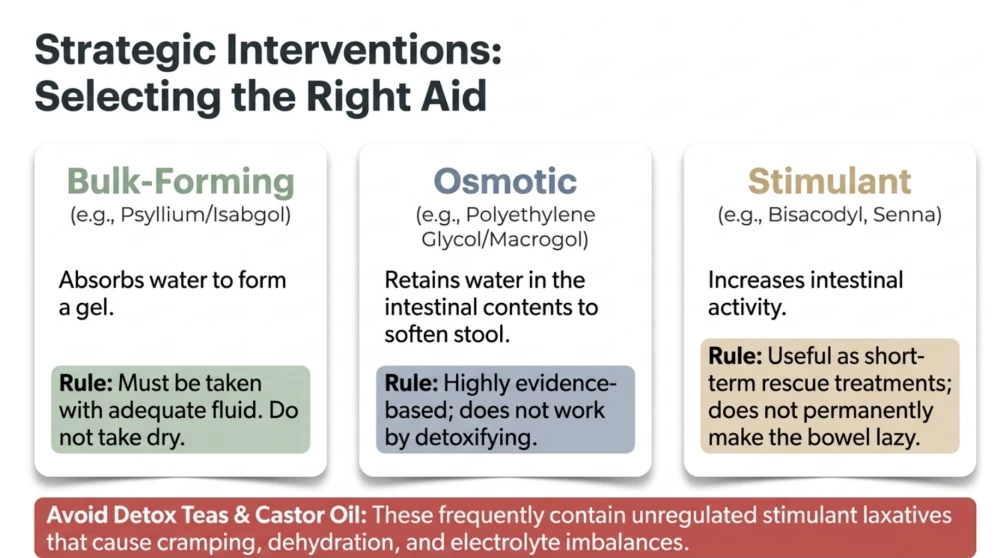
Osmotic agents such as polyethylene glycol, also known as macrogol, draw water into the bowel and are commonly used for constipation.
Other options exist, including bulk-forming agents, stool-softening approaches and stimulant laxatives in appropriate situations.
The best choice depends on the individual rather than simply selecting the strongest product available.
Do Not Use “Detox” or Herbal Laxative Teas as Your Main Strategy
Products marketed as detox teas frequently contain stimulant laxative ingredients.
They do not remove toxins or burn body fat.
Repeated unsupervised use can produce diarrhoea, abdominal cramping and electrolyte problems.
Constipation caused by a medication deserves rational management rather than a detox programme.
A Practical Summary of the Eight Strategies
| Strategy | Practical Approach | Common Mistake |
|---|---|---|
| 1. Hydration | Spread appropriate fluid intake through the day | Forcing several litres regardless of medical conditions |
| 2. Dietary fibre | Increase fibre-rich foods progressively | Suddenly consuming huge amounts of fibre |
| 3. Psyllium | Use appropriately with adequate fluid when suitable | Taking large amounts with insufficient fluid |
| 4. Movement | Walk regularly and reduce prolonged sitting | Becoming increasingly inactive because food intake is low |
| 5. Toilet routine | Respond to the urge and allow unhurried toilet time | Repeatedly suppressing the urge |
| 6. Toilet position | Use a footstool if it improves evacuation | Prolonged aggressive straining |
| 7. Nutrition review | Ensure appetite suppression has not made intake excessively low | Assuming the less you eat, the better the medicine is working |
| 8. Appropriate medication | Use evidence-based constipation treatment when required | Depending on detox teas or repeatedly using laxatives without assessing the cause |
When Is Constipation on Semaglutide More Than a Minor Side Effect?
Mild constipation is very different from progressive gastrointestinal symptoms suggesting a more serious problem.
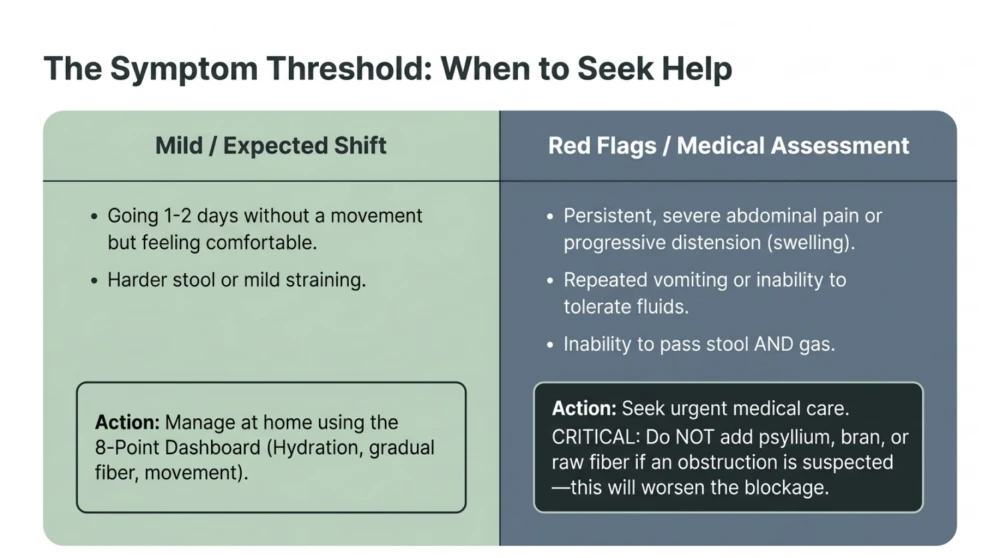
Seek medical assessment if constipation becomes severe or persistent, particularly when accompanied by significant abdominal pain, repeated vomiting, progressive abdominal distension, inability to tolerate fluids, gastrointestinal bleeding or inability to pass stool or gas.
Do Not Simply Keep Adding Fibre When Obstruction Is a Possibility
If someone has severe abdominal swelling, vomiting and inability to pass stool or gas, increasing fibre at home is not an appropriate response.
Such symptoms require prompt medical evaluation.
Should You Stop Semaglutide or Tirzepatide Because of Constipation?
Not necessarily.
Mild constipation can often be managed without discontinuing otherwise effective treatment.
But persistent or severe symptoms should be discussed with the prescriber.
Depending on the circumstances, the clinician may review the diet, hydration, other medications, constipation treatment and dose-escalation plan.
Do Not Change the Dose on Your Own
Skipping doses, accelerating dose increases or repeatedly changing the dose without medical guidance can complicate both effectiveness and tolerability.
The appropriate response depends on the severity of symptoms and the medicine being used.
How Much Fibre Do You Actually Need?
When constipation on semaglutide develops, one of the first pieces of advice patients hear is, “Eat more fibre.”
That advice is reasonable—but incomplete.
Fibre requirements vary with age, sex, calorie intake and overall dietary pattern. For many adults, approximately 25–30 grams of fibre per day is a practical nutritional target, although an individual does not need to calculate every gram indefinitely.
The bigger issue during semaglutide or tirzepatide treatment is that fibre intake may fall dramatically when total food intake decreases.
Increase Fibre Gradually
If you are currently eating very little fibre, suddenly trying to reach a high target overnight may produce bloating, abdominal discomfort and excessive gas.
A gradual increase is usually better tolerated.
This is especially important with GLP-1-based medicines because early satiety and gastrointestinal symptoms may already make large-volume meals uncomfortable.
Soluble Versus Insoluble Fibre: Does the Difference Matter?
Both types of fibre contribute to gastrointestinal health, although foods usually contain a mixture rather than fitting perfectly into one category.
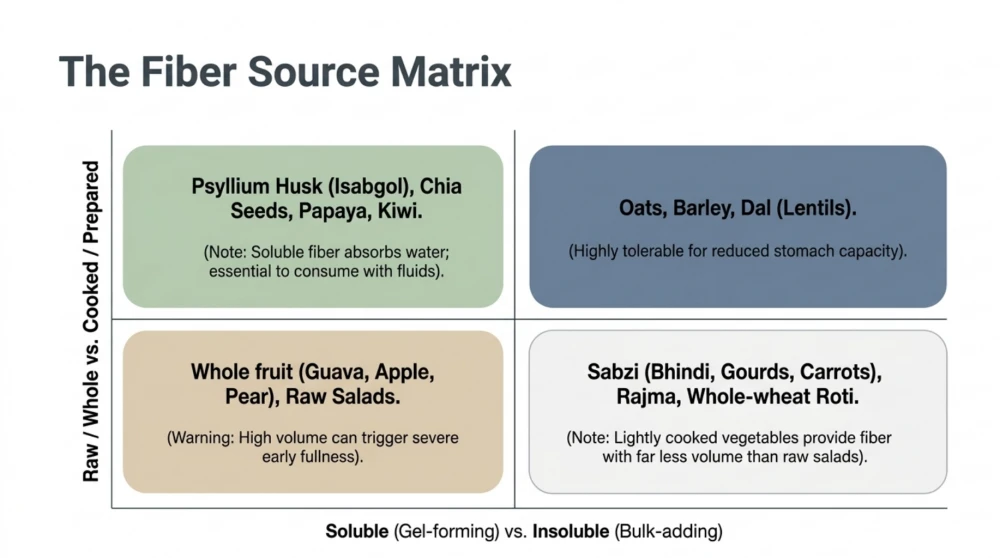
Soluble fibre absorbs water and can form a gel-like material. Psyllium is an important example.
Insoluble fibre adds bulk and can help movement of intestinal contents. Whole grains, wheat bran and many vegetables contribute insoluble fibre.
The Best Strategy Is Usually Variety
You do not need to construct your diet around one type of fibre.
Vegetables, whole fruit, legumes, whole grains, nuts and seeds provide different fibres and other nutrients.
If constipation persists despite an otherwise reasonable diet, a fibre supplement such as psyllium may sometimes be useful.
Psyllium, Chia or Flaxseed: Which Is Better?
All three can contribute fibre, but they should not be treated as identical constipation medicines.
Psyllium has particularly useful evidence as a bulk-forming fibre for improving stool consistency and bowel frequency.
Chia and flaxseed are nutritious foods that provide fibre together with other nutrients, but they do not need to be added in enormous quantities.
Do Not Take All Three at Once
A common response to constipation is to add psyllium in the morning, chia seeds at breakfast and several tablespoons of flaxseed later in the day.
For someone already experiencing delayed gastrointestinal symptoms and early satiety, this sudden fibre load may produce more bloating than benefit.
Choose one change, assess tolerance and increase gradually.
Can Psyllium Make Constipation Worse?
Yes, in the wrong circumstances.
Psyllium absorbs water. If it is taken with inadequate fluid, or if someone has significant difficulty swallowing or a suspected gastrointestinal obstruction, it may be inappropriate.
Bulk-forming fibre is also not the correct home treatment for severe constipation associated with vomiting, progressive abdominal distension or inability to pass gas.
Which Indian Foods Can Help With Constipation?
You do not need imported “gut health” products to build a fibre-rich diet.
Many ordinary Indian foods provide useful fibre.
| Food Group | Practical Choices | GLP-1 Consideration |
|---|---|---|
| Vegetables | Bhindi, beans, carrots, gourds, peas, leafy vegetables and mixed sabzi | Cooked vegetables may sometimes be easier to tolerate than very large raw salads |
| Whole fruit | Guava, pear, apple, orange, kiwi, papaya and other whole fruits | Prefer whole fruit rather than juice |
| Legumes | Dal, chana, rajma, lobia and whole moong | Increase gradually if bloating is troublesome |
| Whole grains | Oats, whole-wheat roti, barley and other minimally processed grains | Portions still need to match calorie and glucose goals |
| Seeds | Chia and ground flaxseed | Small amounts are usually enough; more is not automatically better |
Raw Salad Is Not Compulsory
Patients trying to lose weight are often told to fill half the plate with raw salad.
That can become difficult when semaglutide or tirzepatide causes pronounced early fullness.
A huge bowl of raw cucumber, cabbage and carrots may fill the stomach before the patient consumes adequate protein.
Cooked Vegetables Count Too
Vegetable soup, lightly cooked vegetables, sabzi and other appropriately prepared vegetables can contribute fibre without requiring enormous quantities of raw food.
The goal is adequate nutrition—not winning a competition for the largest salad.
Can Kiwi Help With Constipation?
Kiwi is an interesting option because clinical studies have found that regular kiwi consumption can improve bowel frequency and gastrointestinal comfort in some people with constipation.
It provides fibre, water and naturally occurring compounds that may contribute to its effects.
Kiwi Is Food, Not a Mandatory Treatment
If you enjoy kiwi and it fits your diet, it can be incorporated as a whole fruit.
There is no need to buy it specifically if it is expensive or unavailable. Other fruits, vegetables and fibre sources remain useful.
What About Prunes?
Prunes have a long history of use for constipation.
They contain fibre and sorbitol, a sugar alcohol that can draw water into the bowel and contribute to a laxative effect.
They may help some patients, but portions matter.
More Prunes Can Mean More Bloating
Large quantities may produce gas, cramping or diarrhoea.
Prunes also provide carbohydrate and calories, so eating them continuously throughout the day is unnecessary.
They should be considered one dietary option rather than a compulsory remedy for everyone taking a GLP-1 medicine.
Does Papaya Treat Constipation?
Papaya provides water and fibre and can certainly be part of a healthy diet.
But it is not a specific treatment for medication-induced constipation.
The same applies to many foods promoted online as “natural laxatives.”
A food can contribute to a bowel-friendly diet without functioning like a pharmacological laxative.
Do You Need More Fat to Pass Stool?
Some patients respond to constipation by adding large amounts of ghee or oil to meals.
This is usually unnecessary.
Dietary fat is an essential nutrient, but increasing calorie-dense fats substantially can undermine weight-loss goals without reliably correcting constipation.
Ghee Is Not a Constipation Medicine
A normal amount of dietary fat can remain part of the diet, but consuming spoonfuls of ghee specifically to stimulate bowel movements is not an evidence-based substitute for addressing fibre, fluids, movement and appropriate constipation treatment.
Protein Becomes Especially Important During GLP-1 Treatment
Constipation management should not accidentally create a low-protein diet.
Semaglutide and tirzepatide can produce substantial weight loss. During weight loss, some lean tissue is lost along with fat.
Preserving muscle therefore deserves attention, particularly in older adults and people undergoing substantial weight reduction.
Do Not Fill the Entire Reduced Appetite With Fibre
If appetite is low enough that only a small amount of food can be eaten, nutritional priorities become important.
Protein-rich foods, vegetables, whole fruit and appropriate carbohydrate portions need to coexist within the smaller food volume.
This is one reason blindly recommending enormous salads or bowls of bran can be counterproductive.
Does Whey Protein Cause Constipation?
Whey protein does not inevitably cause constipation.
The problem is often what happens to the rest of the diet.
A person may start using protein shakes while simultaneously eating less fruit, fewer vegetables, fewer legumes and less total food. Fibre intake falls, and constipation is then blamed on the whey.
Look at the Complete Diet
If whey is being used, check total fluid intake, fibre intake and overall food volume before assuming the protein itself is responsible.
Some products also contain sweeteners or other ingredients that can cause gastrointestinal symptoms in susceptible individuals.
What if Fibre and Fluids Are Not Enough?
Persistent constipation does not mean you have failed at lifestyle management.
Evidence-based constipation medicines can be appropriate.
The choice depends partly on whether the main problem is hard stool, infrequent stool, difficulty evacuating or a combination of these.
Polyethylene Glycol: A Commonly Used Osmotic Option
Polyethylene glycol, often called PEG or macrogol, is an osmotic laxative.
It retains water in the intestinal contents, helping produce softer stools and improve bowel movements.
It is widely used for constipation and has good evidence supporting its effectiveness.
It Does Not Work by “Detoxifying” the Colon
The purpose is simply to improve stool hydration and passage.
The exact product, dose and duration should follow local product instructions or clinical advice, particularly when other medical conditions are present.
What About Lactulose?
Lactulose is another osmotic laxative.
It can soften stools and increase bowel movements, but fermentation in the colon can cause gas and bloating.
For a patient already experiencing GLP-1-related bloating, this may become an important practical consideration.
Are Stool Softeners Useful?
Stool-softening agents are sometimes used when hard stool and straining are prominent.
However, not every product commonly labelled a stool softener has equally strong evidence for chronic constipation.
The treatment should therefore be selected according to the problem rather than automatically adding several products together.
What About Bisacodyl or Other Stimulant Laxatives?
Stimulant laxatives increase intestinal activity and can be effective for constipation.
Bisacodyl and sodium picosulfate are commonly used examples in many countries.
They can be particularly useful as short-term or rescue treatments in appropriate patients.
Stimulant Does Not Automatically Mean Dangerous
Patients sometimes fear that taking any stimulant laxative will permanently make the bowel “lazy.”
This oversimplifies the evidence.
At the same time, someone who repeatedly requires rescue laxatives should have the underlying constipation pattern reviewed rather than continuing indefinite self-treatment without assessment.
Is Senna an Option?
Senna is another stimulant laxative that can improve bowel movements.
It can also cause abdominal cramping in some people.
As with other medications, the appropriate choice depends on symptom pattern, frequency of use, medical history and other treatments.
Should You Take Magnesium for Constipation?
Certain magnesium salts have an osmotic laxative effect and can improve constipation in selected patients.
But magnesium should not be treated as universally harmless because it is sold as a supplement.
Kidney Function Matters
The kidneys normally remove excess magnesium.
In significant kidney impairment, magnesium-containing laxatives or supplements can lead to excessive magnesium accumulation.
This is therefore an area where individual medical context matters.
Do Probiotics Help GLP-1 Constipation?
Probiotics are heavily marketed for “gut health,” but their effects are strain-specific and evidence for constipation is variable.
They should not automatically be the first treatment for constipation on semaglutide or tirzepatide.
A patient who is dehydrated, eating almost no fibre and barely moving is unlikely to solve the entire problem by adding a probiotic capsule.
What About Isabgol?
Isabgol is psyllium husk.
It is therefore not a fundamentally different treatment from the psyllium discussed earlier.
Used appropriately, it can be useful as a bulk-forming fibre supplement.
Do Not Take Dry Isabgol and Then Ignore Fluids
It should be taken according to product directions with adequate fluid.
It is inappropriate when intestinal obstruction is suspected or when a patient has significant difficulty swallowing.
Should You Take a Laxative Every Day While Using Semaglutide?
Not everyone needs one.
Some patients can manage bowel habits through appropriate hydration, fibre, food intake and activity. Others may benefit from regular pharmacological treatment.
The decision depends on the severity and persistence of constipation rather than the fact that someone takes semaglutide.
What Happens When Constipation Appears After a Dose Increase?
This is a particularly useful clue.
Imagine that a patient tolerated a lower dose well for several weeks. The dose is increased and within days the patient develops substantial nausea, early satiety and constipation.
That temporal relationship should be discussed before automatically proceeding with the next planned escalation.
The Dose-Escalation Calendar Is Not a Race
Titration schedules are designed partly to improve tolerability.
A patient does not receive extra credit for reaching the maximum dose as quickly as possible.
The appropriate maintenance dose depends on the particular medicine, treatment indication, response and tolerability.
Should You Skip the Next Injection if You Are Constipated?
Do not make medication changes solely from generic internet advice.
Mild constipation and severe constipation with vomiting and abdominal distension are completely different clinical situations.
Whether treatment should continue, escalation should be delayed, or medication should be temporarily withheld requires consideration of symptom severity and the individual patient's circumstances.
A Step-by-Step Plan for Mild GLP-1 Constipation
For mild constipation without warning symptoms, a practical approach can proceed systematically rather than adding multiple remedies simultaneously.
| Step | What to Review |
|---|---|
| 1 | Confirm that this is genuine constipation rather than simply less frequent stool because food intake has fallen. |
| 2 | Review fluid intake and reasons for dehydration. |
| 3 | Assess whether fruit, vegetables, legumes and other fibre sources have disappeared from the diet. |
| 4 | Increase fibre gradually and consider psyllium when appropriate. |
| 5 | Increase ordinary movement and walking if activity has fallen. |
| 6 | Use a regular toilet routine and avoid repeatedly suppressing the urge. |
| 7 | If symptoms persist, consider an evidence-based laxative appropriate for the individual. |
| 8 | If constipation appeared or worsened after dose escalation, discuss the dosing plan with the prescriber. |
What if You Have Not Passed Stool for Three Days?
The number of days alone does not determine severity.
Someone who normally passes stool every three days and feels completely comfortable is different from someone who normally goes daily and now has no bowel movement for three days together with increasing pain, distension and vomiting.
Symptoms and change from baseline matter.
Ask These Questions
Are you still passing gas? Is the abdomen becoming increasingly swollen? Are you vomiting? Is the pain severe or persistent? Can you tolerate food and fluids? Is there blood in the stool?
These details are more important than following a rigid rule that a bowel movement must occur every 24 hours.
When Fibre Is the Wrong Next Step
This point deserves emphasis because “eat more fibre” is so commonly recommended.
If constipation is accompanied by significant abdominal distension, persistent vomiting, severe pain or inability to pass gas, do not continue loading the gastrointestinal tract with fibre in an attempt to force a bowel movement.
Medical evaluation is more appropriate.
Could Constipation Mean Gastroparesis?
Not by itself.
Gastroparesis refers to delayed gastric emptying without mechanical obstruction and typically produces symptoms such as nausea, vomiting, early satiety, post-meal fullness and upper-abdominal symptoms.
Constipation concerns the lower gastrointestinal tract and does not establish a diagnosis of gastroparesis.
Semaglutide and Tirzepatide Do Affect Gastric Emptying
Both medicines delay gastric emptying as part of their pharmacological effects. Current prescribing information also advises caution regarding severe gastrointestinal adverse reactions and does not recommend these medicines in patients with severe gastroparesis.
But this does not mean that ordinary constipation while taking one of these medicines should automatically be labelled gastroparesis.
Could Severe Constipation Become Faecal Impaction?
Yes. Prolonged constipation can occasionally progress to faecal impaction, particularly in susceptible individuals.
Paradoxically, a person with impaction may sometimes develop leakage of liquid stool around the impacted stool and mistakenly believe the constipation has turned into diarrhoea.
Persistent Rectal Pressure or Inability to Evacuate Deserves Assessment
When severe constipation continues despite treatment, especially with significant pain, rectal pressure or inability to evacuate, medical assessment may be necessary rather than repeatedly adding oral remedies.
Constipation Should Not Be the Price of Successful Weight Loss
Some patients tolerate significant gastrointestinal symptoms because they believe nausea, inability to eat and constipation prove that the medication is “working.”
That is not the objective of treatment.
Successful obesity management should improve health while maintaining adequate nutrition, hydration, physical function and quality of life.
A medication can be effective without making normal eating or bowel function miserable.
When Does Constipation on Semaglutide Need Medical Attention?
Most cases of constipation on semaglutide or tirzepatide are uncomfortable rather than dangerous. They may improve after reviewing fluid intake, gradually increasing fibre, becoming more active and using an appropriate constipation treatment when necessary.
However, there is an important difference between uncomplicated constipation and progressive gastrointestinal symptoms that could indicate a more significant problem.
The severity of abdominal symptoms matters more than simply counting how many days have passed since the last bowel movement.
Do Not Judge Severity Only by Stool Frequency
One person may normally pass stool every second or third day and feel completely well. Another may usually pass stool every morning but suddenly develop four days without a bowel movement together with increasing abdominal pain, distension and vomiting.
Those are very different clinical situations.
Warning Signs That Should Not Be Ignored
Contact a healthcare professional promptly if constipation becomes severe, persistent or progressively worse, particularly if it is associated with:
- Severe or persistent abdominal pain.
- Repeated vomiting.
- Progressive abdominal swelling or distension.
- Inability to pass gas as well as stool.
- Inability to keep fluids down.
- Blood in the stool or significant rectal bleeding.
- Marked weakness or symptoms of dehydration.
- Fever with significant abdominal symptoms.
- New severe gastrointestinal symptoms following a dose increase.
These symptoms should not be managed by repeatedly adding fibre, herbal remedies or increasingly strong laxatives without assessment.
Could Severe Constipation Represent Bowel Obstruction?
Intestinal obstruction means that movement of intestinal contents is mechanically or functionally impaired.
Symptoms can include abdominal pain, marked distension, vomiting and inability to pass stool or gas.
Not every patient with constipation has an obstruction, and constipation alone should not create unnecessary alarm.
But Suspected Obstruction Is Not a “More Fibre” Situation
If someone develops severe abdominal distension, repeated vomiting and inability to pass stool or gas, loading the intestine with psyllium, bran or other bulk-forming fibre is not appropriate.
Urgent clinical assessment is required.
What Is Faecal Impaction?
Faecal impaction occurs when a large amount of hard stool becomes lodged in the rectum or colon and cannot be passed normally.
It is more likely in people with prolonged constipation, reduced mobility, certain neurological disorders and some medication exposures.
Diarrhoea Does Not Always Exclude Impaction
Liquid stool can occasionally leak around impacted stool, producing what appears to be diarrhoea.
This can be misleading.
Persistent rectal pressure, abdominal discomfort, difficulty evacuating and a history of prolonged constipation may warrant clinical assessment.
Severe Abdominal Pain Is Not Always Constipation
This is particularly important for people taking GLP-1-based medicines.
Semaglutide and tirzepatide have gastrointestinal effects, but abdominal pain should not automatically be attributed to constipation.
Other causes may need consideration depending on the location, severity and associated symptoms.
What About Pancreatitis?
Acute pancreatitis has been reported with GLP-1 receptor agonists, including semaglutide, and is included among the important warnings for tirzepatide.
Persistent severe abdominal pain, particularly when accompanied by vomiting or pain radiating toward the back, requires prompt medical assessment.
Do Not Treat Severe Upper-Abdominal Pain With a Laxative and Wait
If the symptom pattern raises concern for pancreatitis or another acute abdominal condition, the appropriate response is medical evaluation rather than assuming that constipation is responsible.
Gallbladder Disease Is Another Important Consideration
Gallstones and gallbladder inflammation can occur during substantial weight loss, regardless of whether weight loss was achieved through lifestyle treatment, bariatric surgery or medication.
GLP-1-based therapies also carry warnings regarding acute gallbladder disease.
Symptoms may include persistent pain in the right upper abdomen or upper central abdomen, sometimes accompanied by nausea, vomiting or fever.
Rapid Weight Loss Can Increase Gallstone Risk
This is another reason that every episode of abdominal pain during semaglutide or tirzepatide treatment should not automatically be labelled “gas” or constipation.
The clinical pattern determines what needs to be investigated.
When Should You Contact the Prescriber?
You do not need to wait until constipation becomes an emergency before discussing it.
Contact the prescribing clinician if constipation is persistent despite reasonable measures, repeatedly requires rescue medication, is significantly affecting food intake or quality of life, or worsens substantially after dose escalation.
The prescriber may need to review the medication dose, escalation schedule, diet, fluid intake, other medicines and constipation treatment.
Should the Next Dose Increase Be Delayed?
This decision should be individualised.
GLP-1-based medicines are deliberately titrated gradually because gastrointestinal tolerability matters.
If a patient develops troublesome constipation, nausea, vomiting or inability to eat adequately after an increase, automatically moving to the next dose simply because the calendar says it is time may not be appropriate.
The Highest Dose Is Not the Goal for Every Patient
The objective is effective and tolerable treatment.
A medication that suppresses appetite so severely that the patient cannot maintain adequate nutrition, hydration or normal daily function requires reassessment.
Do not accelerate dose escalation independently in an attempt to produce faster weight loss.
Should You Stop Semaglutide or Tirzepatide?
Mild constipation alone does not automatically require discontinuing treatment.
Many patients can continue therapy successfully once constipation is addressed.
However, severe or persistent gastrointestinal symptoms require discussion with the prescriber, and suspected serious adverse effects require prompt medical assessment.
Medication decisions should be based on the clinical situation rather than a generic rule from social media.
Do Not Forget Dehydration During Vomiting or Diarrhoea
Although this article focuses on constipation, gastrointestinal adverse effects can occur in combination.
Someone may initially develop nausea or vomiting, eat and drink very little and subsequently become constipated.
Volume depletion can also affect kidney function, particularly in susceptible patients.
Constipation May Be Only One Part of the Problem
If urine output falls substantially, dizziness becomes prominent or the patient cannot maintain fluid intake, medical assessment may be necessary.
A Practical One-Day Eating Pattern for Someone With Mild GLP-1 Constipation
There is no universal “semaglutide constipation diet.” Calorie and protein requirements differ substantially between individuals.
However, the following example illustrates how fibre, protein and fluids can coexist without requiring enormous meals.
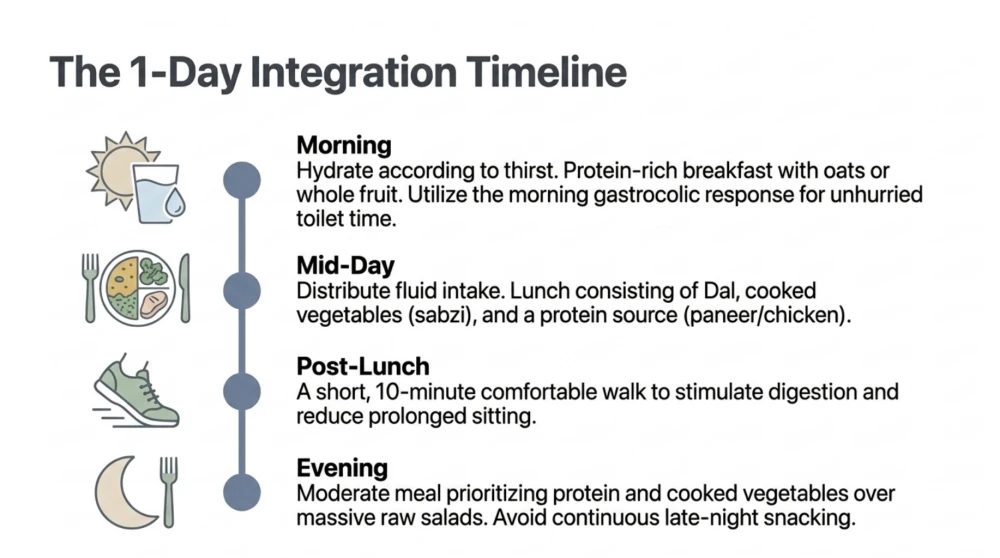
| Time | Example | Why It May Help |
|---|---|---|
| Morning | Water according to thirst and individual fluid needs | Begins distributing fluid intake rather than drinking huge quantities at once |
| Breakfast | Protein-rich breakfast with oats or another fibre-containing food and a suitable whole fruit | Combines protein and fibre without excessive food volume |
| Mid-morning | Fluid; fruit if required and tolerated | Supports hydration and fibre intake |
| Lunch | Dal, paneer, eggs, fish or chicken with cooked vegetables and an appropriate portion of roti or rice | Maintains protein while providing vegetables and fibre |
| After lunch | Short comfortable walk if medically appropriate | Reduces prolonged sitting and increases daily movement |
| Evening | Fluid and a small nutrient-dense snack only if needed | Avoids unnecessary continuous snacking |
| Dinner | Moderate meal containing a protein source and cooked vegetables | Provides nutrition without an excessively large late meal |
The exact quantities should be adjusted for body size, treatment goals, diabetes status, kidney function, activity and overall calorie and protein requirements.
What Should You Do on Injection Day?
There is no requirement for everyone to follow a special liquid diet or fasting programme on injection day.
If gastrointestinal symptoms tend to occur around the injection, smaller meals and avoiding unusually heavy or high-fat meals may be more comfortable for some patients.
Continue appropriate fluid intake and prioritise adequate nutrition according to tolerance.
Do You Need to Avoid Roti or Rice?
No.
Constipation management does not require eliminating traditional carbohydrate foods.
The overall dietary pattern matters more.
If the entire diet consists of small portions of refined carbohydrate with almost no vegetables, fruit or legumes, fibre intake may be inadequate. But appropriately portioned roti or rice can remain within a balanced diet.
Do Bananas Cause Constipation?
The relationship is not as simple as “banana causes constipation.”
Ripeness, individual tolerance and the overall dietary pattern matter.
There is rarely a reason to eliminate a particular fruit solely because someone has started semaglutide unless there is a reproducible problem or another dietary reason.
Should You Drink Warm Water Every Morning?
If warm water helps you establish a morning routine, there is little problem with using it.
But warm water is not pharmacologically superior to ordinary water as a treatment for medication-related constipation.
The important issue is appropriate overall hydration.
Does Coffee Help?
Coffee can stimulate colonic activity in some people and may encourage a bowel movement.
That does not mean progressively increasing caffeine is a good constipation strategy.
Excess caffeine can produce palpitations, sleep disturbance, reflux or anxiety-like symptoms in susceptible individuals.
Should You Use Castor Oil?
Castor oil has a stimulant laxative effect, but it is not an ideal routine strategy for managing chronic constipation on semaglutide or tirzepatide.
More predictable and better-studied constipation treatments are generally available.
Repeated self-treatment with strong purgatives can also cause cramping, diarrhoea and fluid or electrolyte problems.
Does “Colon Cleansing” Help?
No routine colon cleanse is required because you are taking a GLP-1 medicine.
The colon does not need periodic detoxification.
Juice cleanses, herbal detox products and aggressive laxative programmes can worsen dehydration and provide little nutritional value.
Common Mistakes When Treating GLP-1 Constipation
| Common Mistake | A Better Approach |
|---|---|
| Suddenly doubling or tripling fibre intake | Increase fibre progressively according to tolerance |
| Forcing excessive amounts of water | Maintain appropriate, individualised hydration |
| Eating huge salads despite severe early satiety | Balance fibre with adequate protein and overall nutrition |
| Treating every missed bowel movement with a stimulant laxative | Assess stool consistency, frequency, diet and underlying contributors |
| Using detox teas | Use evidence-based constipation management |
| Continuing rapid dose escalation despite significant symptoms | Discuss tolerability and the dosing plan with the prescriber |
| Assuming all abdominal pain is constipation | Consider other causes when pain is severe, persistent or accompanied by warning signs |
| Trying to achieve the lowest possible food intake | Maintain adequate protein, fibre, fluids and micronutrient intake while creating an appropriate calorie deficit |
Common Myths About Constipation on Semaglutide or Tirzepatide
Myth 1: If I Am Not Passing Stool Every Day, I Am Constipated
Not necessarily. Normal bowel frequency varies. Hard stools, straining, difficulty evacuating and a meaningful change from your usual pattern are more informative.
Myth 2: The More Fibre I Eat, the Faster Constipation Will Resolve
False. Excessive fibre introduced suddenly can worsen bloating and discomfort. Fibre should generally be increased gradually and accompanied by appropriate fluid intake.
Myth 3: Severe Constipation Means I Need an Even Stronger Laxative
Not always. Severe constipation associated with vomiting, significant abdominal distension or inability to pass gas may require medical evaluation rather than escalating home treatment.
Myth 4: Ghee Will Lubricate the Intestine
Ghee is dietary fat, not a treatment for medication-induced constipation. Adding large amounts also increases calorie intake substantially.
Myth 5: Isabgol Is Completely Harmless Because It Is Natural
Psyllium can be useful, but it needs appropriate fluid intake and is not suitable when obstruction is suspected or in some people with swallowing difficulties.
Myth 6: Constipation Means Semaglutide Has Damaged My Stomach
Constipation is a recognised gastrointestinal adverse effect and does not by itself establish gastroparesis or permanent gastrointestinal injury.
Myth 7: Stronger Appetite Suppression Always Means Better Weight Loss Treatment
Effective obesity treatment should still permit adequate nutrition and hydration. Inability to eat enough protein or maintain basic nutrition is not a treatment target.
Myth 8: I Should Stop the Injection Immediately if I Become Constipated
Mild constipation often can be managed without stopping treatment. Severe or persistent symptoms, however, should be discussed with the prescriber.
A Practical Constipation Checklist for Patients Taking GLP-1 Medicines
If your constipation is mild, review these questions:
- Am I drinking appropriately throughout the day?
- Has my total food intake fallen dramatically?
- Am I still eating vegetables and whole fruit?
- Am I getting fibre from legumes, whole grains or other suitable foods?
- Did I suddenly add too much fibre?
- Am I consuming adequate protein despite my lower appetite?
- Has my physical activity fallen?
- Am I ignoring the urge to pass stool?
- Did constipation worsen after my latest dose increase?
- Am I taking another medicine or supplement that can worsen constipation?
Key Takeaways
- Constipation on semaglutide and tirzepatide is a recognised gastrointestinal adverse effect.
- Reduced food, fluid and fibre intake after appetite suppression can contribute substantially to the problem.
- You do not need to pass stool every day to have normal bowel function.
- Increase fibre gradually rather than suddenly consuming large quantities of bran, psyllium, chia and flaxseed together.
- Psyllium can be useful when appropriate, but adequate fluid intake is important.
- Whole fruit, vegetables, legumes and suitable whole grains can help provide dietary fibre.
- Do not allow fibre to displace adequate protein from an already small diet.
- Regular walking and an appropriate toilet routine may help.
- Polyethylene glycol and other evidence-based laxatives can be considered when lifestyle measures are insufficient.
- Do not rely on detox teas, colon cleanses or large amounts of ghee.
- Constipation that becomes significantly worse after dose escalation should be discussed with the prescriber.
- Severe abdominal pain, persistent vomiting, marked distension or inability to pass stool and gas requires prompt medical assessment.
References
- U.S. Food and Drug Administration. Current prescribing information for semaglutide-containing products, including warnings, gastrointestinal adverse reactions and information regarding delayed gastric emptying.
- U.S. Food and Drug Administration. Current prescribing information for tirzepatide, including gastrointestinal adverse reactions, acute gallbladder disease, pancreatitis, volume depletion and delayed gastric emptying.
- American Gastroenterological Association and American College of Gastroenterology. Clinical practice guidance on pharmacological management of chronic idiopathic constipation.
- American Gastroenterological Association. Clinical guidance and patient resources concerning constipation and bowel disorders.
- National Institute of Diabetes and Digestive and Kidney Diseases. Clinical information concerning constipation, gastrointestinal motility and digestive disorders.
- Peer-reviewed clinical literature concerning dietary fibre, psyllium, polyethylene glycol, stimulant laxatives and dietary interventions for chronic constipation.
- Peer-reviewed clinical trials and systematic reviews evaluating semaglutide and tirzepatide for obesity and type 2 diabetes, including gastrointestinal tolerability and adverse events.
Medical note: This article is intended for general education and should not replace individual medical advice. The appropriate management of constipation depends on symptom severity, medical history, kidney and heart function, other medications and the GLP-1 medicine being used. Patients with severe abdominal pain, persistent vomiting, progressive abdominal distension or inability to pass stool or gas should seek prompt medical assessment.
Written by Dr. Pankaj Kumar , General & Lifestyle Physician, Dwarka, New Delhi