

















- 10th September 2026
Table of Contents
- What Actually Causes Blood Sugar to Rise After Breakfast?
- Why Breakfast Can Produce a Surprisingly Large Glucose Rise
- Reason 1: Your Healthy Breakfast May Still Contain Too Much Carbohydrate
- Reason 2: Portion Size Can Turn a Good Food Into a High Glycaemic Load
- Reason 3: Your Breakfast May Contain More Sugar Than You Realise
- Reason 4: Drinking Your Breakfast Can Change the Glucose Response
- Reason 5: Your Breakfast May Be Too Low in Protein
- Reason 6: “High Fibre” on the Packet May Not Mean a Low Glucose Response
- Reason 7: Processing Can Change How Quickly Carbohydrate Is Digested
- A Classic Example: Oats Are Healthy, So Why Did My Glucose Spike?
- Another Example: Is Poha a Healthy Breakfast?
- What About Idli, Dosa and Upma?
- What About Fruit for Breakfast?
- The Bigger Problem: “Healthy” and “Glucose-Friendly” Are Not Synonyms
- Why Can Two People Eat the Same Breakfast and Get Very Different Glucose Readings?
- Insulin Resistance Changes What Happens After Breakfast
- Why Morning Insulin Resistance Can Be Different
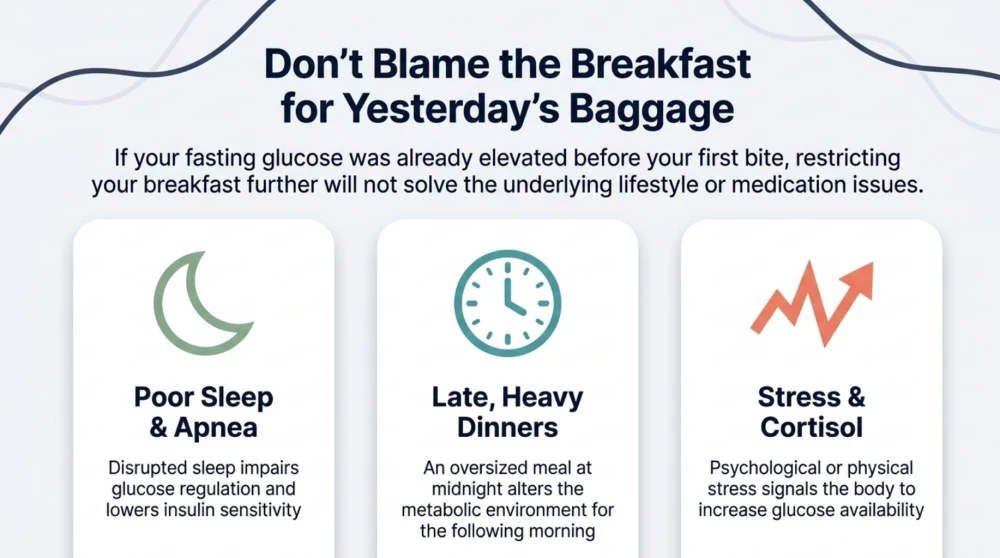
- Your Dinner Can Affect Your Breakfast Glucose
- Poor Sleep Can Change Your Glucose Response the Next Morning
- Stress Can Also Push Glucose Higher
- Exercise Can Change How Your Body Handles Breakfast
- Muscle Mass Is an Underappreciated Part of Glucose Control
- Can Eating Protein Before Carbohydrate Reduce a Glucose Spike?
- Why Adding Protein and Fibre Can Help
- How Can You Improve a Bowl of Oats?
- How Can You Improve Poha?
- How Can You Improve an Idli Breakfast?
- What About Paratha?
- How Can You Improve a Fruit-Based Breakfast?
- Why Smoothies Can Be Particularly Misleading
- What About Muesli and Granola?
- Does a Blood Sugar Spike Mean You Must Stop Eating That Food?
- When Should You Measure Glucose After Breakfast?
- Do You Need to Avoid All Carbohydrates at Breakfast?
- A Better Way to Build a Glucose-Friendly Breakfast
- Breakfast Should Be Personalised, Not Feared
- What Counts as a Blood Sugar Spike After Breakfast?
- Why the Starting Glucose Matters
- How to Check Whether Your Breakfast Is Really Causing the Problem
- Can Walking After Breakfast Reduce the Glucose Rise?
- Can You Exercise Your Way Out of an Excessive Breakfast?
- What Does a More Glucose-Friendly Breakfast Look Like?
- Practical Breakfast Combinations for Better Glucose Balance
- Do You Need 30 Grams of Protein at Breakfast?
- Should People With Diabetes Stop Eating Bananas?
- Are Oats Good or Bad for Diabetes?
- Is Honey Better Than Sugar for Blood Glucose?
- What About Millet Breakfasts?
- Can a “No Added Sugar” Breakfast Still Spike Glucose?
- Five Common CGM Mistakes After Breakfast
- 1. Trying to Keep the Glucose Line Completely Flat
- 2. Judging Food Only by the Highest Glucose Number
- 3. Comparing Different Foods Eaten in Different Circumstances
- 4. Eliminating Nutritious Foods After One Reading
- 5. Ignoring the Accuracy Limitations of the Device
- When Repeated Breakfast Spikes May Mean More Than a Food Problem
- When Should You Discuss Post-Breakfast Glucose With Your Doctor?
- Common Myths About a Healthy Breakfast and Blood Sugar
- Myth 1: If a Food Is Healthy, It Cannot Spike Blood Sugar
- Myth 2: Honey and Jaggery Do Not Affect Blood Sugar Like White Sugar
- Myth 3: People With Diabetes Should Never Eat Fruit
- Myth 4: Oats Are Always the Best Breakfast for Diabetes
- Myth 5: Millet Cannot Raise Blood Sugar
- Myth 6: A Perfect Breakfast Should Produce No Glucose Rise
- Myth 7: A High Post-Breakfast Reading Always Means the Breakfast Was Wrong
- A Practical Breakfast Checklist
- Key Takeaways: Why a Healthy Breakfast Can Still Cause a Blood Sugar Spike
- References
Why a “Healthy” Breakfast Can Still Cause a Blood Sugar Spike
You replaced white bread with oats. You stopped adding sugar to tea. Your breakfast now contains fruit, muesli, milk, perhaps some nuts and a glass of fresh juice.
Everything appears healthy.
Yet when you check your glucose after breakfast, the number is unexpectedly high.
This can be confusing, particularly for someone with prediabetes or diabetes who has genuinely tried to improve their diet. The immediate reaction is often: “I did not eat anything unhealthy, so why did my sugar increase?”
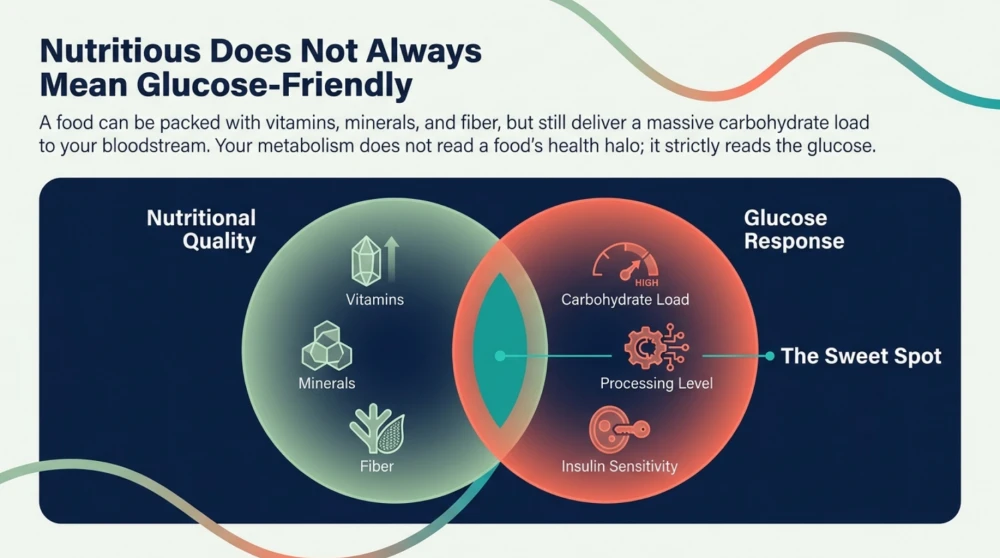
The answer is that a healthy breakfast can still cause a blood sugar spike because nutritional quality and glucose response are related, but they are not exactly the same thing.
A food can contain vitamins, minerals, fibre or other beneficial nutrients and still provide a substantial amount of carbohydrate. Once digested, much of that carbohydrate eventually reaches the bloodstream as glucose.
The size of the glucose rise depends on several factors: the amount of carbohydrate, the type of carbohydrate, how processed the food is, portion size, whether the carbohydrate is eaten alone or as part of a mixed meal, and—very importantly—how efficiently your body can handle glucose at that particular time.
This is why the same bowl of oats or the same banana may produce very different glucose responses in two different people.
What Actually Causes Blood Sugar to Rise After Breakfast?
After eating carbohydrate-containing food, digestion breaks much of the carbohydrate into smaller molecules, including glucose.
Glucose is absorbed through the intestine and enters the bloodstream. In response, the pancreas releases insulin.
Insulin helps move glucose from the bloodstream into tissues where it can be used or stored. Skeletal muscle is particularly important because it represents a major site of insulin-mediated glucose disposal.
In someone with good insulin sensitivity and adequate pancreatic function, this system can handle a carbohydrate-containing meal efficiently.
In someone with insulin resistance, the same insulin signal may produce a weaker response in tissues such as muscle and liver. The pancreas may compensate by producing more insulin, sometimes for years.
Eventually, glucose after meals may begin rising more noticeably.
Post-Meal Glucose Can Become Abnormal Before Fasting Glucose Looks Dramatically High
This explains an important clinical pattern.
A person may wake up with a fasting glucose that appears reasonably controlled but experience substantial glucose excursions after meals.
Post-meal glucose therefore provides different information from fasting glucose.
This becomes particularly relevant when someone says, “My fasting sugar is fine, but my glucose goes high after breakfast.”
Why Breakfast Can Produce a Surprisingly Large Glucose Rise
Breakfast has a unique metabolic context because it follows the overnight fasting period.
During the early morning hours, hormones involved in preparing the body for waking—including cortisol and growth hormone—can influence hepatic glucose production and insulin sensitivity.
This contributes to what is commonly called the dawn phenomenon in people with diabetes.
The liver may already be releasing glucose into the circulation before breakfast begins.
If a substantial carbohydrate load is then added through breakfast, the resulting glucose excursion can be larger than expected in some people.
The Same Food Does Not Necessarily Produce the Same Response at Every Time of Day
Human glucose metabolism follows circadian rhythms.
Meal timing, sleep, previous physical activity, medications, stress and individual physiology can all influence post-meal glucose.
This is one reason a food should not automatically be labelled “good” or “bad” based on a single glucose reading.
Context matters.
Reason 1: Your Healthy Breakfast May Still Contain Too Much Carbohydrate
One of the most common reasons for a healthy breakfast blood sugar spike is simply carbohydrate quantity.
Consider a breakfast containing:
- A large bowl of oats or muesli.
- Milk.
- A banana.
- Raisins or dates.
- Honey.
- A glass of orange juice.
Every individual item can be marketed or perceived as healthy.
But together, the total carbohydrate load can become substantial.
Healthy Ingredients Can Add Up
People often evaluate breakfast one ingredient at a time.
“Oats are healthy.”
“Fruit is healthy.”
“Milk is healthy.”
“Dates are natural.”
“Honey is better than sugar.”
These statements do not tell us what happens when all of those carbohydrate-containing foods are consumed together.
The body responds to the entire meal.
A nutritious breakfast can therefore still deliver considerably more carbohydrate than a person with significant insulin resistance can comfortably handle at one sitting.
Reason 2: Portion Size Can Turn a Good Food Into a High Glycaemic Load
The glycaemic index and glycaemic load are related concepts, but they are not interchangeable.
The glycaemic index describes how quickly a carbohydrate-containing food raises glucose under standardised testing conditions.
But in real life, the amount eaten also matters.
A Large Portion of a Moderate-GI Food Can Still Matter
Imagine someone eating a small serving of oats compared with another person eating a very large bowl.
The food is identical.
The nutritional reputation is identical.
The carbohydrate exposure is not.
This is why simply replacing one carbohydrate with a supposedly healthier carbohydrate does not guarantee that post-meal glucose will remain within the desired range.
Quantity still matters.
Reason 3: Your Breakfast May Contain More Sugar Than You Realise
Many breakfast foods occupy an unusual nutritional category: they look healthier than desserts but can still contain significant amounts of added or rapidly available sugars.
Examples include some:
- Breakfast cereals.
- Granola.
- Flavoured yoghurt.
- Protein bars.
- Packaged smoothies.
- Flavoured milk.
- Instant oatmeal products.
- Breakfast drinks.
The front of the package may say “high fibre,” “multigrain,” “with real fruit,” “no refined sugar,” or “source of protein.”
None of these claims automatically means that the product contains little carbohydrate or will produce a small glucose response.
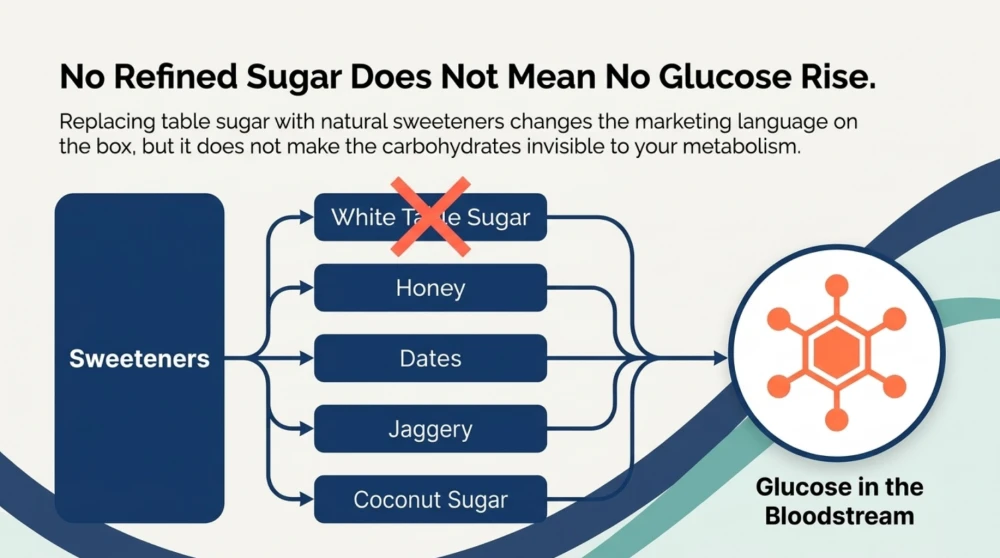
“No Refined Sugar” Does Not Mean “No Glucose Rise”
This distinction is particularly important.
A product may use dates, jaggery, honey, coconut sugar, fruit concentrate or another sweetener instead of white table sugar.
The marketing language may change.
Your glucose metabolism does not read the label.
These ingredients can still contribute sugars and carbohydrate.
Replacing white sugar with a more “natural” sweetener therefore does not make the carbohydrate metabolically invisible.
Reason 4: Drinking Your Breakfast Can Change the Glucose Response
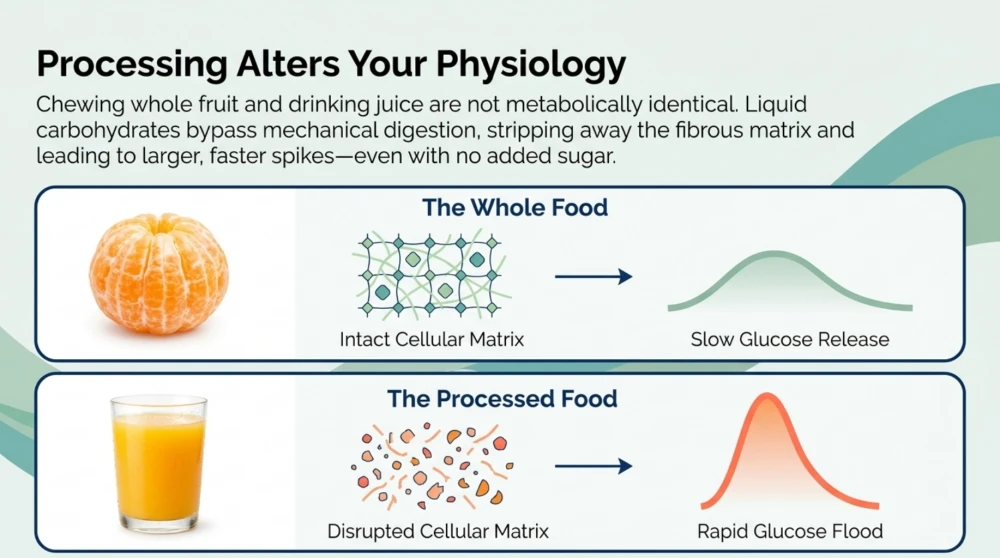
Fruit is generally a nutritious food. Fruit juice is not metabolically identical to eating the intact fruit.
When you eat an orange, you chew the intact fruit structure and consume its fibre-containing matrix.
When several oranges are squeezed into a glass of juice, much of that structure is disrupted and it becomes easy to consume the carbohydrate from multiple fruits within a few minutes.
Juice Is Not the Same as Whole Fruit
This does not mean that fruit juice is a poison or that one sip will cause diabetes.
It means that the form in which carbohydrate is consumed matters.
A similar issue can occur with smoothies.
A smoothie may contain banana, mango, dates, oats, milk and honey. Every ingredient can sound nutritious, yet the final drink can deliver a large carbohydrate load rapidly.
Because liquids are also easy to consume quickly, portion size can become larger than expected.
Reason 5: Your Breakfast May Be Too Low in Protein
A common “healthy” breakfast pattern is heavily weighted towards carbohydrate:
Fruit plus cereal.
Toast plus juice.
Poha plus tea.
Oats plus banana.
Idli with limited accompanying protein.
These meals can certainly fit into a healthy diet, but their overall metabolic effect depends on portion size and what else accompanies them.
Protein changes the physiology of a mixed meal.
Adding Protein Can Modify the Post-Meal Glucose Response
Protein stimulates several gastrointestinal and pancreatic responses and can modify gastric emptying, insulin secretion and the glucose response to carbohydrate.
This does not mean that adding protein magically “cancels” carbohydrate.
If someone consumes an extremely large carbohydrate portion and adds one spoonful of seeds, the meal does not suddenly become glucose-neutral.
But constructing breakfast around a meaningful protein source rather than treating protein as a garnish can improve the overall composition of the meal.
Depending on dietary preference, examples may include eggs, curd or Greek-style yoghurt without excessive added sugar, paneer, tofu, soy foods, dals or other appropriate protein sources.
Reason 6: “High Fibre” on the Packet May Not Mean a Low Glucose Response
Fibre is beneficial for digestive and metabolic health, but a food containing fibre can still contain substantial digestible carbohydrate.
Consider a breakfast cereal containing whole grains and added fibre.
It may genuinely provide more fibre than a refined cereal.
But if the portion is large and the product also contains significant starch or added sugars, post-meal glucose can still rise substantially.
Do Not Evaluate a Food From One Nutrient
This is a common nutrition mistake.
A food becomes “healthy” because it contains fibre.
Another becomes “healthy” because it contains protein.
Another becomes “healthy” because it contains nuts.
But the metabolic response depends on the complete food and the complete meal.
For glucose control, the total amount and quality of carbohydrate remain particularly important.
Reason 7: Processing Can Change How Quickly Carbohydrate Is Digested
Two foods can begin with the same basic ingredient but behave differently after processing.
Grinding, puffing, flaking, cooking, blending and other processing methods can alter food structure and influence how accessible starch becomes to digestive enzymes.
This is why “made from oats” or “made from whole grains” does not guarantee that two products will produce identical glucose responses.
Food Structure Matters
Compare intact or minimally processed grains with finely milled flour made from the same grain.
The nutrient labels may appear similar in some respects, but the physical structure is very different.
Finely processing a food can increase the surface area available to digestive enzymes and, depending on the food and preparation, may accelerate carbohydrate digestion.
The same principle helps explain why chewing whole fruit and drinking fruit juice should not be treated as metabolically identical experiences.
A Classic Example: Oats Are Healthy, So Why Did My Glucose Spike?
Oats are a nutritious whole-grain food and can provide soluble fibre, including beta-glucan.
But “oats” describes a family of products rather than one metabolically identical food.
Steel-cut oats, rolled oats, quick oats, instant flavoured oats and finely ground oat flour differ in processing and preparation.
Then consider what is added.
A breakfast may contain oats plus banana, raisins, honey and milk.
The patient may understandably describe this as “just oats.”
Metabolically, however, the body is responding to the entire bowl.
The Solution Is Not Necessarily to Ban Oats
The better question is:
How much did you eat, which type did you choose, what did you add to it, and what was the rest of the meal?
A smaller portion of minimally processed oats combined with an appropriate protein source and nuts or seeds may produce a very different glucose pattern from a large bowl of instant oats sweetened with banana, raisins and honey.
Another Example: Is Poha a Healthy Breakfast?
Poha is frequently described as a light and healthy Indian breakfast.
It can certainly be part of a balanced diet.
But flattened rice remains predominantly a carbohydrate-containing food.
A large plate of poha with only a small amount of vegetables and very little protein may produce a substantial glucose response in someone with diabetes or insulin resistance.
Adding Vegetables Is Helpful but Does Not Remove the Carbohydrate
Peas, onions, carrots, peanuts, sprouts or other additions can improve nutritional quality.
However, if the quantity of poha remains very large, adding vegetables does not make its carbohydrate disappear.
A more useful approach is to reconsider the portion and overall meal composition, including an appropriate protein source.
What About Idli, Dosa and Upma?
The same principle applies to traditional breakfasts.
Whether a breakfast is homemade, traditional, fermented or made from familiar ingredients does not by itself determine its post-meal glucose effect.
Idli and dosa contain carbohydrate derived primarily from rice and lentils in varying proportions. Upma commonly contains semolina. The final glucose response depends on quantity, preparation, accompaniments and the person's metabolic status.
Fermentation Does Not Make Carbohydrate Disappear
Fermentation can alter flavour, texture, digestibility and some nutritional characteristics of food, but it should not be interpreted as a guarantee that a fermented breakfast cannot raise glucose.
Three or four large idlis, for example, represent a different carbohydrate exposure from one or two idlis accompanied by adequate protein and other foods.
What About Fruit for Breakfast?
Whole fruit provides vitamins, minerals, phytochemicals and fibre and can be part of a healthy diet for people with diabetes.
The problem usually arises when “fruit is healthy” becomes “unlimited fruit cannot affect glucose.”
Fruit contains carbohydrate.
A Fruit Bowl Can Become a Large Carbohydrate Meal
One portion of fruit is different from a large bowl containing banana, mango, grapes, chikoo, dates and dried fruit.
Adding honey because it is “natural” increases the carbohydrate load further.
Someone with significant insulin resistance may therefore experience a substantial rise in glucose despite having eaten nothing that they consider junk food.
The answer is generally not to become afraid of fruit.
It is to understand portion, selection, meal composition and individual glucose response.
The Bigger Problem: “Healthy” and “Glucose-Friendly” Are Not Synonyms
This is the central message of the article.
Food can be nutritious while still raising glucose.
A banana contains useful nutrients and carbohydrate.
Oats provide fibre and carbohydrate.
Milk provides protein, minerals and lactose.
Dal provides protein, fibre and carbohydrate.
Whole grains contain more nutrients and fibre than many refined grains but still contain starch.
There is no contradiction here.
You Do Not Need to Choose Between Nutrition and Glucose Control
The objective should not be to remove every food that causes any increase in glucose.
Blood glucose is supposed to rise after eating.
The more meaningful questions are how high it rises, how long it remains elevated, whether the response is appropriate for the person's metabolic condition, and whether the overall diet supports long-term health.
That requires looking beyond simplistic labels such as “healthy,” “natural,” “sugar-free” or “diabetic-friendly.”
Why Can Two People Eat the Same Breakfast and Get Very Different Glucose Readings?
One of the biggest mistakes in nutrition is assuming that a particular food should produce the same blood glucose response in everyone.
Imagine two people eating exactly the same breakfast: two idlis with sambar and curd. One person checks glucose after the meal and sees only a modest rise. The other experiences a much larger increase.
The difference does not necessarily mean that the second person ate the “wrong” food.
Their ability to handle the carbohydrate may simply be different.
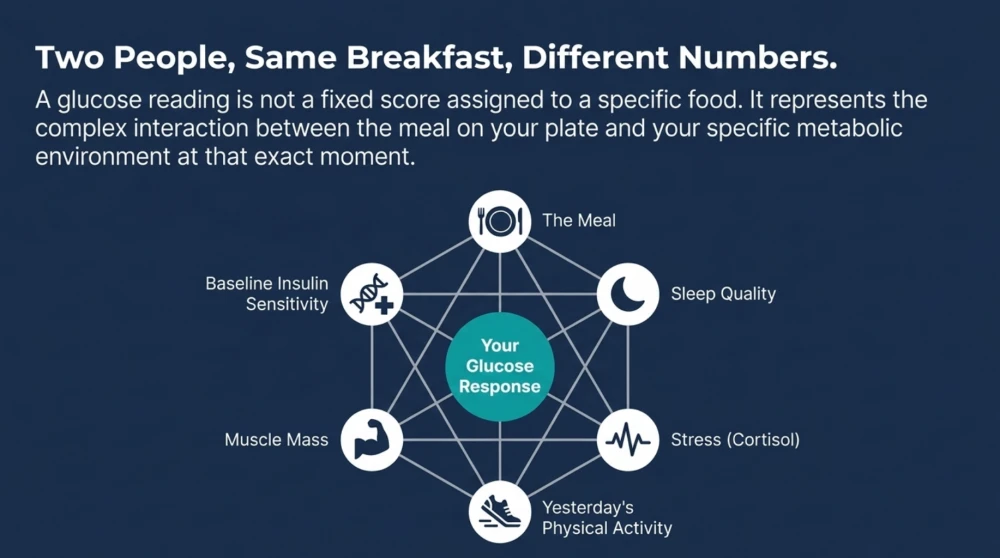
Insulin sensitivity, pancreatic beta-cell function, muscle mass, physical activity, sleep, stress, medications, previous meals and the degree of diabetes or prediabetes can all influence post-meal glucose.
Your Glucose Response Reflects Both the Food and Your Metabolism
This is an important distinction when trying to understand a healthy breakfast blood sugar spike.
The glucose reading after breakfast is not simply a score assigned to the food.
It represents an interaction between the meal and the person eating it.
This explains why copying someone else's “diabetes-friendly breakfast” from social media may not produce the same result for you.
Insulin Resistance Changes What Happens After Breakfast
When carbohydrate is digested and glucose enters the bloodstream, insulin helps coordinate its movement into tissues and suppresses unnecessary glucose production by the liver.
With insulin resistance, these processes become less efficient.
Skeletal muscle may respond less effectively to insulin, while the liver may continue releasing glucose more than it should.
Initially, the pancreas often compensates by producing more insulin.
For some time, glucose may therefore remain relatively normal despite increasing insulin resistance.
Eventually the Compensation May Become Insufficient
As metabolic dysfunction progresses, post-meal glucose can begin rising more noticeably.
This may happen before fasting glucose becomes dramatically abnormal.
Breakfast can expose this reduced metabolic flexibility because carbohydrate arrives at a time when morning hormonal changes and hepatic glucose output may already be influencing blood glucose.
Why Morning Insulin Resistance Can Be Different
Some people notice that a food produces a larger glucose rise at breakfast than when they eat a similar amount of carbohydrate later in the day.
There is no universal pattern that applies to everyone, but morning glucose physiology can be particularly challenging in people with diabetes.
Hormones such as cortisol and growth hormone change across the night and early morning and can influence insulin sensitivity and hepatic glucose production.
The Dawn Phenomenon Can Add to the Breakfast Rise
In people with diabetes, glucose may begin increasing before breakfast because the liver releases glucose during the early morning hours.
If fasting glucose is already climbing and breakfast then supplies a substantial carbohydrate load, the post-breakfast reading may become considerably higher.
This does not necessarily mean breakfast itself caused the entire increase.
Looking at the pre-breakfast value and the change after eating provides more information than looking only at the final number.
Your Dinner Can Affect Your Breakfast Glucose
Morning glucose metabolism does not begin when you take your first bite of breakfast.
What happened the previous evening can influence what you see the following morning.
A very large late-night meal, excessive alcohol, poor sleep, unusual inactivity or substantial glucose elevation overnight may alter the metabolic environment in which breakfast is eaten.
Late-Night Eating Can Complicate the Picture
Someone who finishes a heavy dinner close to midnight and eats breakfast early the next morning may have a very different glucose pattern from someone who eats an earlier, appropriately portioned dinner and sleeps adequately.
This is why repeatedly changing breakfast without considering the rest of the day can sometimes fail to solve the problem.
Poor Sleep Can Change Your Glucose Response the Next Morning
Sleep is frequently overlooked when people investigate unexplained glucose readings.
Experimental and observational research has linked insufficient or disrupted sleep with impaired glucose regulation and reduced insulin sensitivity.
One poor night does not suddenly create diabetes, but repeated inadequate sleep can contribute to an unfavourable metabolic environment.
Snoring and Sleep Apnoea Also Matter
If someone repeatedly wakes unrefreshed, snores loudly, has witnessed pauses in breathing, experiences morning headaches or remains excessively sleepy during the day, obstructive sleep apnoea deserves consideration.
Sleep apnoea is associated with insulin resistance, hypertension and broader cardiometabolic risk.
Changing oats to eggs will not address untreated sleep apnoea.
Stress Can Also Push Glucose Higher
Psychological and physical stress can influence glucose through hormones such as adrenaline and cortisol.
These hormones help make energy available during situations the body interprets as demanding.
Part of that response involves increasing glucose availability.
Therefore, glucose after exactly the same breakfast may not be identical on a relaxed morning and on a morning involving significant stress, pain, illness or sleep deprivation.
One Unexpected Reading Should Not Trigger an Extreme Diet Change
If a normally well-tolerated breakfast produces one unusual glucose reading, first consider whether something else was different that day.
Look for patterns rather than reacting to every isolated number.
Exercise Can Change How Your Body Handles Breakfast
Skeletal muscle is one of the body's largest sites for glucose disposal.
Physical activity can increase glucose uptake by muscle and improve insulin sensitivity.
This is why a physically active person may tolerate a particular carbohydrate portion differently from someone who spends most of the day sitting.
Yesterday's Activity May Still Matter Today
The metabolic benefits of exercise do not necessarily end when the workout finishes.
Regular aerobic exercise and resistance training can improve insulin sensitivity over time, while prolonged inactivity works in the opposite direction.
Daily movement therefore belongs in the discussion when breakfast glucose remains consistently elevated.
Muscle Mass Is an Underappreciated Part of Glucose Control
Weight alone does not tell us how much metabolically active tissue a person has.
Two people may weigh exactly 70 kg while having very different amounts of muscle and visceral fat.
Skeletal muscle provides a major destination for glucose after meals.
Preserving muscle therefore becomes especially important during weight loss.
Losing Weight Is Not Enough if Too Much Muscle Is Lost
Severe calorie restriction, inadequate protein and lack of resistance exercise can contribute to loss of lean mass during weight reduction.
The weighing scale may look impressive while body composition becomes less favourable than expected.
For metabolic health, reducing excess fat while preserving muscle is generally a better objective than simply pursuing the lowest possible body weight.
Can Eating Protein Before Carbohydrate Reduce a Glucose Spike?
Meal sequence has attracted considerable research interest.
Some studies suggest that eating vegetables and protein before carbohydrate can reduce the early post-meal glucose excursion compared with eating carbohydrate first.
Several mechanisms may contribute, including effects on gastric emptying and gut hormones.
However, meal sequence should not become another nutritional trick that distracts from the composition of the meal itself.
Meal Order Cannot Rescue an Excessive Carbohydrate Portion
Eating salad before a very large plate of refined carbohydrate does not make the carbohydrate disappear.
Similarly, eating two almonds before a large bowl of sweetened cereal is unlikely to transform the meal.
Meal sequence may be a useful additional strategy, but total carbohydrate, food quality, portion size and overall meal composition remain more important.
Why Adding Protein and Fibre Can Help
Carbohydrate eaten as part of a mixed meal behaves differently from carbohydrate consumed alone.
Protein, fibre and fat can influence digestion, gastric emptying, satiety and the overall post-meal metabolic response.
The goal is not to add unlimited fat simply to flatten a glucose curve. A meal can produce a smaller glucose excursion while still containing excessive calories or poor-quality fats.
Instead, breakfast should ideally provide a sensible balance of nutrients appropriate for the individual's health goals.
How Can You Improve a Bowl of Oats?
Suppose breakfast currently consists of a large bowl of instant oats with banana, raisins and honey.
The person considers it healthy because oats and fruit are present.
Instead of banning oats completely, several aspects can be reconsidered.
A More Balanced Oats Breakfast
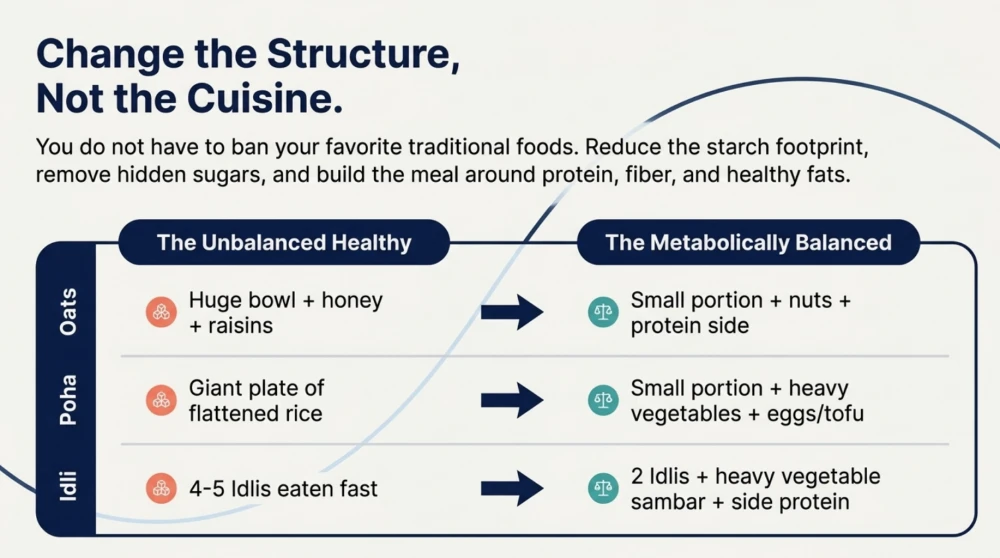
The portion of oats can be matched to individual carbohydrate requirements. Less processed varieties can be chosen where practical. Honey and unnecessary dried fruit can be removed if they are adding substantial sugars.
A meaningful protein source can be incorporated, and nuts or seeds can contribute texture, unsaturated fats and additional fibre.
If fruit is included, the portion can be appropriate rather than automatically adding multiple fruits to the same bowl.
The result remains an oats breakfast, but its overall carbohydrate load and nutritional balance can be very different.
How Can You Improve Poha?
Poha does not need to disappear from the diet simply because someone has prediabetes or diabetes.
The problem may be a large plate dominated almost entirely by flattened rice.
Change the Structure of the Meal
A practical approach may include a smaller portion of poha with substantially more non-starchy vegetables and an appropriate protein source.
Depending on dietary preference and total calorie requirements, protein might come from curd, paneer, tofu, eggs, sprouts or another suitable food.
Peanuts can contribute some protein and healthy fats, although a small sprinkling of peanuts should not be assumed to convert a carbohydrate-heavy plate into a high-protein meal.
How Can You Improve an Idli Breakfast?
Idli often creates confusion because fermentation gives it a healthy reputation.
Fermentation is useful, but portion size still matters.
Four or five idlis eaten quickly with limited accompaniment can provide considerably more carbohydrate than one or two idlis eaten as part of a balanced meal.
Make Sambar More Than a Decorative Accompaniment
A generous serving of vegetable-rich sambar can improve meal quality and provide some protein from dal.
An additional appropriate protein source may be useful depending on the individual's requirements.
The objective is not to label idli as forbidden. It is to avoid constructing the entire breakfast around a large quantity of starch.
What About Paratha?
A homemade paratha is often considered unhealthy simply because it contains wheat and some cooking fat, while packaged granola is considered healthy because its packaging uses words such as whole grain and high fibre.
Nutrition is rarely that simple.
A sensibly portioned paratha made with an appropriate amount of oil and eaten with curd, paneer, egg or another protein-containing accompaniment may fit some people's meal plans.
A large serving of sweetened granola with flavoured yoghurt, banana, raisins and honey may deliver considerably more carbohydrate and sugar.
The Label “Healthy” Is Less Useful Than Looking at the Whole Meal
This does not mean paratha is automatically better than granola.
It means foods should be assessed according to ingredients, portion, preparation, accompaniments and the needs of the person eating them.
How Can You Improve a Fruit-Based Breakfast?
Fruit-only breakfasts are popular among people trying to lose weight or “eat clean.”
But a large fruit bowl can provide substantial carbohydrate while containing relatively little protein.
Some people may also become hungry again relatively quickly.
Fruit Does Not Need to Be Removed
Instead of consuming several fruits as the entire breakfast, one appropriate portion of whole fruit can be combined with a meaningful protein-containing meal.
This allows the nutritional benefits of fruit to remain while avoiding the assumption that unlimited fruit is metabolically neutral.
Why Smoothies Can Be Particularly Misleading
A homemade smoothie can contain foods that individually appear excellent:
- Banana.
- Mango.
- Dates.
- Oats.
- Milk.
- Honey.
- Peanut butter.
- Chia seeds.
The result may contain fibre, protein, vitamins, minerals and healthy fats.
It can also contain a substantial amount of carbohydrate and energy.
“Nutrient Dense” and “Low Calorie” Are Not the Same Thing
Nor does nutrient dense mean that a food cannot raise glucose.
This is particularly relevant for people who drink a smoothie alongside another breakfast rather than recognising that the smoothie itself may already represent a substantial meal.
What About Muesli and Granola?
Muesli and granola vary enormously between brands.
Some contain relatively simple combinations of whole grains, nuts and seeds. Others contain substantial dried fruit, syrups, honey, chocolate or added sugars.
Granola can also be calorie dense because of added fats and sweeteners.
Read the Nutrition Label, Not Just the Front of the Packet
Look at the actual serving size, total carbohydrate, added sugars where declared, fibre and protein.
Then compare the manufacturer's serving size with the quantity you actually pour into the bowl.
A product may look reasonable per 30-gram serving while the real breakfast portion is two or three times larger.
Does a Blood Sugar Spike Mean You Must Stop Eating That Food?
Not necessarily.
This is particularly important for people using continuous glucose monitors or frequently checking post-meal glucose.
Glucose normally rises after eating.
The goal is not a perfectly flat glucose line after every meal.
A single excursion also needs context: the starting glucose, meal size, timing of measurement, medications, activity, sleep and individual treatment targets all matter.
Look for Reproducible Patterns
If the same breakfast repeatedly produces an excessive glucose rise under similar conditions, that information can be useful.
You can then experiment intelligently with portion size, carbohydrate source, protein, vegetables, food form or physical activity.
If the glucose response remains excessive despite reasonable meal modification, the problem may not be breakfast alone. The overall diabetes treatment plan may need review.
When Should You Measure Glucose After Breakfast?
The timing of glucose measurement matters enormously.
A reading taken 30 minutes after the first bite cannot be directly compared with one taken two hours later.
For conventional post-meal monitoring, clinical targets commonly refer to glucose measured at a defined interval after the beginning of the meal, often around one to two hours depending on the clinical purpose and guidance being followed.
Patients should use the timing recommended for their particular monitoring plan rather than checking at random times and comparing unrelated readings.
CGM Shows the Curve, but the Curve Still Needs Interpretation
Continuous glucose monitoring can reveal when glucose begins rising, approximately when it peaks and how long it takes to return towards baseline.
That information can be valuable.
But CGM can also encourage people to judge every food by the height of one glucose peak.
A nutritious food should not automatically be eliminated simply because glucose rises after eating it.
Do You Need to Avoid All Carbohydrates at Breakfast?
No.
For most people, good glucose management does not require eliminating every carbohydrate-containing food.
The appropriate amount depends on the individual.
A physically active person with good insulin sensitivity may tolerate a different breakfast from someone with poorly controlled diabetes and significant insulin resistance.
Carbohydrate Quality and Quantity Both Matter
Whole grains, legumes, vegetables, dairy foods and whole fruits can contribute valuable nutrients while also containing carbohydrate.
The aim is to use them in quantities and combinations that fit the person's metabolic health and nutritional requirements.
Extremely restrictive diets are not automatically metabolically superior simply because they produce smaller short-term glucose excursions.
A Better Way to Build a Glucose-Friendly Breakfast
Instead of beginning with the question, “Which breakfast food is best for diabetes?”, start with the structure of the meal.
Ask:
- Where is the main protein source?
- How much carbohydrate am I actually eating?
- Is the carbohydrate minimally processed or highly refined?
- Am I eating whole food or drinking much of the carbohydrate?
- Is there a useful source of fibre?
- Does the portion match my energy requirements?
- Am I adding unnecessary sugar, honey, jaggery or dried fruit?
- Does this breakfast keep me comfortably satisfied?
- What happens to my glucose when I eat this meal repeatedly under similar conditions?
These questions are more useful than searching for one universally perfect “diabetes breakfast.”
Breakfast Should Be Personalised, Not Feared
A healthy breakfast blood sugar spike does not necessarily mean that the entire breakfast was unhealthy.
It may mean the carbohydrate portion was too large for your current glucose tolerance. The food may have been more processed than expected. The meal may have lacked protein. You may have consumed carbohydrate in liquid form. Poor sleep, dawn phenomenon, inactivity or inadequate diabetes treatment may also have contributed.
Understanding the reason allows the meal to be improved rather than unnecessarily restricted.
What Counts as a Blood Sugar Spike After Breakfast?
The phrase “blood sugar spike” is used frequently, particularly since continuous glucose monitors have become more widely available. But there is no single rise in glucose that should automatically be labelled dangerous for every person.
Blood glucose is expected to increase after eating carbohydrate. The important questions are how high it rises, where it started, how long the elevation lasts, whether the pattern occurs repeatedly, and whether the person has diabetes, prediabetes or normal glucose regulation.
This is why seeing glucose increase after oats, fruit or poha does not automatically mean the breakfast was unhealthy.
Clinical Targets Are More Useful Than Chasing a Completely Flat Curve
For many non-pregnant adults with diabetes, commonly used treatment goals include a pre-meal glucose of approximately 80–130 mg/dL and a peak post-meal glucose below 180 mg/dL, although targets should always be individualised.
Age, medications, risk of hypoglycaemia, duration of diabetes, pregnancy, kidney disease and other medical conditions can change the appropriate target.
People without diabetes should also be cautious about applying diabetes treatment thresholds to themselves or interpreting every temporary CGM rise as evidence of disease.
Why the Starting Glucose Matters
Consider two people whose glucose reaches 170 mg/dL after breakfast.
The first starts breakfast at 90 mg/dL. The second starts at 145 mg/dL.
The final number is identical, but the metabolic situation is not.
The second person was already hyperglycaemic before eating.
Do Not Blame Breakfast for Glucose That Was Already High
If fasting or pre-breakfast glucose is repeatedly elevated, simply removing more and more foods from breakfast may not solve the underlying problem.
Persistent fasting hyperglycaemia may reflect hepatic glucose production, dawn phenomenon, inadequate diabetes treatment, late-night eating or broader deterioration in glucose regulation.
Both the pre-meal value and post-meal response therefore deserve attention.
How to Check Whether Your Breakfast Is Really Causing the Problem
Random glucose testing can create more confusion than clarity.
If you want to understand how a particular breakfast affects you, try to make the comparison reasonably consistent.
Record the glucose before breakfast, what you actually ate, approximate portion size and the glucose at the recommended post-meal interval.
Then look for a repeated pattern rather than drawing conclusions from one morning.
Do Not Change Five Things at Once
Suppose your usual breakfast is oats with banana, raisins, honey and milk.
If you simultaneously remove the banana, halve the oats, add eggs, start walking after breakfast and change your diabetes medicine, you may improve the reading—but you will not know which change mattered most.
When clinically safe, making one or two sensible changes at a time can help identify what works.
Can Walking After Breakfast Reduce the Glucose Rise?
Yes, post-meal physical activity can be a useful strategy.
Muscle contraction increases glucose uptake, and even relatively short periods of walking after meals can improve post-meal glucose compared with remaining sedentary.
This does not mean that everyone needs an intense workout immediately after eating.
A Short Walk Can Be Surprisingly Practical
For many people, a comfortable 10–15 minute walk after breakfast is more realistic than planning a long exercise session.
It can be particularly useful for someone who otherwise eats breakfast and immediately sits in a car, at a desk or in front of a computer for several hours.
Regular daily movement should complement—not replace—structured aerobic exercise and resistance training.
Can You Exercise Your Way Out of an Excessive Breakfast?
Not reliably.
A post-meal walk should not become permission to consume an unnecessarily large carbohydrate load every morning.
The better strategy is to combine appropriate meal composition with regular activity.
Diet and exercise work together rather than cancelling each other out.
What Does a More Glucose-Friendly Breakfast Look Like?
There is no single breakfast that is ideal for every person with prediabetes or diabetes.
A useful framework is to build the meal around four questions:
- What is my meaningful protein source?
- What is my carbohydrate source and portion?
- Where is the fibre coming from?
- Does the total meal match my calorie and metabolic requirements?
This framework allows traditional Indian foods to remain in the diet rather than replacing everything with unfamiliar “diabetic foods.”
Practical Breakfast Combinations for Better Glucose Balance
| Common Breakfast | Possible Problem | A More Balanced Approach |
|---|---|---|
| Large bowl of oats + banana + raisins + honey | Several carbohydrate sources combined in one meal | Moderate oats portion + meaningful protein source + nuts/seeds + appropriate whole-fruit portion |
| Large plate of poha | Meal dominated by flattened rice with limited protein | Smaller poha portion + more vegetables + curd/paneer/tofu/eggs or another suitable protein source |
| 4–5 idlis with little accompaniment | Large starch portion | Fewer idlis + generous vegetable-rich sambar + appropriate additional protein where required |
| Fruit bowl + juice | Large carbohydrate load with limited protein; juice adds rapidly consumed carbohydrate | Appropriate portion of whole fruit incorporated into a protein-containing breakfast; avoid routine juice |
| Sweetened muesli + flavoured yoghurt | Hidden added sugars and potentially oversized cereal portion | Unsweetened cereal in an appropriate portion + plain high-protein yoghurt/curd + nuts/seeds |
| Smoothie with banana + dates + oats + honey + milk | Multiple carbohydrate sources consumed rapidly in liquid form | Prefer a structured solid breakfast; if using a smoothie, simplify ingredients and control the carbohydrate portion |
| Toast + jam + juice | Predominantly carbohydrate with little protein | Appropriate whole-grain toast portion + eggs/paneer/tofu/curd + vegetables; whole fruit rather than juice if desired |
These are frameworks rather than fixed prescriptions. Portion requirements differ substantially according to body size, activity, medications, glucose control and individual nutritional needs.
Do You Need 30 Grams of Protein at Breakfast?
There is growing interest in distributing protein more evenly across the day rather than consuming most of it at dinner.
However, there is no single breakfast protein target appropriate for every adult.
Daily protein requirements depend on body weight, age, physical activity, calorie intake, kidney function, weight-loss goals and whether preservation or gain of muscle is a priority.
Think “Meaningful Protein,” Not “A Few Grams Somewhere”
A few peanuts sprinkled over poha or one teaspoon of chia seeds in a large bowl of oats technically adds protein, but the meal may still remain predominantly carbohydrate.
The more useful question is whether breakfast contains a substantial protein source appropriate for the individual's overall diet.
Should People With Diabetes Stop Eating Bananas?
No universal rule says that everyone with diabetes must avoid bananas.
Bananas contain carbohydrate, but portion size, ripeness, what is eaten alongside the fruit and the person's glucose tolerance all influence the response.
The problem may arise when a large banana is combined with oats, raisins, honey and juice and the entire breakfast is still considered “low sugar” because no white sugar was added.
Whole Fruit Is Different From Unlimited Fruit
People with diabetes can generally include whole fruit within an appropriately structured eating pattern.
Fruit juice and large portions of dried fruit deserve greater caution because substantial carbohydrate can be consumed quickly.
Are Oats Good or Bad for Diabetes?
Oats do not deserve either label.
They are a whole-grain food that can provide useful fibre, including beta-glucan. But they also provide carbohydrate.
The glucose response depends on processing, portion size, preparation and what is added.
Do Not Turn One Glucose Reading Into a Permanent Food Ban
If a large bowl of instant oats with sweet additions repeatedly produces an excessive rise, first modify the meal.
Try a more appropriate portion, less processed oats, removal of unnecessary sweeteners and a meaningful protein source.
If the response remains excessive, an alternative breakfast may suit that individual better.
Is Honey Better Than Sugar for Blood Glucose?
Honey may contain small amounts of compounds not present in refined table sugar, but it remains a concentrated source of sugars.
Replacing table sugar with honey should therefore not be interpreted as removing sugar from the meal.
The same caution applies to jaggery, brown sugar, coconut sugar, maple syrup and date syrup.
“Natural” Does Not Mean Glucose-Free
This is particularly relevant to breakfast because honey is commonly added to oats, smoothies, yoghurt, granola and fruit bowls under the assumption that it is a healthier sweetener.
From the perspective of total carbohydrate exposure, the amount still matters.
What About Millet Breakfasts?
Millets can provide fibre, minerals and nutritional variety, but replacing wheat or rice with millet does not make carbohydrate disappear.
Millet dosa, millet porridge, millet upma and millet flour products can still produce significant glucose responses depending on processing and portion size.
Millet Is a Food, Not a Diabetes Medicine
A heavily processed millet product consumed in a large portion should not automatically be considered metabolically superior simply because the package says “millet.”
The same principles of portion, processing, protein, fibre and overall meal composition continue to apply.
Can a “No Added Sugar” Breakfast Still Spike Glucose?
Absolutely.
Starch does not need to taste sweet to raise blood glucose.
Rice, wheat, oats, poha, semolina, bread and many breakfast cereals contain starch that is broken down during digestion into glucose.
A person can therefore consume no added sugar whatsoever and still eat a substantial carbohydrate load.
“Sugar-Free” and “Low-Carbohydrate” Are Different Claims
This distinction is fundamental for diabetes education.
Removing table sugar can certainly be useful, especially when it reduces unnecessary calories and rapidly absorbed sugars. But glucose management requires looking beyond sweetness to the total carbohydrate content and structure of the meal.
Five Common CGM Mistakes After Breakfast
Continuous glucose monitoring can provide valuable information, but it can also create unnecessary food anxiety when every curve is treated as a verdict on the meal.
1. Trying to Keep the Glucose Line Completely Flat
Some increase after a carbohydrate-containing meal is normal physiology.
2. Judging Food Only by the Highest Glucose Number
The starting glucose, duration of elevation, overall meal quality and individual clinical context also matter.
3. Comparing Different Foods Eaten in Different Circumstances
Sleep, exercise, stress, illness, medications and previous meals may all change the response.
4. Eliminating Nutritious Foods After One Reading
A single unexpected excursion should usually lead to investigation rather than an immediate permanent food ban.
5. Ignoring the Accuracy Limitations of the Device
CGM measures glucose in interstitial fluid rather than directly measuring blood glucose. Sensor readings can lag behind rapidly changing blood glucose and may occasionally require confirmation with a blood glucose meter when readings do not match symptoms or clinical expectations.
When Repeated Breakfast Spikes May Mean More Than a Food Problem
Sometimes breakfast modification is not enough because the underlying glucose regulation has deteriorated.
Suppose a patient previously tolerated two idlis and sambar reasonably well but now repeatedly experiences much higher glucose after the same meal.
Several possibilities deserve consideration.
Weight may have increased. Physical activity may have fallen. Sleep may have deteriorated. Diabetes may have progressed. Medication may need adjustment. Steroid treatment, illness or another medical condition may also be contributing.
Do Not Keep Removing Food While Glucose Control Continues to Worsen
This is an important practical message.
A person may start with oats, see a high reading and remove oats. Then fruit is removed. Then roti. Then dal. Eventually the diet becomes unnecessarily restrictive while glucose remains high.
At that point the question should not be, “Which carbohydrate should I remove next?”
The overall diabetes management plan needs review.
When Should You Discuss Post-Breakfast Glucose With Your Doctor?
Medical review is appropriate when post-meal glucose is repeatedly above your agreed target despite reasonable dietary measures, particularly when fasting glucose or HbA1c is also increasing.
Other reasons for assessment include:
- Newly detected high glucose without a previous diabetes diagnosis.
- Repeated symptoms of excessive thirst or urination.
- Unexplained weight loss.
- Recurrent hypoglycaemia after attempting to correct post-meal spikes.
- Very high glucose readings.
- Pregnancy or gestational diabetes.
- Use of insulin or medicines where dietary changes may increase hypoglycaemia risk.
- Glucose readings that remain unexpectedly high during illness.
People using insulin or glucose-lowering medicines that can cause hypoglycaemia should be particularly careful about making major carbohydrate reductions without appropriate medication review.
Common Myths About a Healthy Breakfast and Blood Sugar
Myth 1: If a Food Is Healthy, It Cannot Spike Blood Sugar
False. Nutritional quality and post-meal glucose response are not the same thing. Whole grains and fruit can be nutritious while still providing carbohydrate.
Myth 2: Honey and Jaggery Do Not Affect Blood Sugar Like White Sugar
False. They remain sources of sugars and can contribute to the glucose response.
Myth 3: People With Diabetes Should Never Eat Fruit
False. Whole fruit can usually be incorporated into an appropriately structured diabetes eating pattern. Portion and context matter.
Myth 4: Oats Are Always the Best Breakfast for Diabetes
False. Oats can be a useful food, but processing, quantity, additions and individual glucose tolerance influence the response.
Myth 5: Millet Cannot Raise Blood Sugar
False. Millets contain carbohydrate. Processing and portion size remain important.
Myth 6: A Perfect Breakfast Should Produce No Glucose Rise
False. Some post-meal increase is normal physiology.
Myth 7: A High Post-Breakfast Reading Always Means the Breakfast Was Wrong
False. Elevated starting glucose, dawn phenomenon, inadequate sleep, illness, stress, reduced activity or insufficient diabetes treatment may contribute.
A Practical Breakfast Checklist
Before calling your breakfast “diabetes-friendly,” ask:
- Does the meal contain a meaningful protein source?
- How much total carbohydrate am I actually eating?
- Am I combining several carbohydrate sources unnecessarily?
- Is the portion larger than I realise?
- Am I drinking fruit or other carbohydrate instead of eating whole foods?
- Have I added honey, jaggery, dates, raisins or other sweeteners because they seem healthier?
- Is the food minimally processed or highly refined?
- Does the meal contain vegetables, whole fruit or another useful fibre source?
- Does this breakfast keep me satisfied until the next planned meal?
- When I monitor glucose appropriately, is the response repeatedly excessive rather than abnormal only once?
Key Takeaways: Why a Healthy Breakfast Can Still Cause a Blood Sugar Spike
A healthy breakfast blood sugar spike is not a contradiction.
A breakfast can contain nutritious foods and still provide more carbohydrate than your current glucose tolerance can handle comfortably.
Portion size matters. Processing matters. Food form matters. Protein and fibre matter. Your insulin sensitivity matters.
Sleep, stress, exercise, muscle mass, dawn phenomenon, medications and the glucose level before breakfast can also change the result.
This is why glucose management should not become a search for a list of “safe” and “unsafe” foods.
The more useful goal is to understand how the entire meal interacts with your metabolism.
References
- American Diabetes Association Professional Practice Committee. Standards of Care in Diabetes—2026. Recommendations on glycaemic goals, nutrition, physical activity, glucose monitoring and management of diabetes.
- American Diabetes Association Professional Practice Committee. Facilitating positive health behaviours and well-being to improve health outcomes. Standards of Care in Diabetes—2026.
- International Diabetes Federation. Current clinical guidance and educational resources concerning postprandial glucose and diabetes management.
- Reynolds A, Mann J, Cummings J, Winter N, Mete E, Te Morenga L. Carbohydrate quality and human health: a series of systematic reviews and meta-analyses. Lancet. 2019;393:434–445.
- Shukla AP, Iliescu RG, Thomas CE, Aronne LJ. Food order has a significant impact on postprandial glucose and insulin levels. Diabetes Care. 2015;38:e98–e99.
- DiPietro L, Gribok A, Stevens MS, Hamm LF, Rumpler W. Three 15-minute bouts of moderate postmeal walking significantly improve 24-hour glycaemic control in older people at risk for impaired glucose tolerance. Diabetes Care. 2013;36:3262–3268.
- National Institute of Diabetes and Digestive and Kidney Diseases. Current information on insulin resistance, prediabetes, diabetes, healthy eating and physical activity.
- Current systematic reviews and clinical research examining meal composition, carbohydrate quantity and quality, food processing, meal sequence, sleep, exercise and postprandial glucose regulation.