

















- 19th August 2026
Table of Contents
- Why Can Fibre and Bloating Occur Together?
- Reason 1: You Increased Fibre Too Quickly
- Reason 2: Some High-Fibre Foods Are Highly Fermentable
- Reason 3: Fibre and Bloating May Be Related to FODMAPs
- Soluble and Insoluble Fibre Do Not Behave Identically
- Reason 4: You Increased Fibre but Not Fluids
- Reason 5: Your Portion Sizes Became Much Larger
- Reason 6: You Added Too Many Seeds and Fibre Supplements
- Reason 7: The Bloating May Not Actually Be Caused by Fibre
- Seven Reasons for Fibre and Bloating at a Glance
- How to Increase Fibre Without Making Bloating Worse
- Should You Reduce Fibre When Bloating Becomes Severe?
- Raw Versus Cooked Vegetables: Which Is Better for Bloating?
- Why Dal, Rajma and Chole Can Cause Gas
- Should You Avoid Sprouts if You Are Bloated?
- Fibre and Bloating From Chia Seeds
- What About Flaxseed?
- Is Psyllium Good for Bloating and Constipation?
- Constipation Can Itself Cause Fibre and Bloating Problems
- IBS Changes the Fibre Conversation
- Should Everyone With Bloating Try a Low-FODMAP Diet?
- Do You Need to Stop Onion and Garlic?
- Is Gluten Responsible for Bloating After Switching to Whole Grains?
- Can Probiotics Fix Fibre and Bloating?
- Does Walking After Meals Help Bloating?
- Keep a Short Food and Symptom Record
- A Practical Way to Rebuild Fibre Intake
- How Much Fibre Do Adults Actually Need?
- A Practical Indian Day With Fibre Without Excessive Bloating
- Hydration Is Part of the Fibre Conversation
- Can Fibre Help With Weight Management?
- Can Fibre Improve Blood Sugar Control?
- When Bloating Needs Medical Evaluation
- When Fibre and Bloating May Suggest IBS
- Common Myths About Fibre and Bloating
- Myth 1: More Fibre Is Always Better
- Myth 2: Bloating Means Fibre Is Bad for You
- Myth 3: Raw Vegetables Are Always Healthier Than Cooked Vegetables
- Myth 4: Everyone With Bloating Should Follow a Low-FODMAP Diet
- Myth 5: Isabgol Fixes Every Constipation Problem
- Myth 6: Probiotics Will Automatically Fix Bloating
- Myth 7: If One High-Fibre Food Causes Symptoms, You Should Avoid the Whole Food Group
- What Should You Do if Fibre and Bloating Continue?
- Key Takeaways About Fibre and Bloating
- References
More Fibre, More Bloating? 7 Reasons a Healthy Change Can Upset Digestion
You decide to improve your diet. White bread is replaced with whole grains. You start eating more vegetables. Dal, beans, salads, fruit, oats, chia seeds, and flaxseeds appear more frequently on your plate.
Then something unexpected happens.
Your abdomen feels fuller. You pass more gas. Your trousers feel tighter by evening, and you may even wonder whether your new “healthy diet” is actually making your digestion worse.
This is where the relationship between fibre and bloating becomes important.
Dietary fibre has important health benefits and should not be considered harmful simply because digestive symptoms appear after increasing it. Fibre supports bowel function and can contribute to better cardiometabolic and gut health. But increasing the amount dramatically—especially when your previous intake was low—can temporarily produce more gas, abdominal fullness, and changes in bowel habits.
Different types of fibre also behave differently inside the gastrointestinal tract. Some hold water, some add bulk, and some are readily fermented by intestinal bacteria. Your response therefore depends not only on how many grams of fibre you eat but also on where that fibre comes from and how sensitive your digestive system is. Recent reviews emphasise these important differences between fibre types and their gastrointestinal effects.
Why Can Fibre and Bloating Occur Together?
Most dietary fibre is not completely digested in the small intestine. It reaches the large intestine, where some types are fermented by gut microorganisms.
Fermentation can produce beneficial metabolites, including short-chain fatty acids, but gases are also produced during the process.
This is normal physiology.
The problem arises when gas production increases faster than your digestive system can comfortably accommodate it, or when you are particularly sensitive to intestinal distension.
That is why fibre and bloating can sometimes occur together even when the foods responsible are nutritious.

More Gas Does Not Automatically Mean Something Is Wrong
People often interpret gas as evidence that a food is “not suiting” them.
That conclusion may be premature.
If you suddenly double your intake of vegetables, legumes, whole grains, fruit, and seeds, your gut receives a much larger amount of fermentable material than before. Some temporary increase in gas may therefore occur while your diet and gut environment adjust.
However, persistent or severe bloating deserves more attention, particularly when it occurs with pain, diarrhoea, constipation, weight loss, vomiting, blood in the stool, or other concerning symptoms.
Reason 1: You Increased Fibre Too Quickly
This is probably the simplest explanation for fibre and bloating after switching to a healthier diet.
Consider someone whose usual breakfast is white bread, lunch consists mainly of white rice, and dinner contains very few vegetables.
After deciding to “eat clean,” the same person suddenly starts having oats with chia seeds at breakfast, a large salad at lunch, fruit and nuts as snacks, and dal with vegetables and whole grains at dinner.
The food quality may have improved considerably, but the digestive system has experienced a major change within a few days.
The British Dietetic Association advises increasing fibre gradually specifically because a sudden increase can cause bloating and gas.
Your Gut May Need Time to Adapt
Adaptation does not mean that the body needs to “detox.” It simply means that changing the amount and type of substrate reaching the colon alters fermentation, stool bulk, water content, and microbial activity.
For many people, symptoms improve as the digestive system adjusts.
Instead of moving from a low-fibre diet to an extremely high-fibre diet overnight, increase fibre progressively.
For example, you might first improve breakfast and then gradually increase vegetables, whole grains, legumes, and seeds over the following days or weeks rather than introducing every high-fibre food simultaneously.
Recent BDA educational guidance suggests gradual increases of roughly 3–5 g every few days while monitoring gastrointestinal tolerance, although individual needs vary.{index=3}
Reason 2: Some High-Fibre Foods Are Highly Fermentable
Not all fibre behaves in the same way.
Some carbohydrates reach the colon and are rapidly fermented by bacteria. This can produce gas and contribute to abdominal distension, particularly in people with sensitive digestive systems.
Common examples of foods that may cause more gas in susceptible individuals include:
- Rajma and other beans.
- Chickpeas.
- Some dals and pulses.
- Onions.
- Garlic.
- Cauliflower.
- Cabbage.
- Certain fruits.
This does not mean these foods are unhealthy. Many provide fibre, protein, vitamins, minerals, and beneficial plant compounds.
Healthy Food Can Still Cause Bloating
This is an important concept.
A food can be nutritionally excellent and still produce symptoms in a particular person.
For example, rajma provides plant protein and fibre, but a large serving may produce considerable fermentation in someone who rarely eats legumes.
The correct response is not necessarily to label rajma as inflammatory or permanently remove it from the diet.
Reducing the portion, increasing it gradually, soaking and cooking dried beans properly, and assessing individual tolerance may be more sensible. BDA guidance for people transitioning toward plant-based eating similarly recommends gradual fibre increases and notes that soaking dried beans and lentils can help with bloating.
Reason 3: Fibre and Bloating May Be Related to FODMAPs
Sometimes the problem blamed on “too much fibre” is actually related partly to FODMAPs.
FODMAP stands for fermentable oligosaccharides, disaccharides, monosaccharides and polyols. These are short-chain carbohydrates that may be poorly absorbed in the small intestine and rapidly fermented in the colon.
In susceptible people, particularly some patients with irritable bowel syndrome (IBS), FODMAP-rich foods can contribute to:
- Bloating.
- Excess gas.
- Abdominal discomfort.
- Diarrhoea.
- Changes in bowel habits.
Several nutritious high-fibre foods also contain FODMAPs, which is why someone may conclude that fibre itself is the entire problem.

IBS Can Change Your Response to Fibre
People with IBS may be particularly sensitive to intestinal gas and distension. A quantity of fermentation that causes little discomfort in one person may produce substantial bloating or pain in another.
Current BDA guidance specifically notes that larger amounts of fermentable fibre may worsen bloating, gas, and diarrhoea in some people with IBS.
This does not mean everyone with IBS should follow a permanently low-fibre diet.
Instead, the type and amount of fibre may need adjustment according to symptoms.
Soluble and Insoluble Fibre Do Not Behave Identically
The terms soluble and insoluble fibre provide a useful starting point, although modern fibre science is more complex than simply dividing fibre into two categories.
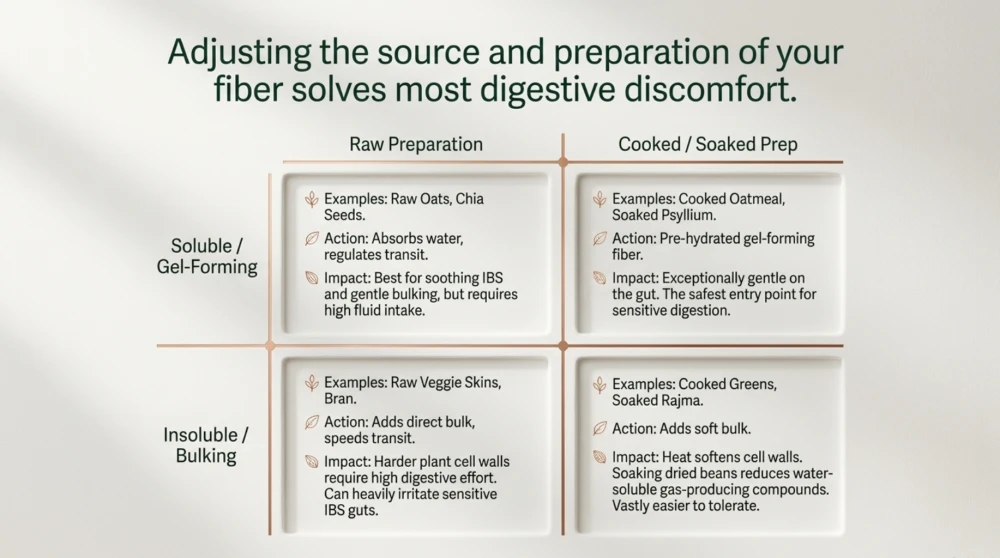
Some soluble fibres absorb water and form a gel-like material. Depending on the specific fibre, they may also be fermented by gut bacteria.
Sources include foods such as:
- Oats.
- Barley.
- Some fruits.
- Legumes.
- Psyllium.
Insoluble fibres tend to contribute more directly to stool bulk and intestinal transit. Whole grains, wheat bran, vegetable skins, and several plant foods provide varying amounts.
The Type of Fibre May Matter More Than Simply Eating More
When someone develops fibre and bloating, the solution should not automatically be “eat less fibre.”
Sometimes changing the source of fibre is more useful.
For example, someone with IBS may tolerate oats or psyllium better than a very large quantity of wheat bran or highly fermentable foods. Current BDA IBS guidance specifically mentions oats and linseeds as options that some people with bloating or constipation may find useful.
This is why dietary advice should focus on symptoms and tolerance rather than simply chasing the highest possible fibre number.
Reason 4: You Increased Fibre but Not Fluids
Increasing fibre while drinking very little fluid can create another problem.
Some types of fibre absorb water and increase stool bulk. Adequate fluid helps support normal stool consistency and passage through the bowel.
If someone dramatically increases bran, psyllium, chia seeds, flaxseeds, whole grains, and vegetables while fluid intake remains low, constipation and abdominal fullness may worsen rather than improve.
BDA guidance therefore recommends maintaining adequate fluid intake while increasing dietary fibre.
More Fibre Does Not Automatically Fix Constipation
Constipation has several possible causes.
Low fibre intake can contribute, but so can inadequate fluid intake, low physical activity, medications, pelvic-floor disorders, slow intestinal transit, IBS, and other medical conditions.
Simply adding more and more fibre may therefore fail to solve the problem and can sometimes worsen bloating.
Interestingly, recent evidence-based BDA guidance on chronic constipation found insufficient randomised-trial evidence to recommend an unspecified high-fibre diet as a universal treatment for chronic constipation, even though adequate fibre remains important for general health.
Reason 5: Your Portion Sizes Became Much Larger
Sometimes fibre and bloating are blamed on one ingredient when the actual issue is the total volume of food.
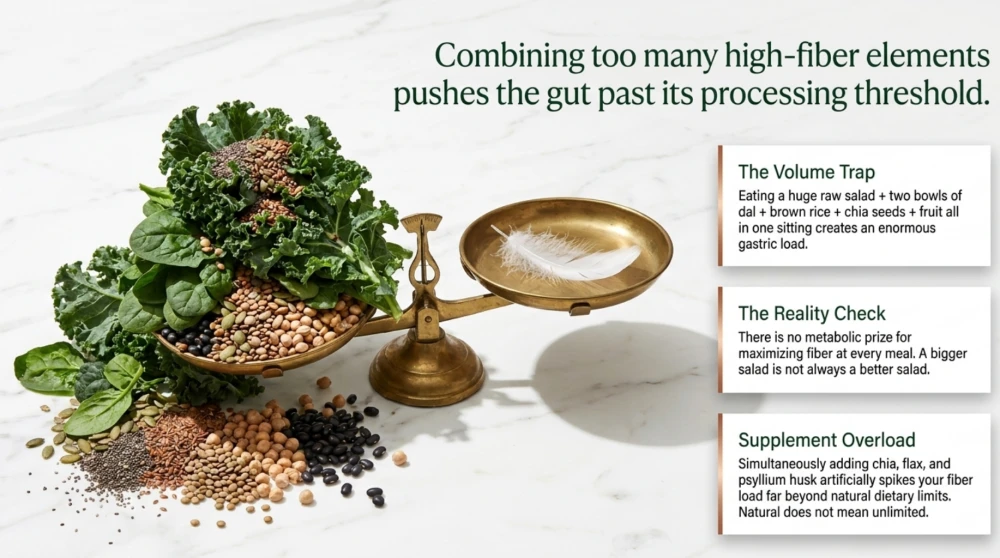
Healthy eating advice often encourages vegetables, fruit, whole grains, legumes, nuts, and seeds. These are valuable foods, but combining large amounts of all of them into one meal can create substantial gastric and intestinal volume.
Imagine a lunch containing:
- A huge raw salad.
- Two bowls of dal.
- Brown rice.
- Curd.
- Fruit immediately afterwards.
- A tablespoon each of chia and flaxseed.
Every individual component may fit within a healthy dietary pattern. But the combined fibre load and food volume may be far greater than the person is accustomed to.
A Bigger Salad Is Not Always a Better Salad
There is no metabolic prize for eating the largest possible bowl of raw vegetables.
If very large raw salads repeatedly produce discomfort, try smaller portions and include cooked vegetables as well.
Cooking changes the physical structure and texture of plant foods and may make some vegetables easier for certain people to tolerate.
The goal is to eat enough fibre for health while maintaining digestive comfort—not to maximise fibre at every meal.
Reason 6: You Added Too Many Seeds and Fibre Supplements
Chia seeds, flaxseeds, psyllium husk and other fibre supplements have become popular additions to weight-loss and “gut health” diets.
Used appropriately, some can be useful.
Problems arise when several are introduced simultaneously.
Someone may have chia seeds at breakfast, flaxseed powder in curd, psyllium at night, high-fibre bread during the day, and multiple servings of vegetables and legumes.
The total fibre intake can increase substantially without the person realising it.
Natural Does Not Mean Unlimited
Seeds and fibre supplements are not automatically better in larger quantities.
Begin with modest portions and increase according to tolerance. Psyllium and other bulking fibres also need to be taken with adequate fluid and according to product or clinical guidance.
If fibre and bloating began soon after adding several new “healthy” ingredients, simplify the diet temporarily and reintroduce them one at a time.
Reason 7: The Bloating May Not Actually Be Caused by Fibre
This is perhaps the most important reason not to diagnose yourself simply from a food diary.
Bloating is a symptom, not a disease.
It can occur with constipation, IBS, lactose intolerance, coeliac disease, functional dyspepsia, certain medications, and several other gastrointestinal conditions.
Someone may notice symptoms after switching to a healthier diet because the timing overlaps, while an underlying digestive problem is actually responsible.
Do Not Blame Every Digestive Symptom on Fibre
Suppose someone develops persistent bloating and simply removes vegetables, fruit, dal, and whole grains.
Symptoms may temporarily change, but an unnecessarily restrictive diet can develop while the actual problem remains unidentified.
Persistent bloating—particularly when accompanied by other symptoms—deserves appropriate evaluation rather than progressively eliminating more foods.
Seven Reasons for Fibre and Bloating at a Glance
- 1. Fibre intake increased too quickly for the digestive system to adjust comfortably.
- 2. Highly fermentable foods increased gas production.
- 3. FODMAP sensitivity or IBS made certain high-fibre foods harder to tolerate.
- 4. Fluid intake did not increase appropriately, contributing to constipation and fullness.
- 5. Meal volume and portion sizes became too large after switching to a “healthy” diet.
- 6. Too many seeds or fibre supplements were added simultaneously.
- 7. Another digestive condition may be responsible for the bloating rather than fibre itself.
The key message is that fibre and bloating occurring together does not mean fibre is bad for your gut. It often means the amount, type, speed of increase, or underlying digestive condition needs closer attention.
How to Increase Fibre Without Making Bloating Worse
If fibre and bloating started together after a major dietary change, the answer is usually not to abandon fibre completely. A better approach is to identify what changed, reduce the digestive load temporarily if necessary, and then increase fibre more gradually.
This matters because fibre-rich foods provide much more than bowel bulk. Whole grains, legumes, vegetables, fruits, nuts, and seeds can contribute to better cardiovascular health, glucose regulation, satiety, and overall diet quality.
The goal is therefore not the highest possible fibre intake. It is an appropriate amount that your digestive system can tolerate consistently.
Change One or Two Things at a Time
One common mistake is trying to transform the entire diet in a single day.
Breakfast suddenly contains oats, chia seeds, flaxseed, fruit, and nuts. Lunch becomes brown rice, rajma, and a huge salad. Fruit replaces every snack, and psyllium is added before bed.
If bloating develops, it becomes impossible to know which change contributed most.
Instead, introduce high-fibre foods progressively. This allows your gastrointestinal system time to adapt and makes it easier to identify foods or portions that consistently cause symptoms.
Should You Reduce Fibre When Bloating Becomes Severe?
Sometimes a temporary reduction is reasonable.
If someone has dramatically increased fibre and is experiencing uncomfortable abdominal distension, gas, and constipation, continuing to add more fibre simply because it is considered healthy may make matters worse.
Temporarily returning to a more comfortable level and then increasing fibre gradually may be more practical.
Reducing Fibre Temporarily Does Not Mean Avoiding It Forever
This distinction is important.
There is a difference between temporarily modifying fibre intake while symptoms settle and permanently removing vegetables, fruit, legumes, and whole grains without a clear reason.
Long-term unnecessary restriction can reduce dietary variety and nutritional quality.
When fibre and bloating remain a persistent problem despite sensible adjustments, the question should become whether a specific digestive condition is present rather than whether all fibre is harmful.
Raw Versus Cooked Vegetables: Which Is Better for Bloating?
Raw vegetables are not inherently healthier than cooked vegetables.
Cooking can change texture and soften plant cell walls, making certain vegetables easier to chew and tolerate. Some people who become uncomfortable after a large raw salad can comfortably eat a similar quantity of cooked vegetables.
Therefore, someone experiencing fibre and bloating does not need to force down enormous bowls of raw salad simply because raw food is perceived as healthier.
Try a Mixture of Raw and Cooked Vegetables
A practical Indian meal might contain a small portion of cucumber or another tolerated raw vegetable alongside cooked sabzi rather than an oversized plate of raw onion, cabbage, radish, cucumber, sprouts, and other vegetables.
Individual tolerance matters. Onion and garlic, for example, can be particularly troublesome for some people with IBS because of their fructan content.
If a particular vegetable repeatedly causes symptoms, portion size and preparation method should be reviewed before concluding that vegetables in general are the problem.
Why Dal, Rajma and Chole Can Cause Gas
Legumes are valuable sources of fibre, plant protein, minerals, and other nutrients. They are also highly fermentable.
Beans and pulses contain oligosaccharides that humans do not completely digest in the small intestine. When these carbohydrates reach the colon, gut bacteria ferment them and produce gas.
This is why someone who rarely eats legumes may notice substantial gas after suddenly eating a large bowl of rajma or chole.
Do You Need to Stop Dal Because of Fibre and Bloating?
Usually not.
Dal is an important source of plant protein and fibre in Indian diets. Eliminating every pulse can make vegetarian meal planning unnecessarily difficult.
Instead, consider the portion and variety.
A small bowl of a well-cooked dal may be better tolerated than a very large serving of rajma or chole. Individual responses vary considerably.
Soaking and Cooking Legumes Properly May Help
For dried beans such as rajma and chickpeas, soaking before cooking and discarding the soaking water may reduce some water-soluble gas-producing compounds. Thorough cooking also improves digestibility.
People who are not accustomed to legumes may benefit from beginning with smaller portions rather than eating a large serving several days in a row.
The digestive system may become more tolerant with regular gradual exposure.
Should You Avoid Sprouts if You Are Bloated?
Sprouts are often promoted as an essential health food, but there is no requirement to eat them if they consistently produce discomfort.
Some people tolerate cooked sprouts better than large quantities of raw sprouts. Others tolerate certain legumes better than others.
Again, the principle is simple: a nutritious food does not need to be forced into the diet in a form or quantity that repeatedly produces symptoms.
Fibre and Bloating From Chia Seeds
Chia seeds provide fibre and can be incorporated into a healthy diet, but they have become unnecessarily associated with the idea that everyone needs them for gut health or weight loss.
A large serving can add a considerable amount of fibre, especially when the rest of the diet is already fibre-rich.
If chia seeds were introduced at the same time as oats, fruit, salads, legumes, and other high-fibre foods, they may simply push the total fibre load beyond what is currently comfortable.
Start With a Small Portion
There is no need to begin with several tablespoons.
A smaller amount can be introduced and adjusted according to tolerance. Adequate fluid intake is also important because chia absorbs substantial amounts of water.
If symptoms began immediately after introducing chia, stopping it temporarily and observing the response is reasonable. This does not mean chia is unhealthy or that you are “intolerant” forever.
What About Flaxseed?
Flaxseed, also called linseed, provides fibre and alpha-linolenic acid, a plant-based omega-3 fatty acid.
Ground flaxseed is generally easier to incorporate into foods than whole seeds and is commonly added to curd, oats, or other meals.
But the same rule applies: more is not automatically better.
If someone is already consuming plenty of whole grains, vegetables, fruit, and legumes, adding large quantities of flaxseed may increase fibre and bloating without providing additional practical benefit.
Is Psyllium Good for Bloating and Constipation?
Psyllium, commonly known as isabgol in India, is a soluble, gel-forming fibre. It can be useful for constipation and can also help regulate stool consistency in some people with IBS.
Unlike some rapidly fermentable fibres, psyllium is generally less gas-producing and is often better tolerated.
Recent evidence-based dietary guidance for chronic constipation supports psyllium supplementation as one of the fibre interventions with useful clinical evidence.
More Isabgol Is Not Always Better
Taking a very large amount from the beginning can still cause fullness, bloating, or discomfort.
It is generally better to introduce psyllium gradually and take it with adequate fluid according to product instructions or professional advice.
Psyllium can also affect the absorption of some medicines if taken at the same time, so medication timing may need consideration.
Constipation Can Itself Cause Fibre and Bloating Problems
Sometimes people increase fibre because they are constipated, but the constipation itself is a major reason they feel bloated.
If stool moves slowly through the colon, additional fermentation and stool accumulation can increase abdominal fullness.
Adding large quantities of fibre without considering the type of constipation may therefore produce disappointing results.
Not Every Constipation Problem Is a Fibre Deficiency
Constipation can occur because of:
- Low fibre intake.
- Inadequate fluid intake.
- Low physical activity.
- Certain medicines.
- IBS with constipation.
- Slow-transit constipation.
- Pelvic-floor dysfunction.
- Hypothyroidism and other medical conditions.
If constipation persists despite sensible dietary measures, repeatedly increasing fibre may not be the correct next step.
IBS Changes the Fibre Conversation
Irritable bowel syndrome is characterised by recurrent abdominal pain associated with altered bowel habits. Bloating is extremely common in people with IBS.
The issue is not necessarily that the intestine produces enormous quantities of gas. Some patients also have increased sensitivity to normal intestinal distension and changes in how gas and intestinal contents move through the gastrointestinal tract.
As a result, fibre and bloating can become particularly complicated in IBS.
Soluble Fibre Is Often Better Tolerated in IBS
Guidelines commonly favour soluble fibre, particularly psyllium, over insoluble wheat bran for global IBS symptoms.
This is a good example of why advice to simply “eat more fibre” is incomplete.
The type of fibre matters.
A person with IBS who adds large quantities of wheat bran because of constipation may experience more bloating, whereas a gradual introduction of a more suitable soluble fibre may be better tolerated.
Should Everyone With Bloating Try a Low-FODMAP Diet?
No.
The low-FODMAP diet is an evidence-based dietary intervention for selected people with IBS, but it is frequently misunderstood as a general “healthy gut diet.”
It is not intended to be a permanently restrictive diet for everyone who experiences occasional gas.
A Low-FODMAP Diet Has Three Stages
A properly implemented low-FODMAP approach usually involves:
- A temporary restriction phase.
- Systematic reintroduction of FODMAP groups.
- Long-term personalisation based on individual tolerance.
The purpose is to identify which carbohydrates and portions actually trigger symptoms, then liberalise the diet as much as possible.
Remaining indefinitely on a highly restrictive version can unnecessarily reduce food variety and may adversely affect nutritional adequacy.

Do You Need to Stop Onion and Garlic?
Onion and garlic contain fructans and can produce substantial symptoms in some people with IBS.
But this does not mean everyone experiencing fibre and bloating needs to eliminate them.
If symptoms strongly suggest IBS and repeatedly occur after fructan-rich foods, a structured dietary assessment may be useful.
Randomly removing onion, garlic, gluten, dairy, fruit, legumes, and several vegetables simultaneously makes it difficult to identify the actual trigger and can leave the diet unnecessarily restricted.
Is Gluten Responsible for Bloating After Switching to Whole Grains?
Not necessarily.
People sometimes notice more bloating after replacing white bread with whole-wheat products and conclude that they have developed gluten intolerance.
But whole wheat contains substantially more fibre than refined wheat and also contains fructans, which are FODMAP carbohydrates.
For some people with IBS, fructans rather than gluten may contribute to symptoms.
Do Not Start a Gluten-Free Diet Before Testing for Coeliac Disease
This is particularly important when coeliac disease is a possibility.
Starting a strict gluten-free diet before appropriate testing can interfere with diagnostic investigations because coeliac serology and intestinal findings may improve after gluten is removed.
Persistent gastrointestinal symptoms, iron deficiency, chronic diarrhoea, unexplained weight loss, or a family history of coeliac disease deserve proper assessment rather than self-diagnosing gluten intolerance.
Can Probiotics Fix Fibre and Bloating?
Probiotics are frequently marketed for bloating, but they are not a universal solution.
Different probiotic products contain different strains and doses, and their effects cannot be assumed to be interchangeable.
Some people report improvement, some notice no difference, and others may initially experience more gas.
Do Not Use Probiotics to Compensate for an Uncomfortable Diet
If someone suddenly triples fibre intake and becomes severely bloated, adding a probiotic while continuing the same excessive fibre load may not address the real problem.
First review the diet, portions, bowel habits, medications, and symptoms.
A probiotic should not become a substitute for identifying why fibre and bloating developed in the first place.
Does Walking After Meals Help Bloating?
Gentle physical activity can support gastrointestinal motility and may help some people feel less heavy after meals.
A short walk after eating also has metabolic benefits, particularly for post-meal glucose regulation.
It is therefore a practical habit for many people, although it should not be presented as a treatment for every cause of chronic bloating.
Keep a Short Food and Symptom Record
If the cause of fibre and bloating is unclear, a short structured record can be more useful than relying on memory.
For one or two weeks, note:
- What you ate.
- Approximate portions.
- Meal timing.
- When bloating appeared.
- Bowel frequency and stool consistency.
- Any associated pain.
- Recent changes in fibre supplements.
The aim is not to become obsessed with every gram of food. It is to identify reproducible patterns.
Look for Patterns, Not One-Off Reactions
Feeling bloated once after eating rajma does not prove permanent rajma intolerance.
Perhaps the serving was unusually large. Perhaps the meal also contained onion, garlic, a large salad, dessert, and a carbonated drink. Perhaps you were already constipated.
Repeated patterns are much more informative than blaming the last food eaten.
A Practical Way to Rebuild Fibre Intake
If bloating started after an aggressive increase in fibre, simplify the process.
Begin with portions of vegetables, fruit, grains, and legumes that you know are reasonably well tolerated. Maintain appropriate fluid intake and regular physical activity.
Then gradually add or increase one fibre source at a time.
If a particular food repeatedly causes symptoms, reduce the portion and test tolerance rather than automatically eliminating the entire food group.
This approach can help separate a genuine food-related trigger from the simple effect of increasing too much fibre too quickly.
The Goal Is Tolerance, Not the Highest Fibre Number
Nutrition is not a competition.
Someone eating 25 or 30 grams of fibre comfortably may have a better long-term dietary pattern than someone forcing down much larger quantities while experiencing constant abdominal discomfort.
The appropriate intake varies according to age, sex, total energy intake, gastrointestinal health, and individual tolerance.
When fibre and bloating occur together, the best strategy is usually to personalise the type, amount, and rate of increase rather than abandoning fibre or continuously adding more.
How Much Fibre Do Adults Actually Need?
One reason fibre and bloating become a problem is that people often move from eating very little fibre to trying to eat as much as possible. In reality, fibre targets are guidelines, not a competition.
For many adults, a daily intake in the range of roughly 25 to 30 grams is a practical target, although requirements vary according to age, sex, total energy intake, health status, and national guidance.
The important point is not to reach a target overnight. Someone consuming only 10 or 12 grams per day may tolerate a gradual increase much better than an immediate jump to 30 or 35 grams.
Increase Fibre Gradually Rather Than Chasing a Number
If fibre and bloating appear after a sudden dietary change, reduce the intensity of that change and rebuild slowly.
For example, improve breakfast first, then increase vegetables, then legumes, then seeds or whole grains. This staggered approach makes adaptation easier and helps identify which foods are contributing most to symptoms.
Comfortable consistency is more useful than an aggressive fibre target that leads to daily abdominal discomfort.
A Practical Indian Day With Fibre Without Excessive Bloating
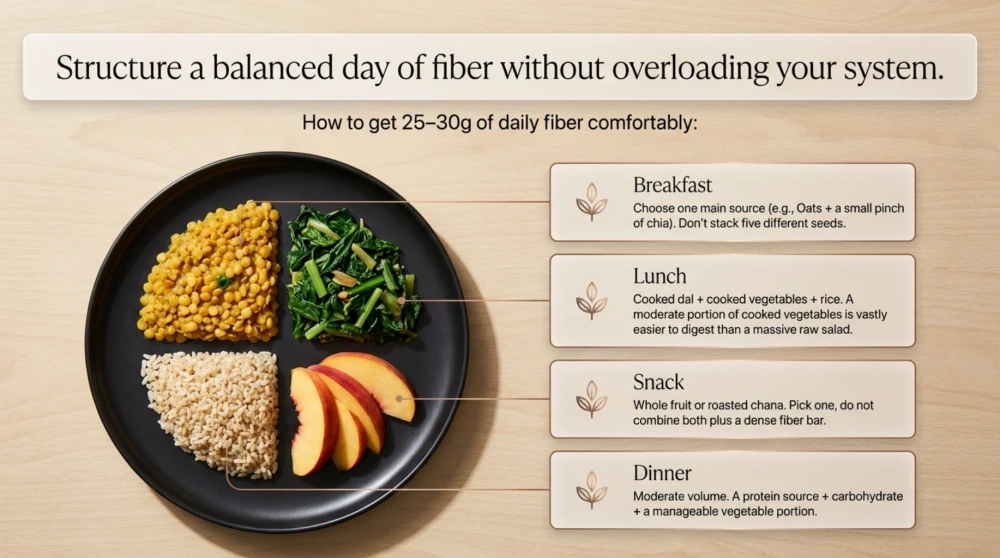
A balanced Indian diet can provide adequate fibre without requiring enormous salads, multiple seed powders, or several bowls of legumes at every meal.
The following example is simply a practical template and should be adjusted for appetite, medical conditions, calorie needs, diabetes control, and individual tolerance.
Breakfast
Choose one fibre-rich base rather than stacking several at once. Oats with curd and fruit, vegetable poha, or moong dal chilla with vegetables can all work well.
If you are new to chia or flaxseed, begin with a small amount rather than adding large portions of both simultaneously.
Lunch
A moderate serving of dal, one or two cooked vegetables, curd, and an appropriate portion of rice or roti can provide substantial fibre without excessive volume.
Someone experiencing fibre and bloating may tolerate cooked vegetables better than a very large raw salad.
Evening Snack
Whole fruit, a small portion of roasted chana, curd, or another simple snack may be preferable to combining fruit, nuts, seeds, sprouts, and a high-fibre bar all at once.
Dinner
Keep the evening meal balanced and moderate in volume. A protein source, cooked vegetables, and an appropriate carbohydrate portion may be easier to tolerate than a very large bowl of raw salad followed by beans and fruit.
Hydration Is Part of the Fibre Conversation
Increasing fibre while drinking very little fluid can worsen constipation and abdominal fullness in some people.
Regular hydration supports stool consistency and helps fibre function appropriately within the bowel.
However, there is no need to force extreme quantities of water simply because fibre intake has increased.
Drink Regularly Through the Day
Spacing fluids across the day is generally more comfortable than consuming very large volumes at once.
People with heart failure, advanced kidney disease, or medically prescribed fluid restrictions should follow individual medical advice rather than increasing fluid intake without guidance.
Can Fibre Help With Weight Management?
Yes, higher-fibre foods can support weight management because they often provide more volume and satiety for fewer calories than highly processed foods.
Vegetables, fruit, legumes, and whole grains may help people stay fuller and make portion control easier.
But excessive fibre is not a weight-loss strategy by itself.
If someone develops constant fibre and bloating from enormous salads, seed-heavy meals, and excessive supplements, the diet may become difficult to maintain.
Satiety Matters More Than Maximum Fibre
A meal should help you feel comfortably satisfied, not physically overfilled.
For sustainable weight management, fibre works best alongside adequate protein, appropriate portions, regular physical activity, sleep, and overall diet quality.
Can Fibre Improve Blood Sugar Control?
Fibre-rich foods can help moderate the glucose response to meals, particularly when they replace refined carbohydrates and are combined with protein and healthy fats.
Soluble and viscous fibres may slow carbohydrate absorption, while whole grains, legumes, vegetables, and whole fruit generally provide a more favourable metabolic profile than refined foods.
For people with prediabetes or diabetes, this can be useful.
However, a person should not tolerate severe fibre and bloating simply because they have been told that more fibre is always better for blood sugar. The type and amount should still be personalised.
When Bloating Needs Medical Evaluation
Occasional bloating after a large meal or sudden increase in fibre is common. Persistent bloating is different.
Medical assessment becomes more important when bloating is recurrent, progressively worsening, or associated with other symptoms.
Red Flags With Fibre and Bloating
Seek medical evaluation if bloating occurs with:
- Unexplained weight loss.
- Blood in the stool.
- Persistent vomiting.
- Severe or progressive abdominal pain.
- Persistent diarrhoea.
- New constipation that does not improve.
- Iron deficiency or anaemia.
- Fever.
- Loss of appetite.
- Symptoms that regularly wake you at night.
These features do not automatically indicate a serious condition, but they should not be managed simply by eliminating more and more foods.
When Fibre and Bloating May Suggest IBS
IBS becomes more likely when bloating occurs together with recurrent abdominal pain and altered bowel habits, such as constipation, diarrhoea, or both.
People with IBS often respond differently to specific fibres and fermentable carbohydrates.
Some tolerate psyllium well but become uncomfortable with wheat bran. Others react strongly to onion, garlic, beans, or certain fruits.
Personalisation Is More Important Than a Generic High-Fibre Diet
Someone with IBS may still benefit from fibre, but the type, portion, and fermentability matter.
This is why structured dietary guidance is often more useful than simply telling someone with chronic fibre and bloating to “eat more roughage.”
Common Myths About Fibre and Bloating
Myth 1: More Fibre Is Always Better
No. Fibre is beneficial, but more is not automatically better. Tolerance, bowel function, and overall diet quality matter.
Myth 2: Bloating Means Fibre Is Bad for You
Not necessarily. Temporary bloating may simply reflect a rapid increase in fermentable material reaching the colon.
Myth 3: Raw Vegetables Are Always Healthier Than Cooked Vegetables
No. Both can be nutritious. Cooked vegetables may be easier to tolerate for some people and can still provide valuable fibre and micronutrients.
Myth 4: Everyone With Bloating Should Follow a Low-FODMAP Diet
No. A low-FODMAP diet is mainly used for selected people with IBS and should generally include structured reintroduction rather than permanent restriction.
Myth 5: Isabgol Fixes Every Constipation Problem
Psyllium can be very useful, but constipation can have multiple causes. It is not a universal solution for slow-transit problems, pelvic-floor dysfunction, medication-related constipation, or every gastrointestinal condition.
Myth 6: Probiotics Will Automatically Fix Bloating
No. Probiotic effects vary by strain and individual response, and they do not replace proper dietary or medical assessment.
Myth 7: If One High-Fibre Food Causes Symptoms, You Should Avoid the Whole Food Group
Usually not. Portion size, preparation, fermentability, and individual tolerance can vary widely between foods within the same group.
What Should You Do if Fibre and Bloating Continue?
If symptoms persist despite reducing portions, increasing fibre more gradually, improving hydration, and adjusting the types of fibre you eat, a more structured assessment may be useful.
Review the timing of symptoms, bowel pattern, medications, lactose tolerance, menstrual factors, recent dietary changes, and possible IBS features.
Depending on the clinical picture, a doctor may consider evaluation for conditions such as coeliac disease, constipation disorders, lactose intolerance, or other gastrointestinal problems.
Do Not Keep Eliminating Foods Without a Plan
One of the biggest risks of chronic bloating is the gradual development of an unnecessarily restricted diet.
A person may first remove beans, then dairy, then gluten, then fruit, then onion and garlic, until very little remains.
This can reduce nutritional adequacy without necessarily solving the underlying problem.
When fibre and bloating become persistent, systematic evaluation is usually more useful than repeated self-experimentation.
Key Takeaways About Fibre and Bloating
- Fibre and bloating can occur together when fibre intake increases too quickly or when highly fermentable foods are introduced in large amounts.
- The type of fibre matters as much as the total amount.
- Soluble fibres such as psyllium may be better tolerated than some insoluble or highly fermentable fibres in certain people.
- Large portions of rajma, chole, salads, seeds, and fibre supplements introduced together can create a substantial digestive load.
- Adequate hydration supports fibre intake, but excessive water is not necessary.
- People with IBS may need individualised fibre and FODMAP guidance rather than a generic high-fibre diet.
- A low-FODMAP diet should not become a permanent restrictive diet without appropriate reintroduction.
- Persistent bloating with weight loss, bleeding, severe pain, anaemia, vomiting, or other red flags requires medical evaluation.
- The goal is not maximum fibre. It is a fibre intake that supports bowel, metabolic, and cardiovascular health while remaining comfortable and sustainable.
References
- British Dietetic Association. Fibre: Food Fact Sheet. Updated guidance accessed 2026.
- British Dietetic Association. Evidence-Based Dietary Guidelines for Chronic Constipation in Adults. 2024–2025.
- British Dietetic Association. Irritable Bowel Syndrome and Diet. Updated guidance accessed 2026.
- O'Grady J, et al. Dietary Fibre in Gastrointestinal Health and Disease: Current Concepts and Clinical Applications. 2024.
- American College of Gastroenterology. Clinical Guidance on Irritable Bowel Syndrome and Dietary Management. Current guidance accessed 2026.
Written by Dr. Pankaj Kumar, General & Lifestyle Physician, Dwarka, New Delhi