

















- 23rd September 2026
Table of Contents
- Should Blood Pressure Be the Same in Both Arms?
- Which Number Matters More: Systolic or Diastolic?
- How Much Difference Between Arms Is Normal?
- Why Does the 15 mmHg Difference Matter?
- Why Should You Use the Arm With the Higher Blood Pressure?
- Why Is My Blood Pressure Different in Each Arm?
- 1. You Measured the Arms at Different Times
- 2. Your Arm Was Not at Heart Level
- 3. The Cuff Size May Be Wrong
- 4. You Were Talking During One Measurement
- 5. You Had Not Rested Before the First Reading
- 6. Your Legs Were Crossed or Your Back Was Unsupported
- 7. The Cuff Was Placed Over Clothing
- 8. The Home Blood Pressure Monitor May Be Inaccurate
- How Should You Correctly Compare Blood Pressure in Both Arms?
- Should You Measure Both Arms Every Day?
- Does It Matter Which Arm Is Higher?
- Can Anxiety Cause Different Blood Pressure in Each Arm?
- When Can a Persistent Difference Suggest a Circulation Problem?
- What Is Subclavian Artery Stenosis?
- Does an Inter-Arm Difference Mean You Have Peripheral Artery Disease?
- Why a Persistent Difference Can Be a Cardiovascular Risk Marker
- What Should You Do if One Arm Is Always 15–20 mmHg Higher?
- When Is the Difference More Concerning?
- When Is Different Blood Pressure in Each Arm an Emergency?
- What Causes a True Blood Pressure Difference Between the Arms?
- Understanding the Arteries Supplying Your Arms
- What Is Subclavian Artery Stenosis?
- What Symptoms Can Subclavian Artery Disease Cause?
- Why Do Smoking, Diabetes and Cholesterol Matter?
- Can Young People Have Different Blood Pressure in Each Arm?
- What Is Subclavian Steal Syndrome?
- What Symptoms Can Occur With Subclavian Steal?
- Does Arm Exercise Make the Difference More Obvious?
- Can the Pulse Be Different Too?
- What Is a Supraclavicular Bruit?
- Can Both Subclavian Arteries Be Narrowed?
- How Does a Doctor Evaluate a Persistent Inter-Arm Difference?
- When Is Doppler Ultrasound Used?
- When Might CT Angiography Be Considered?
- Sequential Versus Simultaneous Blood Pressure Measurement
- Can You Improve Sequential Measurement at Home?
- What if One Arm Shows Hypertension and the Other Does Not?
- Could Using the Lower Arm Make Hypertension Look Controlled?
- Should the Higher Arm Be Used for Home BP Monitoring?
- How Should You Monitor Blood Pressure at Home?
- What if the Difference Changes Sides?
- What if the Difference Appears Only Occasionally?
- Does a 10 mmHg Difference Matter?
- Can an Inter-Arm Difference Predict Heart Attack or Stroke?
- Should You Take Aspirin Because Your Arms Have Different BP?
- Should You Start a Cholesterol Medicine Because of the Difference?
- What if Both Arms Have High Blood Pressure?
- What if Both Arms Are Normal but 15 mmHg Apart?
- What if You Have Diabetes?
- What if You Smoke?
- Can Weight Training Cause Different BP Between Arms?
- What About Previous Breast Surgery or Lymph Node Surgery?
- Can Dialysis Access Affect Which Arm Is Used?
- A Practical Decision Pathway
- When Is Different Blood Pressure in Each Arm an Emergency?
- Can Aortic Dissection Cause Different Blood Pressure in the Arms?
- Do Not Repeatedly Check Your BP if You Have Emergency Symptoms
- Can Thoracic Outlet Problems Cause an Arm BP Difference?
- Can Inflammation of the Arteries Cause Different BP in Each Arm?
- What About Previous Arterial Surgery?
- When Should You Make a Routine Doctor's Appointment?
- What Will Your Doctor Usually Do First?
- Do You Automatically Need a Doppler Test?
- A Step-by-Step Home Protocol for Comparing Both Arms
- Step 1: Use the Right Equipment
- Step 2: Prepare Properly
- Step 3: Rest
- Step 4: Position Yourself Correctly
- Step 5: Support the Arm
- Step 6: Remain Silent
- Step 7: Compare Both Arms
- Step 8: Repeat Rather Than React
- Step 9: Identify the Consistently Higher Arm
- Step 10: Record the Arm Used
- How Often Should You Compare Both Arms?
- Should You Use the Higher Arm Even if the Difference Is Only 5 mmHg?
- What if the Higher Arm Shows 140 but the Lower Arm Shows 125?
- What if the Lower Arm Is the Dominant Arm?
- Does Sleeping on One Side Cause a Persistent BP Difference?
- Can Cervical Spondylosis Cause Different Blood Pressure in Each Arm?
- Can Stress Cause One Arm to Have Higher Blood Pressure?
- Does a Different Pulse Rate Between Arms Matter?
- Special Situations Where Routine Advice May Need Modification
- Common Myths About Different Blood Pressure in Each Arm
- Myth 1: Both Arms Must Always Have Exactly the Same BP
- Myth 2: A 10 mmHg Difference Means an Artery Is Blocked
- Myth 3: The Arm With Higher BP Contains the Blockage
- Myth 4: You Should Always Measure BP in the Left Arm Because It Is Closer to the Heart
- Myth 5: You Should Average the Right- and Left-Arm Readings
- Myth 6: A Large Difference Always Means Aortic Dissection
- Myth 7: If Both Arms Are Below 140/90, the Difference Does Not Matter
- Myth 8: You Should Keep Checking Both Arms Every Day
- Frequently Asked Questions
- Is a 5 mmHg Difference Between Arms Normal?
- Is a 10 mmHg Difference Dangerous?
- What About a 20 mmHg Difference?
- Which Arm Should I Use for BP?
- Should I Measure Both Arms at the Same Time?
- Can Different BP in Each Arm Cause a Stroke?
- Can I Check This With a Smartwatch?
- Key Takeaways
- References
Different Blood Pressure in Each Arm: When Should You Be Concerned?
You check your blood pressure in the right arm and get 138/84 mmHg.
A few minutes later, you check the left arm and it reads 126/80 mmHg.
Immediately, a question comes to mind:
Why is my blood pressure different in each arm?
This is a surprisingly common observation.
A small difference between arms does not automatically mean that something is wrong. Blood pressure naturally fluctuates from minute to minute, and differences in measurement technique can easily produce slightly different readings.
However, a persistent blood pressure difference between arms deserves attention because, in some people, it may provide a clue to underlying vascular disease.
The important word is persistent.
One isolated difference between the right and left arm is very different from repeatedly finding a substantial difference under properly standardised measurement conditions.
Should Blood Pressure Be the Same in Both Arms?
Not necessarily.
The human circulatory system is not perfectly symmetrical, and blood pressure measurements themselves have normal biological and technical variability.
A small difference in systolic blood pressure between the arms is therefore common.
The first reading may also be higher simply because you were anxious, had just sat down, were talking, or had not yet rested adequately.
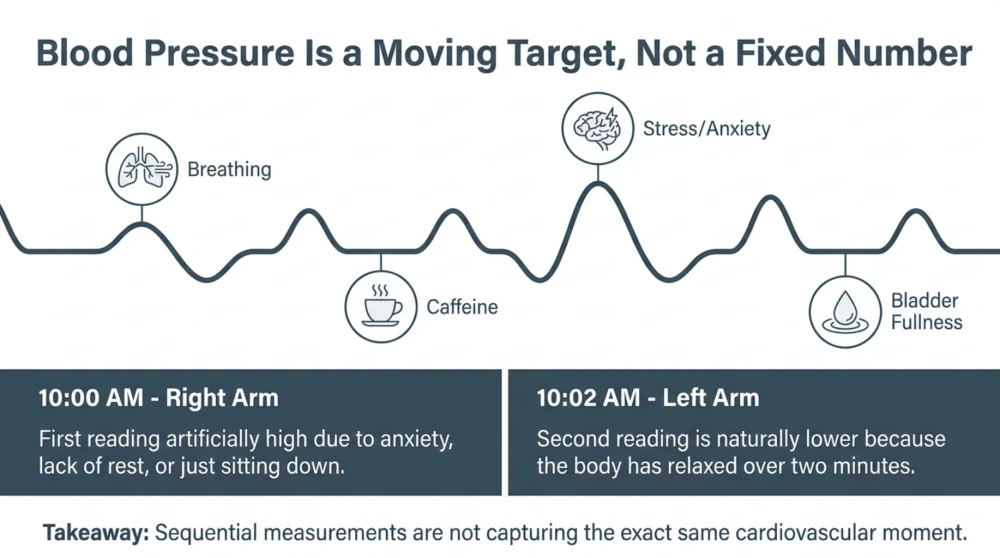
Blood Pressure Is Not a Fixed Number
Your blood pressure changes continuously.
It responds to breathing, movement, stress, temperature, pain, caffeine, exercise, bladder fullness, medication and even the position of your arm during measurement.
So if you measure the right arm first and the left arm two minutes later, you are not measuring exactly the same cardiovascular moment.
This is one reason a single inter-arm difference should not immediately be interpreted as disease.
Which Number Matters More: Systolic or Diastolic?
When doctors discuss an inter-arm blood pressure difference, most of the clinical evidence focuses on the difference in systolic blood pressure—the upper number.
For example:
Right arm: 142/82 mmHg
Left arm: 126/80 mmHg
The systolic inter-arm difference is 16 mmHg.
The diastolic difference is only 2 mmHg.
A persistent systolic difference of this magnitude is more clinically relevant than a small difference in the lower number.
How Much Difference Between Arms Is Normal?
There is no single number that separates every normal person from every person with vascular disease.
Small differences are common, particularly when the arms are measured one after the other rather than simultaneously.
As the difference becomes larger and remains reproducible on repeated measurements, its clinical significance increases.
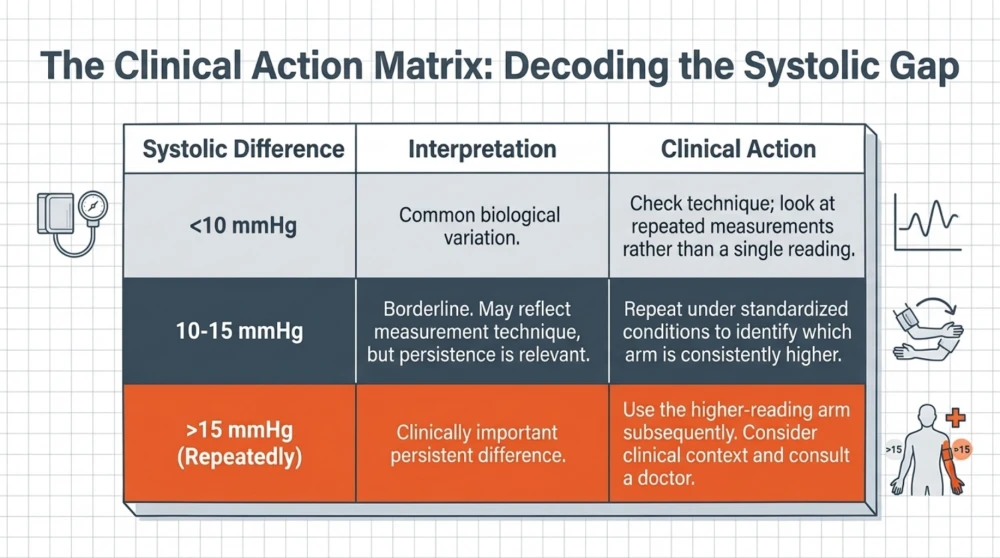
A Practical Way to Think About the Difference
| Systolic Difference Between Arms | Practical Interpretation | What to Do |
|---|---|---|
| Less than 10 mmHg | A small difference is common | Check technique and look at repeated measurements rather than one reading |
| Around 10–15 mmHg | May still reflect measurement or biological variation, but persistence becomes more relevant | Repeat under standardised conditions and identify which arm is consistently higher |
| More than 15 mmHg repeatedly | Clinically important persistent inter-arm difference | Use the higher-reading arm subsequently and consider the clinical context and vascular assessment |
| Large sudden difference with concerning symptoms | Potentially different clinical situation | Seek urgent medical assessment when associated with acute chest, back, neurological or limb symptoms |
These ranges are practical guides rather than rigid diagnostic boundaries.
Why Does the 15 mmHg Difference Matter?
Current NICE hypertension guidance recommends measuring blood pressure in both arms when assessing a patient.
If the difference between arms is greater than 15 mmHg, the measurements should be repeated.
If the difference remains greater than 15 mmHg on repeat measurement, future blood pressure measurements should be taken from the arm with the higher reading.
This Does Not Mean a 16 mmHg Difference Automatically Means Blocked Arteries
A threshold used to guide clinical measurement is not the same thing as a diagnosis.
A persistent difference tells us that the finding should not simply be ignored.
The patient's age, cardiovascular risk factors, symptoms and examination determine whether further vascular assessment is appropriate.
Why Should You Use the Arm With the Higher Blood Pressure?
This has an important practical consequence.
Imagine your right-arm blood pressure repeatedly averages 142/86 mmHg while your left arm averages 128/82 mmHg.
If you always use the left arm, you may conclude that your blood pressure is satisfactory.
But the higher arm may reveal clinically relevant hypertension.
Using the lower-reading arm can therefore lead to underestimation of blood pressure and potentially affect diagnosis and treatment decisions.
The Higher Arm Should Usually Become the Reference Arm
Once a consistent difference has been established, routine home and clinic monitoring is generally performed using the higher-reading arm.
This also makes follow-up more consistent.
Why Is My Blood Pressure Different in Each Arm?
There are two broad possibilities.
The first is that there is no true sustained difference at all—the apparent difference is being created by normal blood pressure variability or measurement technique.
The second is that there really is a persistent physiological difference in pressure between the two arms.
The first explanation is extremely important because home blood pressure measurement is more technically sensitive than many people realise.
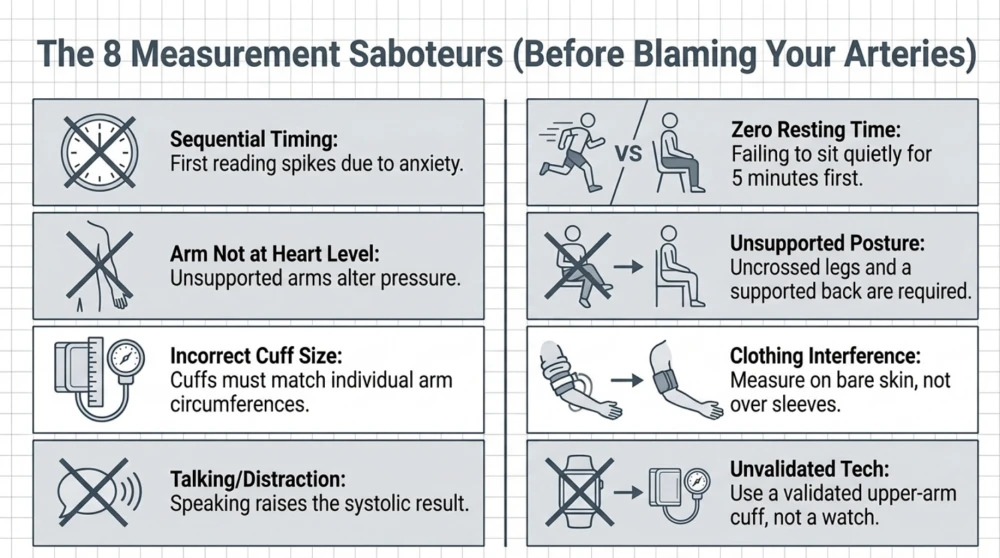
1. You Measured the Arms at Different Times
Most people measure one arm, remove the cuff, move it to the opposite arm and measure again.
Several minutes may pass between those readings.
During that time, blood pressure can change naturally.
The First Reading Is Often Different
The first measurement may be higher because the person has only just sat down or is still slightly anxious about the result.
By the time the opposite arm is measured, they may be more relaxed.
This can create an apparent arm difference even though the arm itself is not responsible.
2. Your Arm Was Not at Heart Level
Arm position can substantially affect a blood pressure reading.
The arm should be supported approximately at heart level.
If one arm is hanging down while the other is properly supported, the comparison is unreliable.
This sounds like a small technical detail, but measurement errors of this kind can be clinically meaningful.
3. The Cuff Size May Be Wrong
The cuff needs to fit the circumference of the upper arm appropriately.
A cuff that is too small can produce an inaccurately high reading, while an incorrectly fitted cuff can make measurements unreliable.
Arm Circumference May Differ
In some people, particularly those with substantial muscular asymmetry, previous surgery, swelling or lymphoedema, the two arms may not have identical circumference.
The appropriate cuff size should be used rather than assuming that one cuff automatically fits both arms correctly.
4. You Were Talking During One Measurement
Talking during blood pressure measurement can raise the reading.
So can checking your phone, answering questions or actively engaging in conversation.
If you talked during the right-arm measurement but remained silent during the left-arm measurement, the resulting difference may have nothing to do with circulation to either arm.
5. You Had Not Rested Before the First Reading
Ideally, you should sit quietly for at least five minutes before measuring blood pressure.
If the first arm is checked immediately after walking into the room and the second arm is checked several minutes later, the first reading may naturally be higher.
6. Your Legs Were Crossed or Your Back Was Unsupported
Posture matters.
Sit with your back supported, feet flat on the floor and legs uncrossed.
The arm should be supported rather than held in the air by muscle effort.
Consistency is essential when comparing one arm with the other.
7. The Cuff Was Placed Over Clothing
Blood pressure should generally be measured on a bare upper arm.
Rolling a tight sleeve upward can also compress the arm and interfere with the measurement.
8. The Home Blood Pressure Monitor May Be Inaccurate
Not every device produces equally reliable measurements.
Validated upper-arm monitors are generally preferred for routine home blood pressure monitoring.
The cuff should also be appropriate for your arm circumference.
Smartwatch Blood Pressure Is Not the Same as Standard Cuff Measurement
Cuffless devices are increasingly marketed for estimating blood pressure, but they should not currently replace properly validated cuff-based measurements for diagnosing or managing hypertension.
How Should You Correctly Compare Blood Pressure in Both Arms?
If you notice different blood pressure in each arm, do not repeatedly alternate arms every 30 seconds while becoming progressively more anxious about the numbers.
Instead, standardise the measurement.
A Better Home Measurement Method
- Avoid exercise, smoking and caffeinated drinks for approximately 30 minutes beforehand.
- Empty your bladder if necessary.
- Sit quietly for at least five minutes.
- Keep your back supported.
- Keep both feet flat on the floor.
- Do not cross your legs.
- Place the cuff on bare skin.
- Support the arm at heart level.
- Remain silent during the measurement.
- Use the correct cuff size.
- Measure both arms initially.
- If a meaningful difference appears, repeat the measurements rather than drawing a conclusion from one pair of readings.
Should You Measure Both Arms Every Day?
Usually, no.
The purpose of checking both arms initially is to determine whether a consistent inter-arm difference exists and identify which arm should be used for routine monitoring.
Once the higher-reading arm has been established, routine home blood pressure monitoring can generally be performed on that arm.
Consistency Makes Your Blood Pressure Log More Useful
Alternating randomly between arms can introduce unnecessary variation into your readings.
If your right arm is consistently higher, use the right arm for subsequent monitoring unless your clinician advises otherwise.
Does It Matter Which Arm Is Higher?
Either arm can produce the higher reading.
The clinically important issue is generally the magnitude and persistence of the difference rather than simply whether the right or left arm is higher.
There is no general rule that the right arm should always have higher blood pressure.
Can Anxiety Cause Different Blood Pressure in Each Arm?
Anxiety can certainly alter blood pressure, but it does not selectively raise pressure in one arm.
Instead, anxiety can create an apparent inter-arm difference when the arms are measured sequentially.
For example, the first measurement may be taken while you are worried and the second after you have begun to relax.
When Can a Persistent Difference Suggest a Circulation Problem?
If a substantial difference persists despite correct repeated measurements, vascular causes become more important to consider.
One possible explanation is narrowing of an artery supplying one arm.
For example, stenosis involving the subclavian or innominate artery can reduce pressure measured downstream in the affected arm.
The Lower Arm May Be the Abnormal Arm
This is an important concept.
People sometimes worry that the arm with the higher blood pressure must contain the blockage.
With significant arterial narrowing supplying an arm, the opposite can occur: the affected arm may show the lower pressure because pressure falls across the narrowed vessel.
What Is Subclavian Artery Stenosis?
The subclavian arteries supply blood to the arms.
Atherosclerosis can narrow these arteries, particularly in people with other cardiovascular risk factors.
If narrowing is substantial, blood pressure measured in that arm may be lower than in the opposite arm.
There May Be No Arm Symptoms
Some people with subclavian artery disease are asymptomatic.
Others may develop arm fatigue, discomfort or weakness during exertion because the affected arm is receiving reduced blood flow.
The clinical significance depends on the degree of narrowing, symptoms and the person's overall vascular health.
Does an Inter-Arm Difference Mean You Have Peripheral Artery Disease?
Not automatically.
A persistent difference can be associated with vascular disease, but it is not by itself sufficient to diagnose peripheral arterial disease or subclavian stenosis.
Further assessment may involve examination of pulses and vascular risk factors and, when clinically indicated, non-invasive vascular testing.
Why a Persistent Difference Can Be a Cardiovascular Risk Marker
Research has found associations between larger inter-arm systolic blood pressure differences and cardiovascular outcomes.
This does not mean the difference itself necessarily causes heart attack or stroke.
Instead, a persistent difference may sometimes act as a marker of underlying vascular disease or greater overall cardiovascular risk.
Association Does Not Mean Every Difference Is Dangerous
A person who gets 128 mmHg in one arm and 136 mmHg in the other on a single home measurement should not conclude that they have blocked arteries.
The first step is accurate repeat measurement.
The finding becomes more relevant when the difference is reproducible.
What Should You Do if One Arm Is Always 15–20 mmHg Higher?
If properly performed repeated measurements continue to show a systolic difference above approximately 15 mmHg, mention it to your doctor.
For routine blood pressure monitoring, the higher-reading arm should generally be used.
The doctor can then decide whether your age, symptoms, cardiovascular risk factors and examination suggest that additional vascular assessment is necessary.
When Is the Difference More Concerning?
A persistent inter-arm difference deserves greater attention when it occurs together with:
- Arm pain or unusual fatigue during use.
- Weak or noticeably different pulses between arms.
- Coldness or colour change affecting one hand or arm.
- Known peripheral arterial disease.
- Smoking history.
- Diabetes.
- High cholesterol.
- Established coronary or cerebrovascular disease.
- A substantial and reproducible difference in systolic pressure.
These findings do not establish a diagnosis, but they increase the importance of clinical assessment.
When Is Different Blood Pressure in Each Arm an Emergency?
Most inter-arm blood pressure differences are not emergencies.
But a suddenly appearing major difference accompanied by acute symptoms is a different situation.
Urgent assessment is appropriate if a large new difference occurs together with severe chest or upper-back pain, fainting, new neurological symptoms, severe shortness of breath or signs that one limb has suddenly lost adequate circulation.
Aortic Disease Is Rare but Important
Acute aortic syndromes, including aortic dissection, can sometimes produce pulse or blood pressure differences when arterial branches are affected.
However, checking different pressures in your two arms at home without acute symptoms does not mean that you have an aortic dissection.
Aortic dissection is considered in the context of an acute clinical syndrome—not from a small isolated home BP difference.
What Causes a True Blood Pressure Difference Between the Arms?
Once incorrect cuff size, poor positioning, inadequate rest and ordinary blood pressure variability have been considered, a persistent difference between the arms raises another question:
Could blood flow to one arm actually be different?
It can.
The arteries carrying blood from the heart eventually divide into vessels supplying the right and left upper limbs. If one of these arteries becomes significantly narrowed, pressure measured beyond that narrowing may be lower.
This is why a persistent blood pressure difference between arms can occasionally provide an early clue to vascular disease.
Understanding the Arteries Supplying Your Arms
Blood leaves the heart through the aorta, the body's largest artery.
Branches arising from the aortic arch eventually supply the head, neck and upper limbs.
The subclavian arteries are major vessels supplying the arms.
If blood flow through one of these vessels becomes significantly restricted, the blood pressure recorded in that arm may be lower than pressure measured in the opposite arm.
The Arm With the Lower Pressure May Be the One With Reduced Blood Flow
This concept is worth repeating because it initially seems counterintuitive.
Suppose the right arm repeatedly measures 148/84 mmHg while the left arm measures 126/82 mmHg.
People sometimes assume that the higher-pressure right arm must contain the blockage.
But if significant narrowing is present in an artery supplying the left arm, pressure may fall across that narrowed segment. The left arm may therefore be the lower-reading arm.
What Is Subclavian Artery Stenosis?
Subclavian artery stenosis means narrowing of one of the major arteries supplying an upper limb.
Atherosclerosis is an important cause, particularly in older adults and people with established cardiovascular risk factors.
The narrowing may develop gradually and produce no obvious symptoms for years.
Sometimes the BP Difference Is the First Clue
A person may have no arm pain and no obvious circulation problem.
During routine blood pressure measurement, however, one arm repeatedly shows a substantially lower systolic pressure.
Examination may then reveal a weaker pulse or other vascular findings on the same side.
This does not prove subclavian stenosis, but it may provide a reason for further evaluation.

What Symptoms Can Subclavian Artery Disease Cause?
Many people remain asymptomatic, particularly when narrowing is moderate and develops gradually.
When symptoms occur, they may become more noticeable when the affected arm is being used.
Possible manifestations include:
- Arm fatigue during activity.
- Arm aching or discomfort with exertion.
- Weakness in one arm.
- A weaker pulse on one side.
- A consistently lower blood pressure in the affected arm.
- Coldness or colour changes in more advanced impairment of circulation.
These symptoms are not specific to arterial disease. Musculoskeletal and neurological problems are far more common explanations for many arm symptoms.
Why Do Smoking, Diabetes and Cholesterol Matter?
Atherosclerosis is a systemic process.
It does not exclusively affect coronary arteries supplying the heart.
The same disease process can affect arteries supplying the brain, kidneys, legs and upper limbs.
Therefore, a persistent different blood pressure in each arm becomes more clinically relevant when the patient also has substantial vascular risk factors.
Important Risk Factors Include
- Smoking or a significant previous smoking history.
- Diabetes.
- Hypertension.
- Elevated LDL cholesterol.
- Increasing age.
- Known coronary artery disease.
- Previous stroke or transient ischaemic attack.
- Known peripheral arterial disease.
- Chronic kidney disease.
The presence of these factors does not mean that an inter-arm difference is caused by arterial stenosis. It changes the clinical probability and therefore influences whether further assessment is worthwhile.
Can Young People Have Different Blood Pressure in Each Arm?
Yes.
A small difference in a young healthy person is commonly related to normal biological variability or measurement technique.
Atherosclerotic subclavian stenosis is much less likely in a young adult without cardiovascular risk factors.
However, persistent substantial differences can occasionally occur for other vascular reasons, including congenital abnormalities, inflammatory arterial disease or anatomical compression.
Age Changes the Differential Diagnosis
The same 20 mmHg persistent difference does not necessarily have the same explanation in a healthy 25-year-old and a 70-year-old smoker with diabetes and established peripheral arterial disease.
The number must always be interpreted in clinical context.
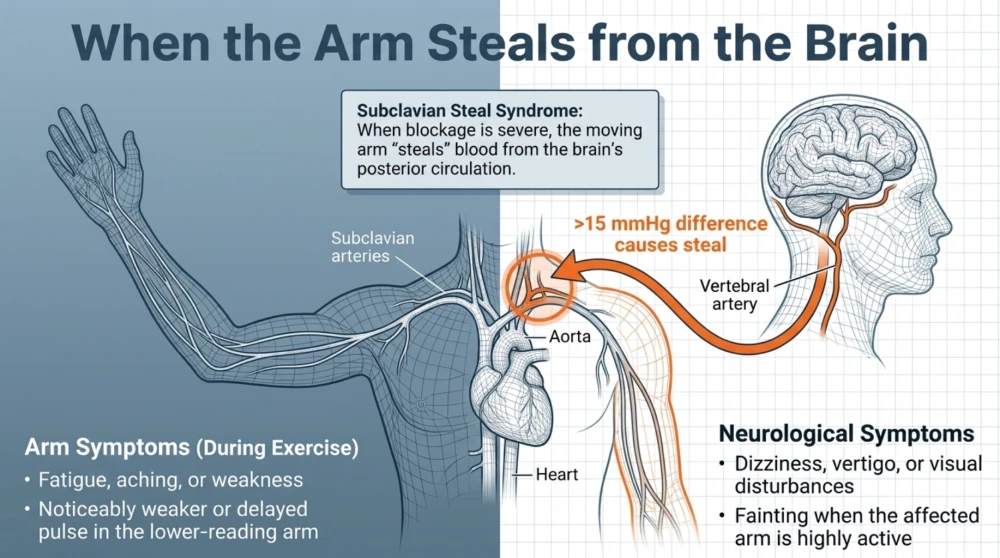
What Is Subclavian Steal Syndrome?
Subclavian steal is a vascular phenomenon that can occur when significant narrowing or obstruction of the subclavian artery is located before the origin of the vertebral artery.
Because pressure beyond the narrowing is reduced, blood flow through the vertebral artery may reverse direction to help supply the arm.
Why Is It Called “Steal”?
The term describes blood being redirected through the vertebral circulation toward the arm because of the pressure difference created by the proximal subclavian narrowing.
The presence of reversed flow itself does not necessarily mean the patient will have symptoms.
When neurological symptoms occur as a consequence of this haemodynamic disturbance, the term subclavian steal syndrome is commonly used.
What Symptoms Can Occur With Subclavian Steal?
Some patients have no symptoms.
Others may develop neurological symptoms associated with reduced posterior cerebral circulation, particularly in situations that increase blood demand in the affected arm.
Possible symptoms can include dizziness, vertigo, imbalance, visual disturbance or fainting.
These symptoms have many other potential causes, so an inter-arm blood pressure difference plus dizziness does not automatically establish subclavian steal syndrome.
Does Arm Exercise Make the Difference More Obvious?
It can in selected patients with significant arterial disease.
When muscles in the affected arm demand more blood during exercise, inadequate arterial supply may produce fatigue or discomfort.
This is somewhat analogous to claudication in the legs, although upper-limb claudication is much less commonly encountered.
Can the Pulse Be Different Too?
Yes.
If arterial narrowing is haemodynamically significant, the radial or brachial pulse on the lower-pressure side may feel weaker or delayed compared with the opposite side.
A clinician may therefore compare:
- Blood pressure in both arms.
- Radial pulses.
- Brachial pulses.
- Temperature and colour of both limbs.
- Capillary perfusion when appropriate.
- Vascular sounds or bruits over relevant arteries.
A clearly weaker pulse together with a substantial persistent inter-arm pressure difference increases the importance of vascular assessment.
What Is a Supraclavicular Bruit?
When blood passes through a significantly narrowed artery, turbulent flow can sometimes create a sound that can be heard with a stethoscope.
A vascular sound heard around the supraclavicular area may provide another clue to arterial disease.
Its absence does not exclude stenosis, and its presence does not by itself determine severity.
Can Both Subclavian Arteries Be Narrowed?
Yes, although bilateral significant disease is less common.
This creates an interesting diagnostic problem because comparing the two arms may become less informative if both sides are affected.
In other words, similar blood pressure in both arms does not prove that the upper-limb arteries are normal.
Inter-arm difference is a clinical clue—not a complete vascular screening test.
How Does a Doctor Evaluate a Persistent Inter-Arm Difference?
The first step is usually not CT angiography.
It is confirming that the difference actually exists.
The clinician may repeat blood pressure measurements under controlled conditions and assess the patient's vascular history and examination.
The Clinical Assessment May Include
| Assessment | What It Helps Determine |
|---|---|
| Repeat BP in both arms | Whether the difference is reproducible |
| Correct cuff assessment | Whether cuff size or placement could explain the finding |
| Pulse examination | Whether one arm has weaker arterial pulsation |
| Vascular auscultation | Whether a bruit suggests turbulent arterial flow |
| Cardiovascular risk assessment | How likely underlying atherosclerotic disease may be |
| Neurological and arm symptoms | Whether vascular disease may be producing clinically important symptoms |
| Vascular imaging when indicated | Whether structural arterial narrowing is present |
When Is Doppler Ultrasound Used?
Duplex Doppler ultrasound is a useful non-invasive method for evaluating blood flow through accessible arteries.
It combines structural ultrasound imaging with Doppler assessment of blood-flow characteristics.
If examination suggests subclavian artery disease, duplex ultrasound may help identify abnormal velocities and flow patterns consistent with significant narrowing.
Doppler Can Also Evaluate Vertebral Artery Flow
In suspected subclavian steal physiology, Doppler assessment can identify abnormal or reversed vertebral artery flow patterns.
Not every patient with a 10 or 15 mmHg difference needs vascular ultrasound. Imaging is chosen according to persistence, magnitude, symptoms, examination findings and overall vascular risk.
When Might CT Angiography Be Considered?
CT angiography can provide detailed anatomical images of the aorta and its arterial branches.
It may be used when significant arterial disease is suspected and more detailed anatomical information is required.
Magnetic resonance angiography is another option in selected situations.
Imaging Should Answer a Clinical Question
Finding a small difference between arms at home is not, by itself, a reason to obtain a CT angiogram.
Imaging becomes useful when history, examination and initial assessment create a meaningful suspicion of vascular pathology.
Sequential Versus Simultaneous Blood Pressure Measurement
This is an important issue when interpreting research and home readings.
Sequential measurement means measuring one arm and then the other.
Simultaneous measurement means measuring both arms at essentially the same time using suitable equipment.
Sequential Measurement Can Exaggerate the Difference
Blood pressure naturally fluctuates from minute to minute.
If the right arm is measured at 10:00:00 and the left arm at 10:02:00, any change during those two minutes becomes part of the apparent inter-arm difference.
Simultaneous measurement reduces this source of variability.
In routine practice, however, simultaneous equipment is often unavailable. Sequential measurement remains practical when performed carefully and repeated appropriately.
Can You Improve Sequential Measurement at Home?
Yes.
If you want to determine whether a difference is reproducible, avoid always measuring the same arm first.
For example, after appropriate rest you can compare both arms, and on another occasion reverse the order.
If the right arm remains higher regardless of which arm is measured first, the finding becomes more convincing.
Do Not Take 20 Readings in One Sitting
Repeatedly measuring blood pressure because the numbers are different often creates more confusion.
Anxiety can increase, the arm may become uncomfortable and natural BP variability generates additional numbers.
A small number of properly performed measurements on more than one occasion is usually more informative than obsessive repeated checking.
What if One Arm Shows Hypertension and the Other Does Not?
This is one of the most clinically important consequences of an inter-arm difference.
Consider the following example:
Right arm: 146/86 mmHg
Left arm: 131/82 mmHg
If you monitor only the left arm, the systolic blood pressure may appear considerably more reassuring.
If the right arm is consistently higher, however, using the lower arm can underestimate the person's actual blood pressure burden.
This Can Affect Hypertension Diagnosis and Treatment
Research comparing higher- versus lower-arm measurements has shown that using the lower arm can place some patients below thresholds that would otherwise affect hypertension diagnosis or treatment decisions.
This is why guidelines recommend identifying the higher-reading arm and using it for subsequent measurements.
Could Using the Lower Arm Make Hypertension Look Controlled?
Yes.
Suppose someone taking antihypertensive medication consistently measures 128/78 mmHg in the left arm but 142/80 mmHg in the right.
If only the left arm is used, treatment may appear more effective than it actually is.
Conversely, treatment decisions should still be based on properly performed repeated measurements rather than a single high reading from either arm.
Should the Higher Arm Be Used for Home BP Monitoring?
Once a reproducible inter-arm difference has been established, the arm with the higher pressure should generally be used for routine monitoring.
Use the same arm consistently so that readings collected over time are comparable.
Write the Reference Arm in Your BP Log
A simple note such as “BP measured in right arm” can make a home blood pressure record more useful.
This becomes especially important when several family members use the same monitor or when readings are reviewed by different healthcare professionals.
How Should You Monitor Blood Pressure at Home?
A good home BP record is based on averages rather than individual spikes.
Use a validated upper-arm monitor with an appropriately sized cuff.
Sit quietly before measuring and avoid talking during the reading.
Once the reference arm has been established, use that arm consistently.
Take More Than One Reading
When routine home monitoring is advised, taking two readings approximately one minute apart can reduce the influence of an isolated measurement.
Record the results rather than relying on memory.
The pattern over several days is usually much more useful than repeatedly reacting to one reading.
What if the Difference Changes Sides?
If the right arm is 12 mmHg higher today, the left arm 8 mmHg higher tomorrow and both arms nearly identical the following day, this pattern is less suggestive of a fixed unilateral arterial obstruction.
Measurement variability becomes a more plausible explanation.
A true haemodynamically important unilateral arterial narrowing would be expected to produce a more consistent tendency for one arm to read lower.
What if the Difference Appears Only Occasionally?
An occasional difference can occur because blood pressure itself is variable.
This is particularly common when measurements are sequential.
The finding becomes more clinically meaningful when:
- The same arm repeatedly reads lower.
- The systolic difference is substantial.
- The difference persists on separate occasions.
- Pulse asymmetry is also present.
- Arm or neurological symptoms occur.
- The person has significant cardiovascular risk factors.
Does a 10 mmHg Difference Matter?
A persistent systolic difference of around 10 mmHg is not automatically pathological.
However, cardiovascular research suggests that risk may increase progressively rather than suddenly beginning at one particular threshold.
This should not be interpreted to mean that everyone with a 10 mmHg difference needs vascular imaging.
Clinical Thresholds and Cardiovascular Risk Are Different Concepts
A guideline threshold may be chosen because it is practical for deciding when to repeat measurements or alter clinical technique.
Cardiovascular risk, however, exists on a continuum.
This is why a persistent difference can contribute to overall risk assessment without functioning as a stand-alone diagnosis.
Can an Inter-Arm Difference Predict Heart Attack or Stroke?
Studies have found associations between larger inter-arm systolic differences and increased cardiovascular events and mortality.
But association should not be confused with direct causation.
The difference itself may partly reflect underlying arterial disease, arterial stiffness or a greater burden of cardiovascular risk.
It is therefore better viewed as a potential risk marker rather than something that directly causes a heart attack.
Should You Take Aspirin Because Your Arms Have Different BP?
No.
An inter-arm blood pressure difference by itself is not an indication to start aspirin.
Aspirin has potential benefits in selected cardiovascular conditions but also increases bleeding risk.
The decision to use antiplatelet treatment depends on established cardiovascular disease and the individual's overall clinical situation—not simply a difference between arm readings.
Should You Start a Cholesterol Medicine Because of the Difference?
Again, not on the basis of the arm difference alone.
However, a persistent substantial difference may prompt a broader cardiovascular assessment.
That assessment may include blood pressure, smoking status, diabetes, lipid profile, kidney function, established cardiovascular disease and overall cardiovascular risk.
If vascular disease is eventually diagnosed, lipid-lowering treatment may become important for reasons much broader than the blood pressure difference itself.
What if Both Arms Have High Blood Pressure?
Then the major issue may simply be hypertension.
For example:
Right arm: 158/94 mmHg
Left arm: 152/92 mmHg
The difference is small.
The clinically important finding is that blood pressure is elevated in both arms.
Do not become so focused on the 6 mmHg inter-arm difference that the hypertension itself is overlooked.
What if Both Arms Are Normal but 15 mmHg Apart?
Consider another example:
Right arm: 124/76 mmHg
Left arm: 108/72 mmHg
Neither reading is hypertensive, but the systolic difference is 16 mmHg.
If that difference repeatedly persists under standardised conditions, it is still worth mentioning during medical assessment.
The significance of an inter-arm difference is therefore not determined solely by whether the higher arm meets a hypertension threshold.
What if You Have Diabetes?
Diabetes increases the long-term risk of atherosclerotic cardiovascular and peripheral arterial disease.
Therefore, a persistent substantial inter-arm difference in someone with diabetes may deserve greater attention than an isolated small difference in a young person without cardiovascular risk factors.
That still does not mean that every person with diabetes and a 10 mmHg difference needs vascular imaging.
The complete clinical picture matters.
What if You Smoke?
Smoking is an important risk factor for atherosclerotic vascular disease.
If a smoker repeatedly has one arm substantially lower than the other, particularly with a weaker pulse or arm symptoms, the threshold for considering vascular disease becomes more clinically relevant.
Smoking cessation remains important regardless of whether the inter-arm difference ultimately proves to be caused by arterial narrowing.
Can Weight Training Cause Different BP Between Arms?
Ordinary resistance training does not usually create a persistent pathological inter-arm blood pressure difference.
Differences in muscle size can, however, affect cuff fit.
A very muscular upper arm may require a larger cuff than expected.
If one arm is substantially larger than the other, using the same poorly fitting cuff on both sides can create misleading results.
What About Previous Breast Surgery or Lymph Node Surgery?
Patients who have undergone breast surgery, axillary lymph-node procedures or who have lymphoedema may have specific instructions regarding which arm should be used for blood pressure measurement.
In these situations, routine advice to simply measure both arms may need modification.
The appropriate measurement site should follow the individual's surgical and clinical circumstances.
Can Dialysis Access Affect Which Arm Is Used?
Yes.
Blood pressure cuffs should generally not be applied over an arm containing an arteriovenous fistula or graft used for haemodialysis.
These patients require an individualised approach to blood pressure measurement.
A Practical Decision Pathway
| Finding | Practical Next Step |
|---|---|
| Small difference on one measurement | Check technique and repeat on another occasion |
| Difference changes sides repeatedly | Measurement and normal BP variability become more likely explanations |
| Same arm repeatedly 10–15 mmHg lower | Confirm carefully and consider the overall cardiovascular risk profile |
| Persistent difference above approximately 15 mmHg | Use the higher arm for routine BP and discuss the finding with your clinician |
| Large difference plus weaker pulse or arm symptoms | Vascular assessment becomes more important |
| Sudden major difference plus severe chest/back pain or neurological symptoms | Urgent medical assessment |
When Is Different Blood Pressure in Each Arm an Emergency?
Most people who notice different blood pressure in each arm do not have a medical emergency.
A difference discovered during routine home monitoring is usually something to confirm carefully rather than something that requires an immediate trip to the emergency department.
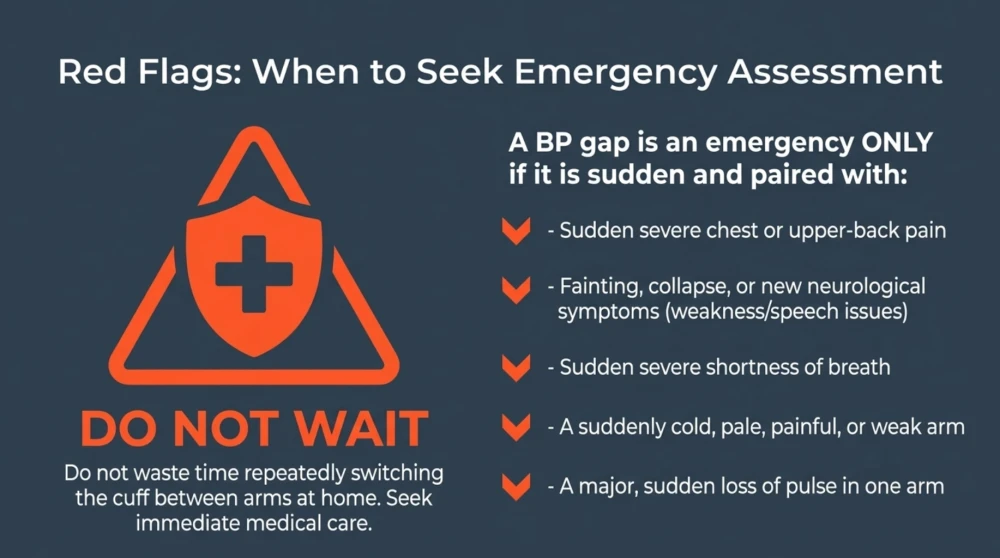
The situation changes when a large inter-arm difference appears suddenly and is accompanied by acute symptoms.
Seek Urgent Medical Assessment When a New Large Difference Occurs With:
- Sudden severe chest pain.
- Sudden severe upper-back pain.
- Fainting or collapse.
- New weakness or numbness affecting one side of the body.
- Difficulty speaking.
- Sudden severe shortness of breath.
- A suddenly cold, pale, painful or weak arm.
- A major new pulse difference between the arms.
In this setting, the blood pressure difference is only one part of a larger acute clinical picture.
Can Aortic Dissection Cause Different Blood Pressure in the Arms?
Yes, it can—but this requires careful explanation because the association can easily create unnecessary anxiety.
An aortic dissection occurs when a tear develops within the wall of the aorta. Depending on its location and the arterial branches involved, blood flow to one upper limb may be affected, potentially producing pulse or blood pressure asymmetry.
However, an inter-arm blood pressure difference alone is neither sensitive nor specific enough to diagnose aortic dissection.
A 10 or 15 mmHg Home Difference Does Not Mean You Have an Aortic Dissection
Aortic dissection is considered in the context of an acute clinical syndrome.
The concern becomes very different when someone develops sudden severe chest or back pain, collapses, develops neurological abnormalities or has evidence of acute limb ischaemia.
Finding 132/78 mmHg in one arm and 142/80 mmHg in the other while otherwise feeling well is a completely different situation.
Do Not Repeatedly Check Your BP if You Have Emergency Symptoms
If someone has sudden severe chest or back pain with collapse or neurological symptoms, the priority is emergency medical assessment.
Repeatedly switching the cuff between arms at home to see whether the difference is increasing can waste valuable time.
Can Thoracic Outlet Problems Cause an Arm BP Difference?
They can in selected circumstances.
The thoracic outlet is the region through which nerves and blood vessels travel from the chest toward the upper limb.
Compression involving the subclavian artery is considerably less common than neurological forms of thoracic outlet syndrome, but arterial compression can affect blood flow to an arm.
Position May Matter
Symptoms related to vascular compression may be influenced by arm position and can include arm fatigue, pain, colour change, coolness or other evidence of impaired circulation.
A simple persistent inter-arm difference in an older adult with vascular risk factors, however, has a different differential diagnosis from positional symptoms in a younger patient.
Can Inflammation of the Arteries Cause Different BP in Each Arm?
Yes.
Although atherosclerosis is an important vascular cause of inter-arm pressure differences, inflammatory diseases affecting large arteries can also produce arterial narrowing.
Takayasu arteritis is a well-known example.
What Is Takayasu Arteritis?
Takayasu arteritis is an uncommon inflammatory disease affecting large arteries, including the aorta and its major branches.
Depending on which arteries are involved, findings may include unequal arm blood pressures, reduced pulses or limb symptoms.
It tends to occur in younger individuals than typical atherosclerotic subclavian disease.
A persistent BP difference in a young person does not mean they have Takayasu arteritis. It is simply one of several possible explanations considered when the overall clinical picture suggests large-vessel disease.
What About Previous Arterial Surgery?
Previous vascular surgery, congenital cardiovascular abnormalities and procedures involving the aorta or major arteries can alter upper-limb circulation.
In these situations, the expected relationship between right- and left-arm pressures may be different.
Blood pressure monitoring should follow the advice of the treating cardiovascular or vascular team.
When Should You Make a Routine Doctor's Appointment?
You do not need emergency care for every persistent difference.
A routine medical review is reasonable when properly performed measurements repeatedly show a substantial difference between the arms, particularly if the systolic difference remains above approximately 15 mmHg.
Arrange Assessment Particularly If:
- The same arm is consistently lower.
- The difference remains above approximately 15 mmHg on repeat measurement.
- One arm has a noticeably weaker pulse.
- You experience arm fatigue or discomfort with activity.
- One hand or arm repeatedly feels colder.
- You have diabetes, smoking history, high cholesterol or known vascular disease.
- You have known coronary artery disease, stroke or peripheral arterial disease.
- The difference is new and substantially greater than previous measurements.
What Will Your Doctor Usually Do First?
The first step is often surprisingly simple: repeat the blood pressure correctly.
Before assuming that an artery is blocked, it is worth confirming that the difference survives proper measurement.
The clinician may then compare pulses, examine both upper limbs, review cardiovascular risk factors and decide whether vascular investigation is warranted.
Do You Automatically Need a Doppler Test?
No.
A persistent inter-arm difference does not automatically require imaging.
Duplex ultrasound becomes more relevant when the difference is substantial and reproducible or when examination, symptoms or cardiovascular history raise suspicion of arterial disease.
CT angiography or MR angiography may be considered when detailed anatomical assessment is clinically necessary.
Testing Should Follow Clinical Probability
A healthy young adult with a one-time 12 mmHg difference and normal pulses is not the same as an older smoker with a persistent 25 mmHg difference, arm claudication and a weak radial pulse.
The number alone should not dictate the investigation.
A Step-by-Step Home Protocol for Comparing Both Arms
If you discover different blood pressure in each arm, use a structured approach rather than repeatedly checking throughout the day.
Step 1: Use the Right Equipment
Use a validated automatic upper-arm blood pressure monitor with a cuff appropriate for your arm circumference.
Step 2: Prepare Properly
Avoid exercise, smoking and caffeine for approximately 30 minutes beforehand. Empty your bladder if necessary.
Step 3: Rest
Sit quietly for at least five minutes before starting.
Step 4: Position Yourself Correctly
Keep your back supported, feet flat on the floor and legs uncrossed.
Step 5: Support the Arm
The arm being measured should rest comfortably at approximately heart level.
Step 6: Remain Silent
Do not talk, use your phone or actively watch the monitor while it is measuring.
Step 7: Compare Both Arms
Measure both arms during the initial assessment. If simultaneous measurement equipment is unavailable, compare them sequentially under otherwise similar conditions.
Step 8: Repeat Rather Than React
If a difference appears, repeat the comparison on another occasion. Consider reversing which arm is measured first.
Step 9: Identify the Consistently Higher Arm
If the same arm repeatedly produces the higher pressure, that should generally become your reference arm for routine monitoring.
Step 10: Record the Arm Used
Write “right arm” or “left arm” alongside your home readings so that your doctor can interpret the log correctly.
How Often Should You Compare Both Arms?
Once a consistent higher-reading arm has been established, there is usually no need to compare both arms every morning and evening.
Use the higher arm consistently for routine monitoring.
The comparison can be repeated during clinical reassessment if there is a reason to do so.
Should You Use the Higher Arm Even if the Difference Is Only 5 mmHg?
If a very small difference is inconsistent, there may not be a meaningful “higher arm.”
For example, the right arm may be 4 mmHg higher today and the left arm 3 mmHg higher tomorrow.
That pattern is compatible with normal measurement variability.
The concept of choosing the higher arm becomes more useful when one side is consistently higher.
What if the Higher Arm Shows 140 but the Lower Arm Shows 125?
This is exactly why both arms should be assessed initially.
If repeated standardised measurements confirm that one arm is consistently around 15 mmHg higher, routine BP assessment should use the higher arm.
Otherwise, hypertension may be underestimated.
Do Not Average the Two Arms Together
Averaging 140 and 125 to obtain 132.5 mmHg may appear mathematically reasonable, but it can conceal the clinically important higher pressure.
Once a reproducible difference is established, use the higher-reading arm rather than averaging the arms.
What if the Lower Arm Is the Dominant Arm?
Dominance does not determine which arm should be used.
There is no general rule that right-handed people should measure the right arm or left-handed people the left.
The reference arm is determined by the actual measurements and any clinical restrictions affecting cuff placement.
Does Sleeping on One Side Cause a Persistent BP Difference?
Ordinary sleeping position is not a typical explanation for a reproducible long-term inter-arm blood pressure difference.
Temporary effects related to position or compression may occur, but a consistent difference across properly performed measurements should not simply be attributed to sleeping on one side.
Can Cervical Spondylosis Cause Different Blood Pressure in Each Arm?
Cervical spondylosis commonly causes neck pain, arm pain, tingling or neurological symptoms, but it does not usually produce a persistent arterial pressure difference between the arms.
If arm symptoms coexist with a substantial BP difference, neurological and vascular explanations may need to be considered separately.
Can Stress Cause One Arm to Have Higher Blood Pressure?
Stress raises blood pressure through systemic physiological mechanisms rather than selectively raising one arm.
However, stress can indirectly create an apparent difference during sequential measurement.
The first reading may occur when anxiety is greatest, while the second is taken after the person has relaxed.
Does a Different Pulse Rate Between Arms Matter?
With a conventional blood pressure monitor, apparent pulse-rate differences between sequential measurements can simply reflect normal heart-rate variation.
Your heart rate is systemic; each arm does not normally have its own independent pulse rate.
A genuinely irregular rhythm can also make automated blood pressure readings less reliable.
If an irregular heartbeat is suspected, it should be assessed independently.
Special Situations Where Routine Advice May Need Modification
| Situation | Important Consideration |
|---|---|
| Dialysis fistula or graft | Avoid routine cuff compression over the vascular-access arm |
| Previous breast or axillary surgery | Measurement strategy may need individualisation according to surgical history and current clinical advice |
| Marked lymphoedema | The affected arm may be unsuitable for routine cuff measurement |
| Previous vascular surgery | Expected pressure relationships may differ depending on anatomy and procedure |
| Very large arm circumference | Correct cuff sizing is essential to avoid falsely high readings |
| Irregular heart rhythm | Automated readings may be more variable and may require clinical confirmation |
Common Myths About Different Blood Pressure in Each Arm
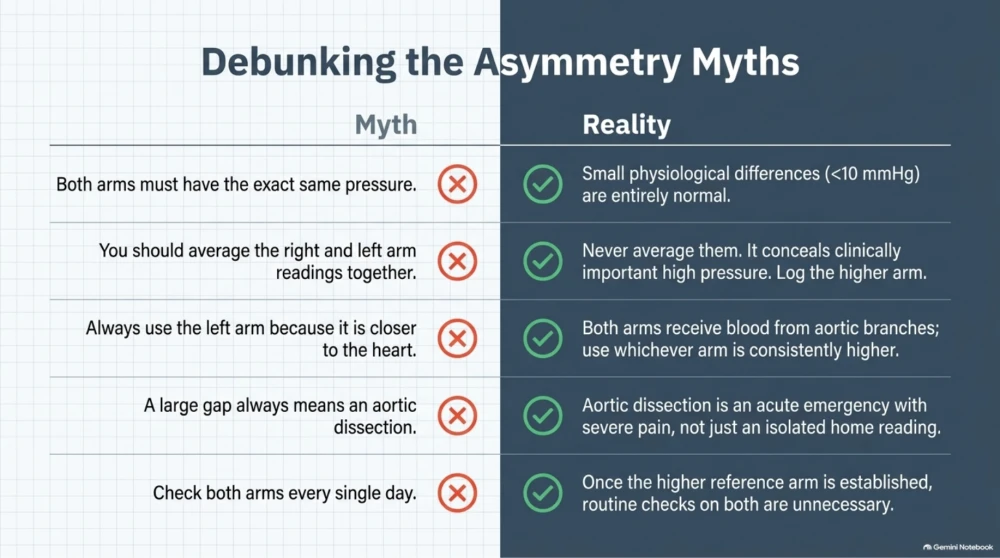
Myth 1: Both Arms Must Always Have Exactly the Same BP
False.
Small differences are common because of normal physiological variation and the limitations of sequential measurement.
Myth 2: A 10 mmHg Difference Means an Artery Is Blocked
False.
A small or moderate difference alone cannot diagnose arterial obstruction.
Persistence, magnitude, symptoms, pulse findings and cardiovascular risk all matter.
Myth 3: The Arm With Higher BP Contains the Blockage
Not necessarily.
Significant narrowing of an artery supplying one arm can reduce pressure downstream, meaning the affected arm may actually have the lower reading.
Myth 4: You Should Always Measure BP in the Left Arm Because It Is Closer to the Heart
False.
Both arms receive arterial blood from branches of the aorta. The left arm is not automatically the correct arm for blood pressure monitoring.
Myth 5: You Should Average the Right- and Left-Arm Readings
Not when a consistent clinically meaningful difference has been established.
The higher-reading arm should generally be used for subsequent monitoring.
Myth 6: A Large Difference Always Means Aortic Dissection
False.
Aortic dissection is an acute medical emergency diagnosed from the overall clinical presentation and appropriate imaging—not from an isolated home BP difference.
Myth 7: If Both Arms Are Below 140/90, the Difference Does Not Matter
Not necessarily.
A substantial persistent difference can still be clinically relevant even when neither arm appears markedly hypertensive.
Myth 8: You Should Keep Checking Both Arms Every Day
Usually unnecessary once the higher-reading reference arm has been established.
Frequently Asked Questions
Is a 5 mmHg Difference Between Arms Normal?
A difference of this size is common and can easily occur because of normal biological and measurement variability.
Is a 10 mmHg Difference Dangerous?
Not by itself. If the difference repeatedly occurs in the same direction, it can be considered alongside the person's cardiovascular risk profile, but it does not automatically indicate vascular disease.
What About a 20 mmHg Difference?
A persistent systolic difference of this magnitude deserves medical review, particularly if one arm is consistently lower or there are vascular symptoms or risk factors.
Which Arm Should I Use for BP?
Measure both arms initially. If one arm is consistently higher, use that arm for subsequent routine measurements unless there is a medical reason not to use it.
Should I Measure Both Arms at the Same Time?
Simultaneous measurement can reduce the effect of natural minute-to-minute BP variation, but special equipment is usually required. Careful repeated sequential measurement is practical in routine clinical and home settings.
Can Different BP in Each Arm Cause a Stroke?
The difference itself is better viewed as a possible marker of vascular disease or cardiovascular risk rather than a direct cause of stroke.
Can I Check This With a Smartwatch?
A validated upper-arm cuff-based monitor is preferred for clinical blood pressure assessment. Cuffless smartwatch estimates should not replace standard measurements when evaluating a suspected inter-arm difference.
Key Takeaways
- A small blood pressure difference between arms is common.
- One isolated difference does not diagnose vascular disease.
- Incorrect cuff size, unsupported arms, inadequate rest and sequential measurements can exaggerate the difference.
- Measure blood pressure in both arms during the initial assessment.
- If the difference is greater than 15 mmHg, repeat the measurements under appropriate conditions.
- If a difference above approximately 15 mmHg persists, the higher-reading arm should generally be used for subsequent measurements.
- Using the lower arm can underestimate blood pressure and potentially affect hypertension diagnosis or assessment of control.
- The lower-pressure arm can occasionally be the arm affected by significant arterial narrowing.
- Subclavian artery stenosis is one possible vascular cause of a persistent inter-arm difference.
- Smoking, diabetes, dyslipidaemia and established vascular disease increase the relevance of a persistent substantial difference.
- A persistent difference is a clinical clue rather than a diagnosis and does not automatically mean that vascular imaging is required.
- A sudden large difference accompanied by severe chest or back pain, neurological symptoms, collapse or acute limb ischaemia requires urgent assessment.
References
- National Institute for Health and Care Excellence (NICE). Hypertension in adults: diagnosis and management. Guidance on bilateral arm measurement, repeat assessment of an inter-arm difference and subsequent use of the higher-reading arm.
- European Society of Cardiology. Current clinical practice guidance on elevated blood pressure and hypertension, including appropriate blood pressure measurement.
- American Heart Association. Scientific guidance and patient resources on accurate blood pressure measurement, cuff selection, patient positioning and home blood pressure monitoring.
- Clark CE, Warren FC, Boddy K, et al. Individual participant data meta-analysis examining inter-arm systolic blood pressure differences and cardiovascular outcomes.
- Peer-reviewed vascular literature concerning subclavian artery stenosis, upper-extremity arterial disease and subclavian steal physiology.
- European and international vascular guidance concerning peripheral arterial and aortic disease, including diagnostic vascular imaging when clinically indicated.
- Peer-reviewed literature concerning inter-arm blood pressure measurement, simultaneous versus sequential measurement and cardiovascular risk.
Medical note: This article provides general educational information and does not replace individual medical assessment. A persistent inter-arm blood pressure difference should be interpreted according to measurement technique, magnitude, symptoms, pulse findings and cardiovascular risk. Sudden severe chest or back pain, collapse, new neurological symptoms or evidence of acute loss of circulation to an arm requires urgent medical assessment.
Written by Dr. Pankaj Kumar , General & Lifestyle Physician, Dwarka, New Delhi