

















- 11th July 2026
Table of Contents
- Why Many People Depend on Weekends to Catch Up on Sleep
- Sleep Is More Than Simply Rest
- What Is Sleep Debt?
- Why Weekend Sleep Often Makes People Feel Better
- Why Chronic Sleep Restriction Affects the Entire Body
- Why Weekend Sleep Cannot Always Restore Mental Performance Completely
- Why Weekend Sleep Does Not Always Improve Energy Throughout the Week
- Why Sleep Consistency Is Becoming More Important Than Sleep Quantity Alone
- Why Sleep Timing Matters as Much as Sleep Duration
- Why Social Jet Lag Can Leave You Feeling Tired
- Why Poor Sleep Can Influence Hunger and Appetite
- Why Weekend Sleep Cannot Completely Reverse Metabolic Changes
- Why Oversleeping Is Not Always the Solution
- Why Sleep Affects Exercise Performance
- Why Mental Fatigue Often Persists Despite Extra Weekend Sleep
- Why Weekday Habits Determine Weekend Recovery
- How to Reduce Sleep Debt Without Depending on Weekends
- Why Consistent Bedtime Is More Important Than Many People Realize
- How Morning Light Helps Reset Your Body Clock
- Why Good Sleep Hygiene Supports Long-Term Recovery
- Why Healthy Sleep Supports Weight Management
- When Persistent Fatigue Should Not Be Ignored
- Building a Lifestyle That Supports Better Sleep
- Key Takeaways: What You Should Remember
Why Many People Depend on Weekends to Catch Up on Sleep
For millions of adults, weekdays are filled with early alarms, demanding work schedules, family responsibilities, long commutes, and late-night screen time. As a result, sleep often becomes one of the first sacrifices in an already busy routine.
Many people sleep five or six hours from Monday to Friday and reassure themselves with a common belief:
"I'll catch up on my sleep over the weekend."
Sleeping until late morning on Saturday and Sunday has become a familiar routine for many working professionals and students. It feels refreshing after a stressful week, and for a short time, it may reduce feelings of tiredness.
However, an important question remains.
Can two days of extra sleep completely reverse the effects of five days of insufficient sleep?
Modern sleep research suggests the answer is more complicated than many people realize.
This is exactly why understanding why weekend sleep recovery may not fully reverse fatigue is important for long-term health and productivity.
Sleep Is More Than Simply Rest
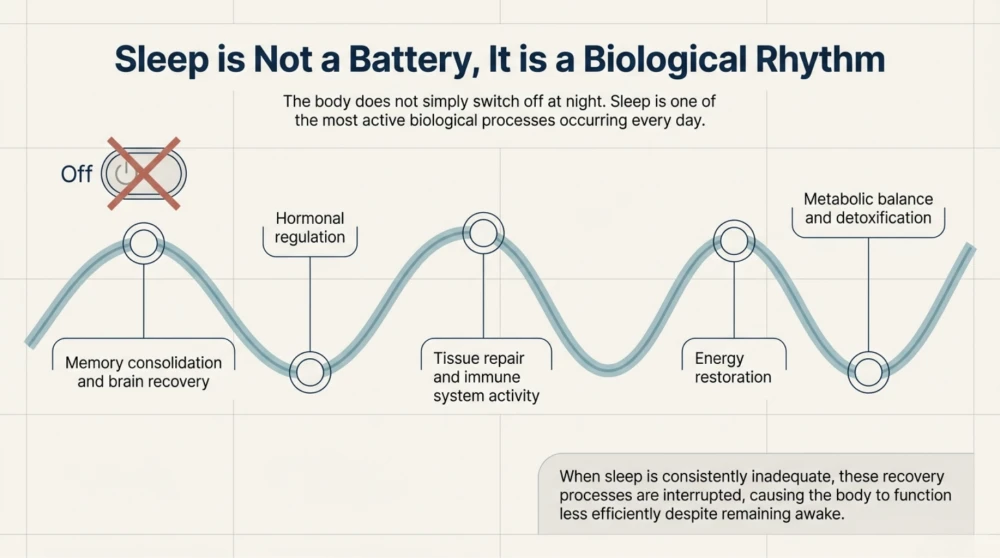
Many people think of sleep as a period during which the body simply "switches off." In reality, sleep is one of the most active biological processes that occurs every day.
During healthy sleep, the body performs numerous essential functions that support both physical and mental health.
These include:
- Memory consolidation
- Hormonal regulation
- Tissue repair
- Immune system activity
- Energy restoration
- Brain recovery
When sleep becomes consistently inadequate, these recovery processes are interrupted. Although the body continues functioning, it often does so less efficiently.
This explains why people may continue working despite poor sleep but feel increasingly tired, less focused, and less productive over time.
What Is Sleep Debt?
The term sleep debt describes the difference between the amount of sleep your body needs and the amount you actually obtain.
For example, if someone regularly requires around seven to nine hours of sleep but consistently sleeps only five or six hours, this shortfall gradually accumulates over several days.
Unlike missing a single meal, sleep loss is not always corrected immediately.
Although sleeping longer during the weekend may reduce some of this accumulated sleep debt, research suggests that certain effects of chronic sleep restriction may persist beyond a single weekend.
This is one reason experts increasingly emphasize sleep consistency rather than relying on occasional recovery sleep.
Why Weekend Sleep Often Makes People Feel Better
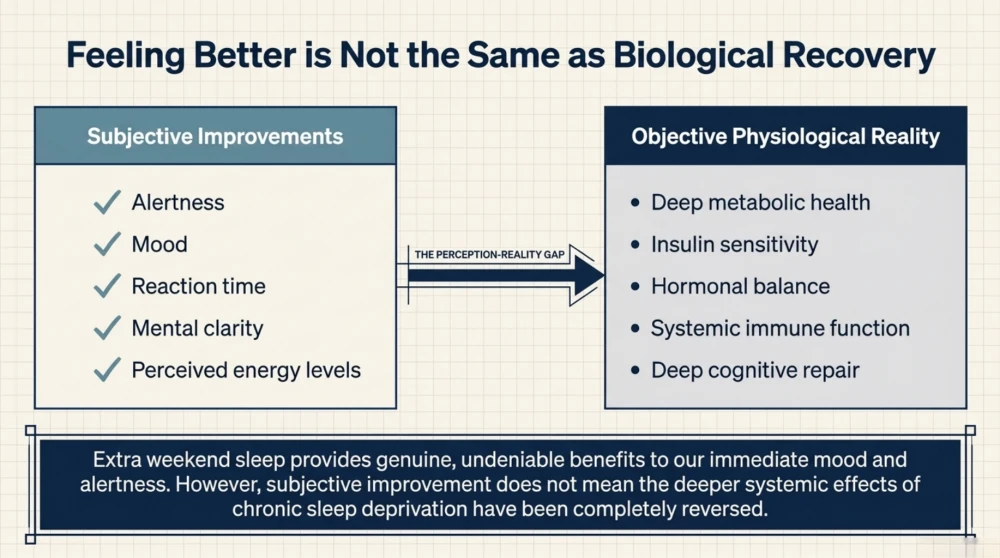
There is a reason many people wake up on Sunday feeling more refreshed than they did on Friday morning. Extra sleep does provide genuine benefits.
After several nights of inadequate sleep, extending sleep duration may temporarily improve:
- Alertness
- Mood
- Reaction time
- Mental clarity
- Energy levels
These improvements are real and should not be dismissed.
However, feeling better does not necessarily mean that every effect of chronic sleep deprivation has been completely reversed. This distinction is important because subjective improvement and full physiological recovery are not always the same thing.
Why Chronic Sleep Restriction Affects the Entire Body
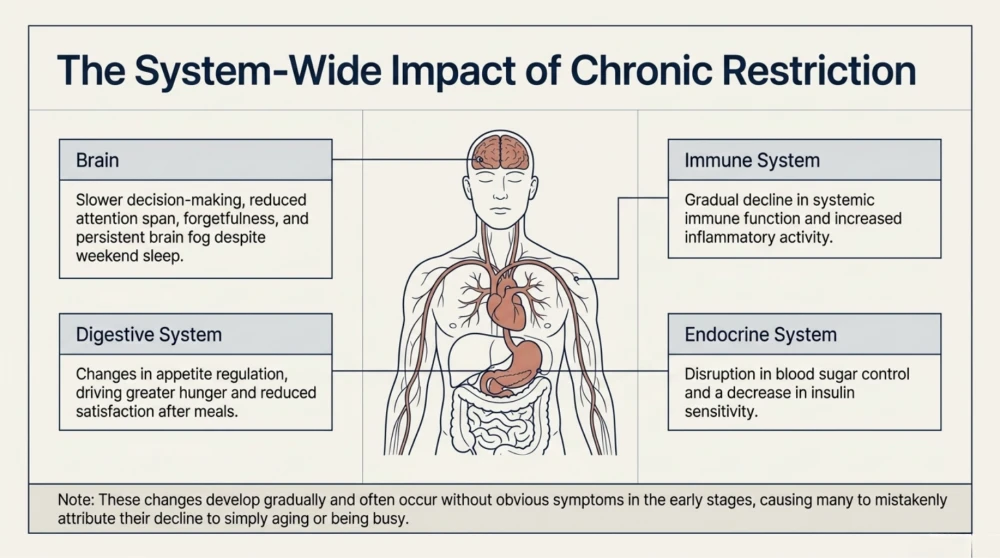
Sleep influences far more than energy levels. When insufficient sleep becomes a long-term habit, multiple systems throughout the body may be affected.
Research has shown associations between chronic sleep restriction and changes involving:
- Appetite regulation
- Blood sugar control
- Hormonal balance
- Immune function
- Metabolic health
These changes develop gradually and often occur without obvious symptoms during the early stages. Many people simply assume they are becoming busier or older when, in reality, chronic sleep deprivation may be contributing to how they feel.
Why Weekend Sleep Cannot Always Restore Mental Performance Completely
One of the first areas affected by insufficient sleep is cognitive performance.
Many individuals notice:
- Difficulty concentrating
- Reduced attention span
- Forgetfulness
- Slower decision-making
- Reduced productivity
Although extra weekend sleep often improves these symptoms temporarily, some aspects of cognitive performance may require more than one or two nights of recovery, particularly if sleep deprivation has been ongoing for weeks or months.
This helps explain why some people continue feeling mentally exhausted even after sleeping longer during the weekend.
If you want to understand this relationship further, you may also explore why brain fog and low concentration should not be ignored.
Why Weekend Sleep Does Not Always Improve Energy Throughout the Week
Many people expect that sleeping for ten or eleven hours on Sunday will provide enough energy for the entire upcoming week.
Unfortunately, sleep does not function like a battery that can simply be fully charged once every seven days. The body performs best when sleep occurs regularly and consistently.
Repeated cycles of:
- Sleep deprivation during weekdays
- Oversleeping during weekends
may create an irregular rhythm that makes maintaining stable energy levels more difficult.
This is one reason many individuals begin feeling tired again by Tuesday or Wednesday despite having slept extensively over the weekend.
Why Sleep Consistency Is Becoming More Important Than Sleep Quantity Alone
Modern sleep medicine increasingly recognizes that both the quantity and the regularity of sleep matter. Sleeping eight hours one night and five hours the next may not provide the same benefits as consistently sleeping seven to eight hours every night.
The body's internal clock functions best when sleep and wake times remain relatively stable. Large differences between weekday and weekend schedules may disrupt these natural rhythms and make it harder to feel refreshed throughout the week.
This is why maintaining consistent sleep habits is often more effective than relying solely on weekend recovery sleep.
Why Sleep Timing Matters as Much as Sleep Duration
Many people focus primarily on the number of hours they sleep while paying much less attention to when they sleep.
However, the human body follows an internal biological clock known as the circadian rhythm. This internal timing system helps regulate sleep, hormone production, body temperature, digestion, alertness, and countless other physiological processes.
When bedtime and wake-up times remain relatively consistent, the body is better able to prepare for sleep and maintain normal daily rhythms. Problems arise when weekday and weekend schedules differ dramatically.
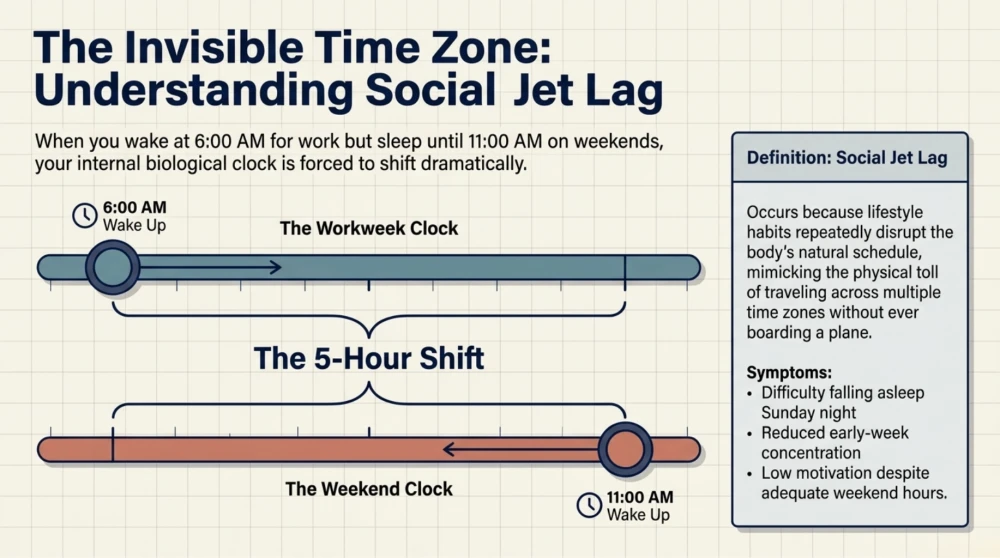
For example, someone may wake at 6:00 AM during the workweek but sleep until 10:30 AM or 11:00 AM on weekends. Although this feels enjoyable, it shifts the body's internal clock.
By Sunday night, many people struggle to fall asleep at their usual bedtime. On Monday morning they must wake early again, often feeling as though they have travelled across time zones.
This phenomenon is commonly referred to as social jet lag. Unlike travel-related jet lag, it occurs because lifestyle habits repeatedly disrupt the body's natural sleep schedule.
Why Social Jet Lag Can Leave You Feeling Tired
Social jet lag has become increasingly common among students, professionals, and shift workers. Although sleeping longer during weekends may reduce some sleep debt, repeatedly changing sleep schedules can create a new problem.
Many individuals notice:
- Difficulty falling asleep on Sunday night
- Feeling unusually tired on Monday morning
- Reduced concentration early in the week
- Low motivation despite adequate weekend sleep
Instead of starting the week feeling refreshed, they begin the week trying to readjust their body clock. This repeated cycle may contribute to persistent fatigue even when total weekend sleep appears sufficient.
Why Poor Sleep Can Influence Hunger and Appetite
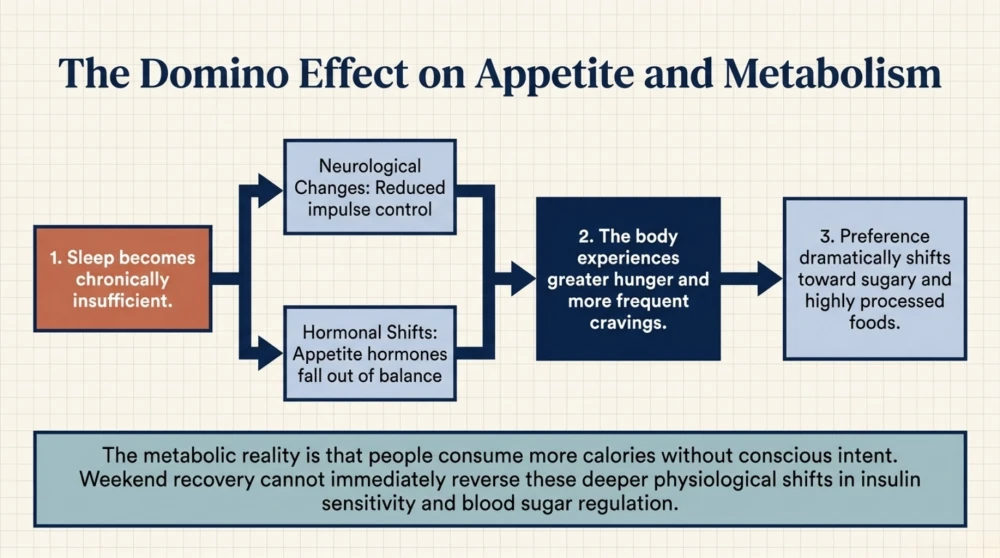
Sleep and appetite are closely connected. When sleep becomes chronically insufficient, the body often responds in ways that make healthy eating more difficult.
Many individuals notice that after several nights of poor sleep they experience:
- Greater hunger
- More frequent food cravings
- Reduced satisfaction after meals
- Increased preference for sugary and highly processed foods
These changes are influenced by complex hormonal and neurological mechanisms that regulate appetite. As a result, people may consume more calories without consciously intending to do so.
This is one reason chronic sleep deprivation is increasingly recognized as an important contributor to long-term weight management challenges.
Why Weekend Sleep Cannot Completely Reverse Metabolic Changes
Several studies suggest that while recovery sleep improves how people feel, it may not immediately reverse all of the metabolic changes associated with repeated sleep restriction.
For example, chronic sleep deprivation has been associated with changes involving:
- Insulin sensitivity
- Blood sugar regulation
- Inflammatory activity
- Appetite control
Sleeping longer for one or two nights may improve alertness and reduce fatigue, but these deeper physiological processes often respond more slowly.
This is one reason experts encourage maintaining healthy sleep habits consistently rather than depending on weekend recovery alone.
Why Oversleeping Is Not Always the Solution
When people feel exhausted after a busy week, their natural response is often to sleep as long as possible during the weekend. Occasionally sleeping an extra hour or two is usually not a concern.
However, routinely sleeping four or five hours longer than usual every weekend may disrupt normal sleep rhythms.
Some individuals wake from very long sleep periods feeling:
- Groggy
- Mentally sluggish
- Less productive
- Unmotivated
This does not necessarily mean extra sleep is harmful. Rather, it highlights that maintaining regular sleep timing is often more beneficial than alternating between sleep deprivation and excessive recovery sleep.
Why Sleep Affects Exercise Performance
Many people expect themselves to exercise consistently while sleeping far less than their body requires. Unfortunately, inadequate sleep often reduces motivation to remain physically active.
People who are chronically tired frequently experience:
- Reduced exercise endurance
- Poor workout quality
- Longer recovery after exercise
- Less enthusiasm for physical activity
Weekend sleep may temporarily improve energy for a Sunday workout, but maintaining regular physical activity throughout the week becomes much easier when adequate sleep occurs consistently.
Why Mental Fatigue Often Persists Despite Extra Weekend Sleep
Many adults perform mentally demanding work throughout the week. Continuous decision-making, meetings, emails, multitasking, and prolonged screen time place considerable demands on the brain.
Weekend sleep helps reduce some of this fatigue, but it cannot instantly erase weeks or months of chronic mental overload.
This explains why some individuals continue experiencing:
- Brain fog
- Poor concentration
- Difficulty focusing
- Mental exhaustion
despite spending many hours asleep over the weekend.
Sleep recovery is valuable, but long-term mental performance depends on maintaining healthy sleep habits throughout the entire week.
Why Weekday Habits Determine Weekend Recovery
One of the most important messages from modern sleep research is that weekends should not be viewed as an opportunity to repair an unhealthy weekday routine.
If someone repeatedly sleeps only five hours every night, weekend recovery may reduce some immediate symptoms, but it is unlikely to completely eliminate the effects of chronic sleep deprivation.
Healthy sleep works best when recovery occurs every night rather than only once a week.
This is why building sustainable weekday sleep habits remains one of the most effective strategies for improving long-term energy, productivity, and metabolic health.
How to Reduce Sleep Debt Without Depending on Weekends
Many people believe that the only solution to weekday sleep deprivation is sleeping for several extra hours on weekends. While additional sleep after a particularly demanding week can certainly help reduce tiredness, relying on this approach every weekend is unlikely to be the most effective long-term strategy.
A more sustainable approach is to gradually reduce sleep debt throughout the week rather than allowing it to accumulate continuously.
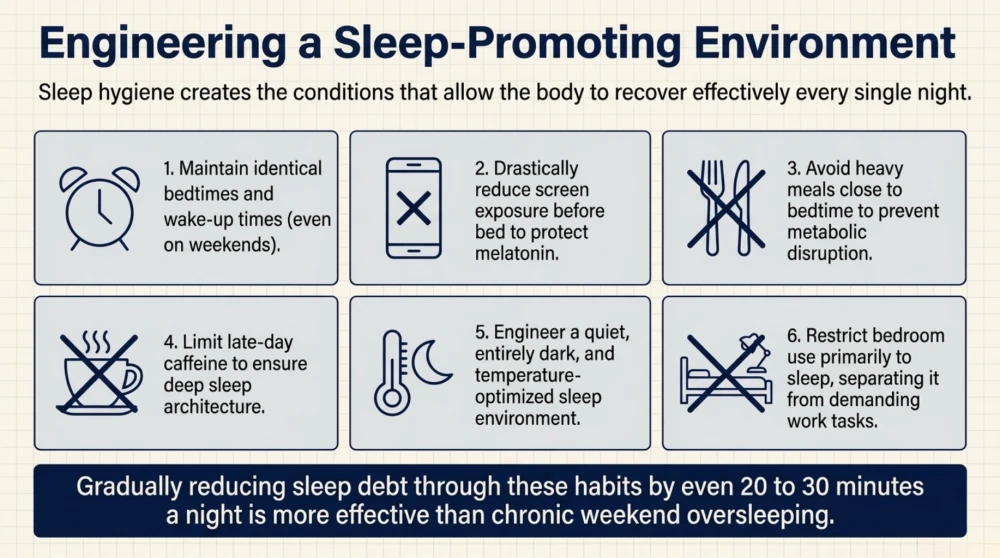
Even adding 20 to 30 minutes of sleep each night can make a meaningful difference over time. Going to bed slightly earlier, limiting unnecessary late-night screen use, and maintaining a consistent bedtime often produce better long-term results than alternating between chronic sleep deprivation and prolonged weekend sleep.
The goal should not be to "catch up" every weekend. Instead, it should be to avoid falling significantly behind in the first place.
Why Consistent Bedtime Is More Important Than Many People Realize
The human body functions best when daily routines remain reasonably predictable. Sleeping at approximately the same time each night helps reinforce the body's natural circadian rhythm.
When bedtime varies by several hours between weekdays and weekends, the internal body clock repeatedly has to adjust. This frequent resetting may contribute to difficulty falling asleep, poor-quality sleep, and persistent daytime fatigue.
Many people focus only on the number of hours they sleep, but consistency often determines how restorative that sleep actually feels.
Maintaining similar bedtimes and wake-up times—even on weekends—helps the brain anticipate when it should prepare for sleep and when it should promote alertness.
How Morning Light Helps Reset Your Body Clock
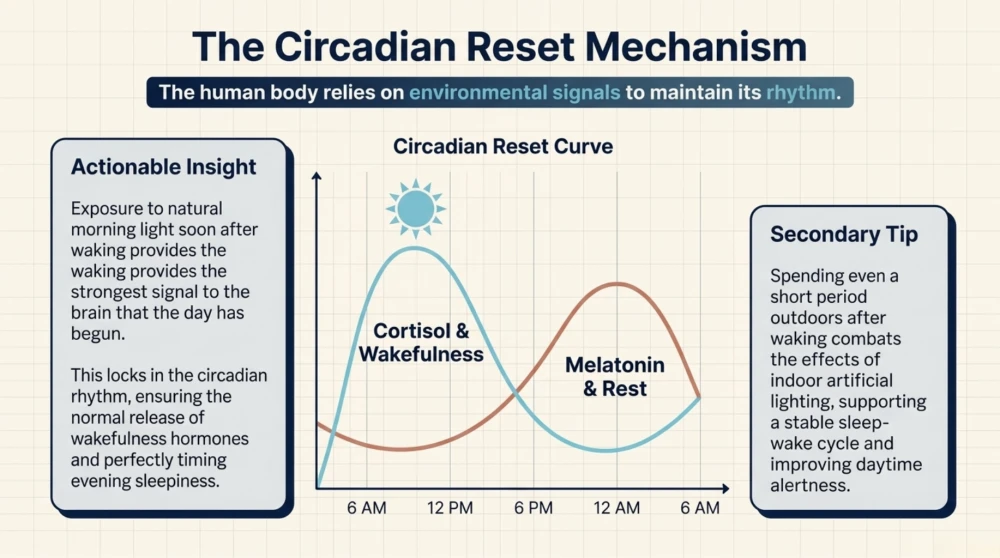
One of the simplest ways to support healthy sleep is exposure to natural light soon after waking.
Morning sunlight provides an important signal to the brain that the day has begun. This helps regulate the circadian rhythm and supports the normal release of hormones involved in wakefulness during the day and sleepiness at night.
Many adults spend their mornings indoors under artificial lighting before remaining inside offices for much of the day. Whenever possible, spending even a short period outdoors after waking may help reinforce a more stable sleep-wake cycle.
Combined with a regular bedtime, this simple habit may improve both sleep quality and daytime alertness.
Why Good Sleep Hygiene Supports Long-Term Recovery
Sleep hygiene refers to everyday habits that encourage healthy sleep. These habits do not guarantee perfect sleep, but they create conditions that allow the body to recover more effectively.
Helpful practices include:
- Keeping a regular bedtime and wake-up time.
- Reducing screen exposure before bed.
- Avoiding heavy meals close to bedtime.
- Limiting caffeine late in the day.
- Creating a quiet, dark, and comfortable sleep environment.
- Using the bedroom primarily for sleep rather than work.
When practiced consistently, these habits often improve sleep quality more effectively than relying solely on weekend recovery sleep.
Why Healthy Sleep Supports Weight Management
Sleep, nutrition, physical activity, and metabolic health are closely interconnected. People who consistently sleep well often find it easier to maintain healthy routines throughout the day.
Adequate sleep may support:
- Better appetite regulation
- Improved food choices
- Higher energy for physical activity
- Greater concentration and productivity
- Improved emotional well-being
By contrast, chronic fatigue often leads to skipped workouts, increased food cravings, emotional eating, and greater reliance on caffeinated or sugary beverages. This is one reason sleep should be viewed as a core pillar of lifestyle medicine alongside nutrition and exercise.
When Persistent Fatigue Should Not Be Ignored
Although insufficient sleep is a common cause of tiredness, it is not the only explanation. If fatigue continues despite obtaining adequate sleep on a regular basis, further evaluation may be appropriate.
Persistent fatigue may occasionally be associated with:
- Iron deficiency or anemia
- Vitamin B12 deficiency
- Vitamin D deficiency
- Thyroid disorders
- Prediabetes or diabetes
- Obstructive sleep apnea
- Depression or anxiety disorders
- Certain medications
Rather than assuming that all fatigue is simply due to poor sleep, it is important to consider the broader clinical picture, particularly if symptoms persist for several weeks or interfere with daily activities.
Building a Lifestyle That Supports Better Sleep
Healthy sleep is rarely achieved through a single intervention. Instead, it develops from a combination of consistent daily habits.
People who regularly prioritize:
- Balanced nutrition
- Regular physical activity
- Stress management
- Consistent sleep schedules
- Morning daylight exposure
often find that their energy levels improve naturally over time.
These habits reinforce one another. Better sleep supports healthier eating, while regular exercise promotes better sleep. Together, they create a positive cycle that benefits both physical and mental health.
Key Takeaways: What You Should Remember
- Weekend sleep recovery can reduce tiredness but may not completely reverse the effects of chronic sleep deprivation.
- Sleep consistency is often as important as total sleep duration.
- Large differences between weekday and weekend sleep schedules can contribute to social jet lag.
- Chronic sleep restriction may influence appetite, metabolism, concentration, and physical performance.
- Gradually reducing sleep debt throughout the week is generally more effective than relying only on weekend recovery.
- Morning sunlight, regular bedtimes, and good sleep hygiene help support a healthy circadian rhythm.
- Persistent fatigue despite adequate sleep should be medically evaluated to identify possible underlying causes.
You can book a consultation here:
Book Appointment
Written by Dr. Pankaj Kumar, General & Lifestyle Physician, Dwarka, New Delhi