
















- 2nd February 2026
Table of Contents
The Paradox of Eating Little and Gaining Weight
Many patients come into our clinic feeling defeated because the scale keeps climbing despite their best efforts to eat less. At the Dr. Pankaj Kumar Medical and Lifestyle Clinic, we believe it is vital to understand that weight is a biological outcome rather than just a test of willpower. One fascinating area of study is Infectobesity, which explores how specific pathogens and your unique gut microbiome influence your metabolic potential. Your internal bacteria can actually determine how much energy your body pulls from the food you eat. To understand this paradox, we must first look at the foundation of how your body burns energy while you are at rest.
The Foundation: Understanding Your Basal Metabolic Rate (BMR)
Your Basal Metabolic Rate, or BMR, is the engine of your body, responsible for about 70 percent of your daily calorie burn while doing nothing. This engine powers essential life processes like circulation, breathing, and cell growth, making it the most significant part of your daily energy expenditure. Your most energetic organs are the primary drivers here, with the liver accounting for 27 percent and the brain using 19 percent of this rest-time energy. It is important to know that BMR is not a fixed number and typically declines by 1 to 2 percent every decade after you reach age 20.
According to the latest data, three primary factors determine your resting burn, with fat-free mass being the most influential component. Research shows that 62 percent of the variation in BMR between different people is explained specifically by their amount of lean, fat-free body mass. This is why preserving muscle is so critical as we age, because as this mass declines, your body's internal engine naturally begins to slow down. When your BMR drops, even a meal that once seemed small can suddenly become a caloric surplus that your body stores as fat.
The top 3 factors that influence a person's BMR include:
- Fat-free mass is the most significant predictor of your resting energy needs, explaining the vast majority of metabolic variation between people. Maintaining this lean tissue is vital for a healthy engine because it is more metabolically active than fat and keeps your internal burn higher throughout the day.
- Age is a factor that typically correlates with a natural decline in the body's metabolic efficiency over time as we get older and less active. This happens primarily due to the loss of lean muscle mass, which slows the rate at which your body uses energy and processes nutrients even while you are asleep.
- Fat mass does contribute to your overall energy needs, but it is far less metabolically active than your highly energetic organs like the heart. While it plays a small role in BMR calculation, its impact is much smaller compared to the significant energy required by lean tissues to maintain daily bodily functions.
The Efficiency Trap: Metabolic Adaptation and Starvation Mode
Long-term dieting often leads to a frustrating weight-loss plateau that many people incorrectly call metabolic damage. In reality, this is a natural process known as metabolic adaptation, where your body tries to protect itself from what it perceives as a threat. This survival mechanism, or adaptive thermogenesis, can cause the body to burn roughly 400 fewer calories per day than a standard calculator would predict. Your system is simply becoming more efficient at using energy to ensure you survive a period of low-calorie availability.
This efficiency is best explained by comparing two different ways the body handles physical activity: the Additive and the Constrained models. The Additive model suggests that the more you move, the more total calories you will burn in a simple, straight-line fashion. However, recent research by Dr. Herman Pontzer suggests the Constrained model is much more accurate for human biology. His studies compared modern Western populations to hunter-gatherers and farmers who are much more active but surprisingly have similar daily energy expenditures.
This research shows that our bodies eventually hit a ceiling and limit total energy burn even as our physical activity continues to increase. This means that moving more does not always result in a linear increase in weight loss because the body compensates internally. Instead of burning more, the body may dial down other metabolic processes to keep the total energy spent within a specific, constrained range. To find the real reason the scale is stuck, we have to look past simple movement and into the chemical signals of your hormones.
The Hormone Factor: Cortisol, Leptin, and the Survival Switch
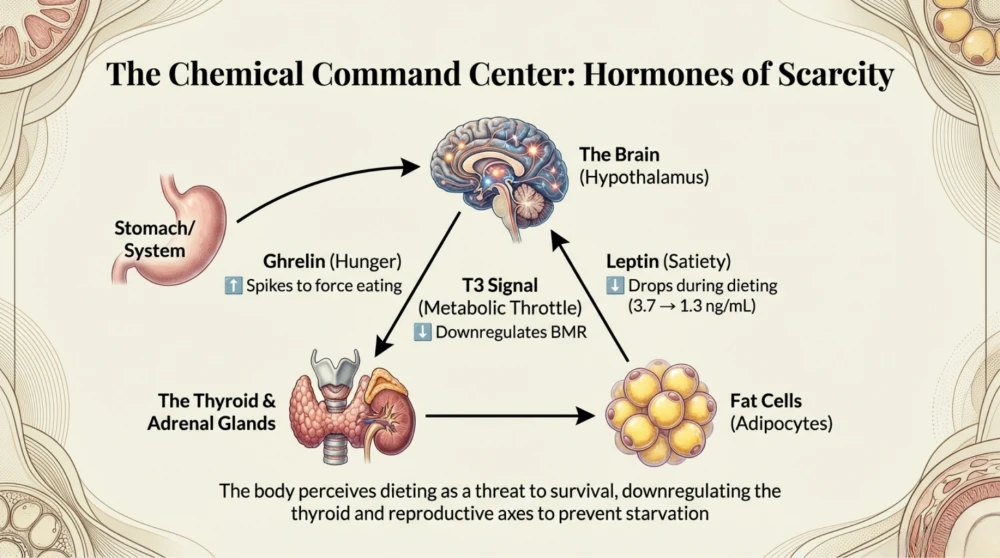
Hormones act as the primary control center for fat storage, and they receive their marching orders from the hypothalamus in the brain. Cortisol, often called the stress hormone, is a major player in this system because it stimulates enzymes that promote fat storage. High cortisol is particularly problematic because it leads to visceral obesity, which is the dangerous fat stored deep within your abdomen. Beyond fat storage, elevated cortisol can trigger intense cravings for comfort foods like those high in sugar and fats.
Another critical factor is Leptin Resistance, which can be devastating for anyone trying to manage their weight through diet alone. Leptin is produced by your fat cells to tell your brain when you are full, but in a resistant state, that signal never arrives. This is not a lack of willpower; it is a broken signal that leaves your brain genuinely convinced you are in danger of starving. When this happens, your brain triggers survival switches that increase hunger and slow your metabolism, regardless of how much fat you have stored.
Poor sleep is a primary driver of these hormonal imbalances, as sleep deprivation directly raises cortisol levels while lowering your satiety signals. When you do not get enough rest, your body enters a high-stress state that encourages the storage of every calorie you consume. This creates a vicious cycle where exhaustion leads to overeating and a biological refusal to burn fat, even in a persistent deficit. These chemical signals are also deeply intertwined with the trillions of bacteria living in your gut, which act as a second metabolic brain.
Your Gut Microbiome: The Hidden Energy Harvesters
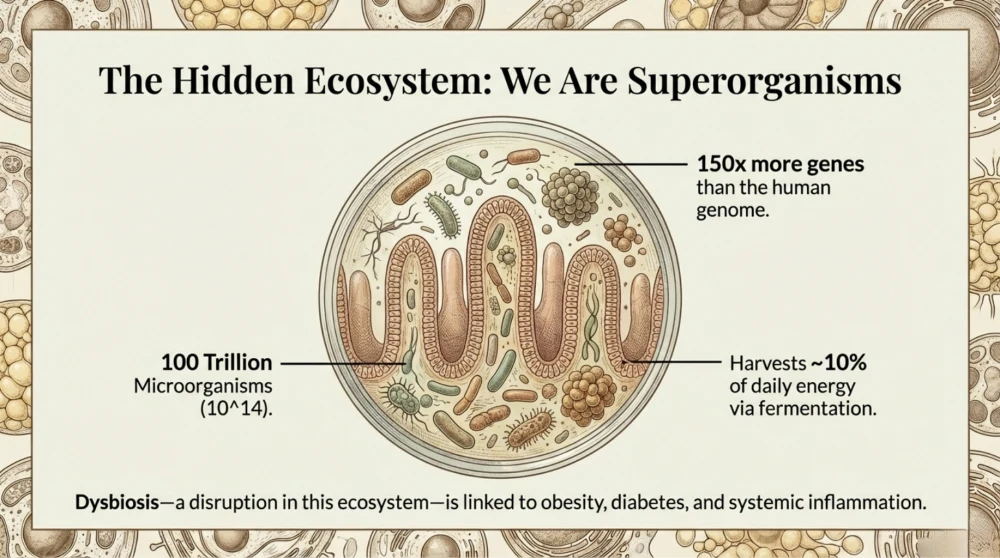
The gut and liver are connected through the gut-liver axis, a two-way communication system where microbes influence how your body harvests energy. A 2024 study from the Korean NIH on Type 2 Diabetes Mellitus (T2DM) patients highlighted the role of the Firmicutes to Bacteroidetes (F/B) ratio. The researchers found that as BMI increased, the proportion of Firmicutes bacteria also rose, indicating a significant link to obesity. These bacteria are highly efficient at extracting extra calories from fibers that are usually considered to be indigestible by the host.
For many people struggling with weight, their gut bacteria are effectively eating for two, turning small amounts of food into more energy than expected. This microbial imbalance, or dysbiosis, can also lead to a condition known as leaky gut, which allows endotoxins to enter the bloodstream. This triggers systemic inflammation throughout the body and is often reflected in elevated liver enzymes such as AST and ALT. In the Korean T2DM study, a higher F/B ratio was positively correlated with AST levels, showing a clear link to liver stress.
Who should be careful?
While understanding these biological mechanisms is helpful, certain individuals must be extremely cautious before making significant lifestyle or dietary changes. This includes individuals who are currently pregnant, as nutritional needs are different and must be managed by a healthcare provider. Those taking specific medications, such as antithyroid agents for hyperthyroidism, must be closely monitored since these drugs directly alter the metabolic rate. If you have a history of medical issues like reflux, sudden shifts in diet can often trigger or worsen your symptoms.
Key points
- Prioritize getting 7 to 8 hours of quality sleep each night to help regulate your cortisol levels and fix your leptin signaling. Proper rest ensures your brain receives the correct fullness signals and prevents the body from switching into a survival fat-storage mode that makes losing weight nearly impossible despite your best efforts.
- Increase your intake of high-fiber foods to help control insulin release and support a healthy balance within your gut-liver axis. These foods slow down digestion and provide the right nutrients to keep your gut microbiome from harvesting excessive energy from your meals and storing it as visceral fat in your abdomen.
- Use slow and progressive dietary changes instead of drastic calorie cuts to prevent your body from entering a state of metabolic adaptation. This careful approach helps you avoid the survival switch that triggers a massive drop in your daily energy expenditure, which is often incorrectly referred to as metabolic damage by the fitness community.
- Focus on maintaining fat-free muscle mass through appropriate activity, as this lean tissue accounts for 62 percent of your BMR variation. Preserving this tissue ensures that your internal engine remains strong and efficient as you age, preventing the natural metabolic slowdown that occurs as people lose muscle mass over the decades.
- Shift your perspective from simple calorie counting to a more holistic approach that considers gut health and hormonal balance for success. Understanding that weight gain is a complex biological process governed by your hypothalamus and gut microbes will help you stay motivated and focused on long-term health rather than just the number on the scale.
Disclaimer
Educational only, not a substitute for medical advice.
Dr. Pankaj Kumar Medical and Lifestyle Clinic
You can book a consultation here: Book Appointment
Written by Dr. Pankaj Kumar, General & Lifestyle Physician, Dwarka, New Delhi