
















- 20th May 2026
Table of Contents
- The Human Body Functions Best With Rhythm and Predictability
- Why Eating Patterns Usually Break Down First
- How Stress Quietly Changes Food Choices
- The Problem With “Eating Healthy Occasionally”
- Why Physical Activity Slowly Disappears From Busy Lives
- Sleep Becomes a “Negotiable” Activity
- The Most Dangerous Part: Gradual Adaptation
- Why Modern Metabolic Healthcare Must Address Lifestyle Structure
- How Busy Work Schedules Quietly Create Insulin Resistance
- The Digital Overload Problem Nobody Talks About Enough
- Why Emotional Eating Becomes More Common During Busy Work Phases
- The Weekend Compensation Myth
- Why Professionals Slowly Lose Consistency
- How Chronic Work Stress Promotes Belly Fat Accumulation
- The Most Important Realization: Health Habits Fail Structurally, Not Just Emotionally
- What Actually Works: Building Health Habits Around Real Life Instead of Fighting It
- Why Consistency Matters More Than Intensity
- Why Meal Structure Matters More Than “Dieting”
- Busy Professionals Need “Low Friction” Exercise Systems
- Why Sleep Recovery Changes Everything
- The Importance of Mental Recovery and Burnout Prevention
- Why “All-or-Nothing” Thinking Damages Long-Term Health Habits
- Why Long-Term Structure Matters More Than Temporary Motivation
- What I Commonly Observe in Clinical Practice
- Key Takeaways: What You Should Remember
- When Should You Pay Attention to Lifestyle Disruption?
One of the biggest health challenges in modern society is not always lack of knowledge. Most people today already understand that sleep matters, exercise is important, stress affects health, and processed food is harmful when consumed excessively.
Yet despite this awareness, millions of working professionals gradually move away from healthy routines every year. What makes this problem dangerous is that the change rarely happens dramatically.
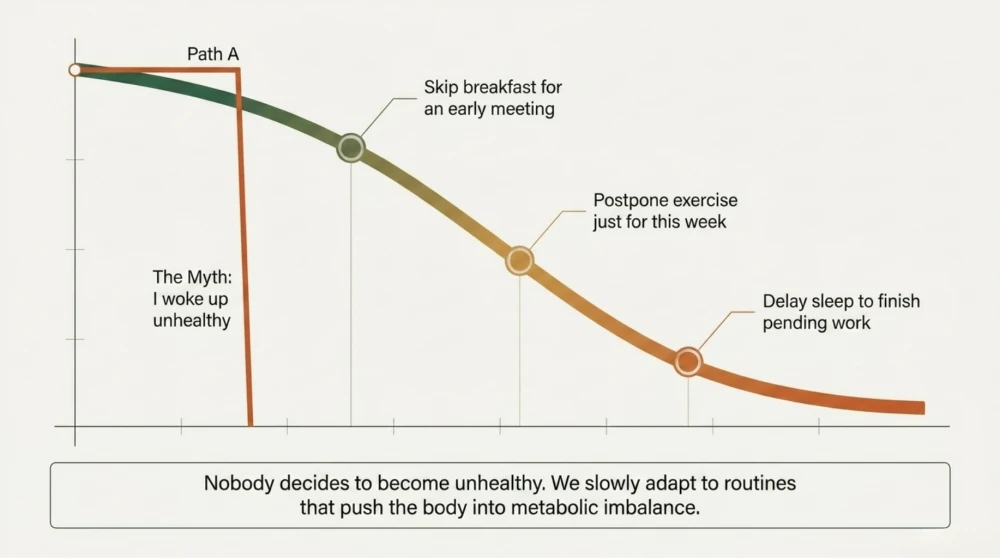
Very few people suddenly wake up one day and decide to become unhealthy. Instead, the transition usually happens slowly through small adjustments made to cope with demanding schedules, deadlines, long working hours, digital overload, and mental fatigue.
Initially, these adjustments appear temporary and practical.
Someone skips breakfast because of an early meeting. Another person delays sleep to finish pending work. Exercise is postponed “just for this week.” Lunch is replaced with convenience food during stressful days. Individually, these decisions may seem harmless.
But when repeated continuously over months and years, they gradually reshape metabolism, energy regulation, sleep quality, eating behavior, and stress response.
This is exactly why understanding why busy work schedules often affect health habits has become increasingly important in modern metabolic healthcare.
In clinical practice, many patients do not develop lifestyle-related health problems because they intentionally ignored their health. Instead, they slowly adapted to routines that continuously pushed the body into metabolic imbalance.
The Human Body Functions Best With Rhythm and Predictability
One of the most overlooked aspects of health is biological rhythm.
The body prefers consistency. Hormonal systems, digestion, energy production, sleep regulation, appetite signaling, and metabolic recovery all function more efficiently when daily patterns remain relatively stable.
For example, the body naturally develops synchronized cycles for:
- Sleep and wake timing
- Hunger and satiety
- Energy expenditure
- Hormonal release
- Digestive activity
Modern work schedules frequently disrupt this biological predictability. Irregular work timing, late-night screen exposure, shift work, prolonged sitting, unpredictable meals, and mental overstimulation create a situation where the body continuously loses rhythm.
And once biological rhythm becomes unstable, healthy habits become increasingly difficult to maintain consistently.
Why Eating Patterns Usually Break Down First
One of the earliest casualties of busy schedules is meal structure. Most professionals do not intentionally choose unhealthy eating patterns. The problem usually begins with time compression.
As work responsibilities increase, meals slowly become secondary to productivity.
Breakfast is skipped because mornings become rushed. Lunch gets delayed due to meetings. Evening hunger becomes excessive after prolonged under-eating during the day. Late-night eating starts becoming common because work extends beyond normal hours.
Initially, the body tolerates these changes reasonably well. But over time, irregular eating creates significant metabolic consequences.
The body begins experiencing unpredictable energy availability. Hunger hormones become dysregulated. Cravings increase, especially for calorie-dense and rapidly rewarding foods.
This is why many busy professionals gradually develop dependence on:
- Sugary beverages
- Frequent caffeine intake
- Convenience snacks
- Late-night comfort eating
The issue is not simply “lack of discipline.” The body itself is adapting to chronic schedule instability.
How Stress Quietly Changes Food Choices
One of the biggest misconceptions about unhealthy eating is the assumption that food choices are controlled only by willpower.
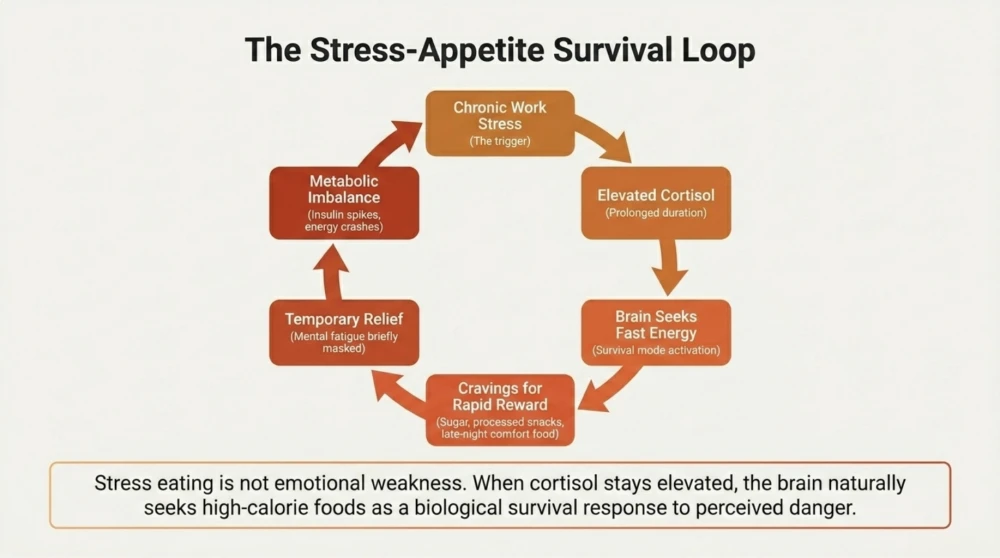
In reality, stress biology strongly influences appetite behavior. When work stress becomes chronic, cortisol levels remain elevated for prolonged durations. This changes how the brain responds to food.
Under stress, the brain naturally begins seeking:
- Fast energy
- High-calorie foods
- Sugar-rich snacks
- Highly palatable comfort foods
This is not simply emotional weakness. It is partly a biological survival response. The brain interprets prolonged stress as a state requiring rapid energy availability.
That is why many professionals notice a pattern where stressful work periods increase cravings for:
- Tea or coffee with sugar
- Processed snacks
- Restaurant food
- Late-night overeating
Over time, these repeated stress-driven eating behaviors gradually affect:
- Body composition
- Insulin sensitivity
- Triglyceride levels
- Fatty liver risk
- Overall metabolic health
The Problem With “Eating Healthy Occasionally”
Another common pattern seen in busy professionals is inconsistent health behavior.
Many individuals alternate between:
- Periods of strict control
- Periods of complete disruption
For example, someone may eat very carefully for a few days and then lose consistency during stressful work periods.
This creates a cycle of:
- Restriction
- Fatigue
- Stress eating
- Guilt
- Restarting again
Over time, this inconsistency becomes emotionally exhausting. The individual starts feeling that healthy habits are impossible to sustain in “real life.”
But the real issue is usually not lack of motivation. The issue is that the lifestyle structure itself does not support consistency.
Why Physical Activity Slowly Disappears From Busy Lives
Exercise habits usually disappear gradually rather than suddenly. Initially, professionals simply reduce frequency because work becomes demanding.
A few missed workouts become a few inactive weeks. Eventually, inactivity becomes normalized.
This matters because prolonged sitting and low movement create major metabolic consequences. The human body is biologically designed for movement.
When muscles remain inactive for prolonged periods:
- Calorie expenditure decreases
- Fat oxidation slows down
- Insulin sensitivity worsens
- Energy production becomes less efficient
At the same time, prolonged sitting reduces overall metabolic flexibility.
This is one reason many working professionals gradually develop:
- Belly fat
- Fatigue
- Fatty liver
- High triglycerides
- Difficulty losing weight
Sleep Becomes a “Negotiable” Activity
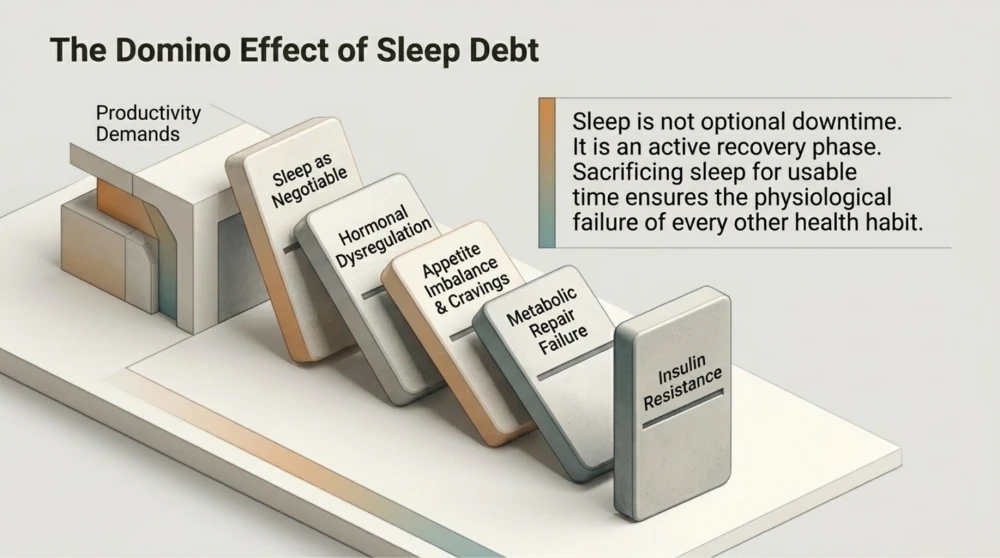
Perhaps the most dangerous normalization in modern work culture is sacrificing sleep for productivity. Many individuals start reducing sleep gradually to create more “usable time.” Initially this may feel manageable.
But biologically, sleep is not optional downtime. It is an active recovery phase essential for:
- Hormonal regulation
- Memory processing
- Metabolic repair
- Appetite balance
- Stress recovery
When sleep becomes chronically inadequate, the body begins functioning in a physiologically stressed state.
This increases:
- Cortisol levels
- Appetite dysregulation
- Cravings
- Mental fatigue
- Insulin resistance
Over time, the individual starts feeling “constantly tired” despite continuing daily routines. Unfortunately, many people normalize this exhaustion because chronic fatigue has become socially common in modern professional culture.
The Most Dangerous Part: Gradual Adaptation
Perhaps the biggest reason busy work schedules quietly damage health habits is human adaptation.
The body and mind gradually normalize repeated behaviors. What initially feels temporary slowly becomes everyday life.
This is why many individuals do not realize how dramatically their lifestyle has changed until they begin noticing:
- Weight gain
- Low stamina
- Poor sleep
- Abnormal health reports
- Reduced mental clarity
By that stage, the unhealthy routine has often already become deeply embedded into daily life. This is exactly why early awareness matters.
Why Modern Metabolic Healthcare Must Address Lifestyle Structure
Modern lifestyle diseases rarely develop because of one isolated unhealthy meal or one missed workout. They usually emerge because daily structure itself gradually shifts away from biological balance.
This is why structured metabolic approaches like the Lifestyle Modification Program focus not just on food charts, but on rebuilding sustainable routines that work realistically within modern work schedules.
How Busy Work Schedules Quietly Create Insulin Resistance
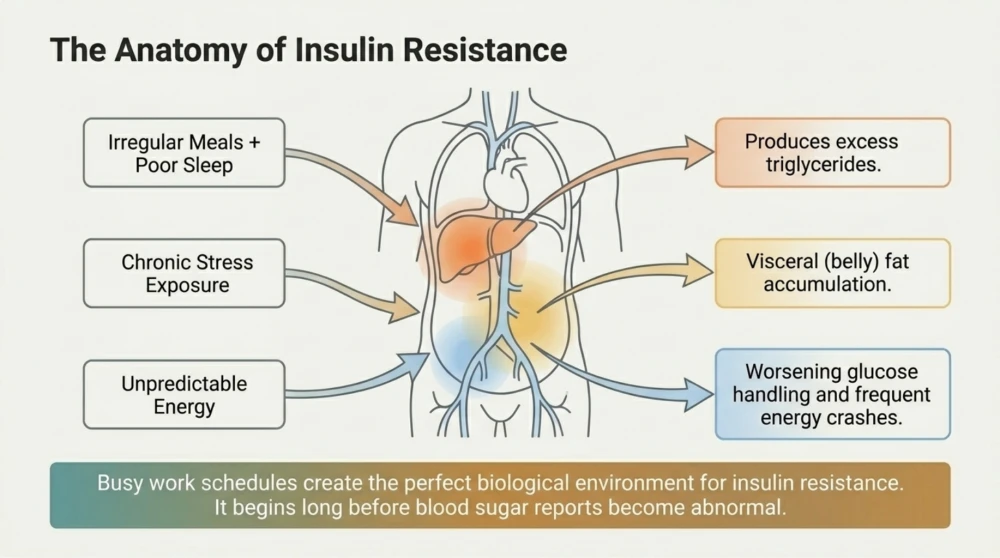
One of the most important metabolic consequences of disrupted work-life rhythm is the gradual development of insulin resistance.
Most people associate insulin resistance only with diabetes, but in reality it begins much earlier and affects energy regulation long before blood sugar reports become abnormal. Busy work schedules create the perfect biological environment for insulin resistance to develop slowly over time.
This usually happens through a combination of:
- Irregular eating patterns
- Poor sleep quality
- Chronic stress exposure
- Reduced physical activity
- Frequent intake of convenience foods
Individually, these factors may appear small. But together they continuously push metabolism toward instability. When stress levels remain elevated and meal timing becomes unpredictable, the body gradually becomes less efficient at handling glucose and fat metabolism.
The liver starts producing more triglycerides. Belly fat begins increasing more easily. Energy crashes become more frequent. Hunger regulation becomes less reliable.
This is why many working professionals eventually notice:
- Increasing waist circumference
- Fatigue after meals
- Difficulty losing weight
- Persistent cravings
- Borderline blood sugar abnormalities
Often, these changes are already signs of worsening metabolic flexibility.
The Digital Overload Problem Nobody Talks About Enough
Modern work stress is very different from traditional physical stress. Today, the nervous system rarely gets true recovery.
Emails continue after office hours. Notifications remain active constantly. Screens dominate both professional and personal life. Even relaxation often involves digital stimulation. This creates continuous cognitive activation.
The brain remains in a state of partial alertness for prolonged durations, even when the body appears physically inactive.
Over time, this constant stimulation affects:
- Sleep quality
- Stress hormone regulation
- Mental recovery
- Appetite behavior
- Energy stability
One important consequence is mental fatigue without physical exhaustion.
The person feels tired mentally but not physically “spent,” which often creates a tendency toward:
- Mindless snacking
- Late-night scrolling with eating
- Emotional comfort eating
- Reduced motivation for exercise
This is one reason modern professionals frequently feel exhausted while simultaneously becoming more sedentary.
Why Emotional Eating Becomes More Common During Busy Work Phases
Food is not driven only by physical hunger. The brain also uses food as a form of emotional regulation.
During stressful or mentally exhausting work periods, many individuals unconsciously start using eating as temporary relief from:
- Mental fatigue
- Stress overload
- Emotional exhaustion
- Cognitive burnout
This is especially common late in the evening after prolonged decision-making and mental strain. At that point, self-control becomes biologically weaker because the brain itself is fatigued.
As a result, the body begins preferring foods that provide rapid reward and comfort.
This explains why late-night eating often involves:
- Sweets
- Processed snacks
- Restaurant food
- High-calorie comfort meals
Over time, this pattern becomes deeply conditioned. The brain starts associating stress recovery with eating behavior. This is why many professionals feel they “deserve” comfort food after difficult workdays.
The pattern becomes psychological, hormonal, and behavioral simultaneously.
The Weekend Compensation Myth
Another extremely common pattern in busy professionals is the belief that health can be “repaired” on weekends.
Many individuals maintain highly disrupted routines throughout the week and then attempt to compensate through:
- One intense workout
- Temporary dieting
- Extra sleep
- Short-term discipline
While some recovery certainly helps, the body responds more effectively to consistency than occasional correction. Metabolic health is influenced by repeated daily signals.
When unhealthy patterns dominate most weekdays, occasional weekend recovery usually cannot fully reverse the physiological effects.
This is why many individuals continue feeling:
- Chronically tired
- Mentally foggy
- Metabolically sluggish
despite trying to “reset” every weekend.
Why Professionals Slowly Lose Consistency
One of the biggest emotional struggles for working individuals is the feeling that they “cannot stay disciplined anymore.” But in reality, the problem is usually not lack of character. The problem is cumulative decision fatigue.
Busy professionals make hundreds of decisions daily under mental stress. Over time, cognitive exhaustion reduces the brain’s ability to continuously maintain health-focused behavior.
This is why even highly motivated individuals gradually struggle with:
- Meal planning
- Exercise consistency
- Sleep discipline
- Stress management
As exhaustion accumulates, convenience slowly starts overpowering long-term health priorities. This transition is extremely common in modern urban work culture.
How Chronic Work Stress Promotes Belly Fat Accumulation
One of the clearest physical effects of prolonged schedule stress is increasing visceral fat accumulation. Visceral fat is the fat stored around abdominal organs.
This type of fat is metabolically active and strongly associated with:
- Insulin resistance
- Fatty liver
- High triglycerides
- Metabolic syndrome
Chronic stress contributes to this process through multiple mechanisms. Elevated cortisol levels increase fat storage tendency, especially around the abdominal region.
At the same time:
- Sleep decreases
- Physical activity reduces
- Cravings increase
- Eating patterns become irregular
Together, these factors gradually reshape body composition. This is why many professionals notice that belly fat increases even when total body weight has not changed dramatically.
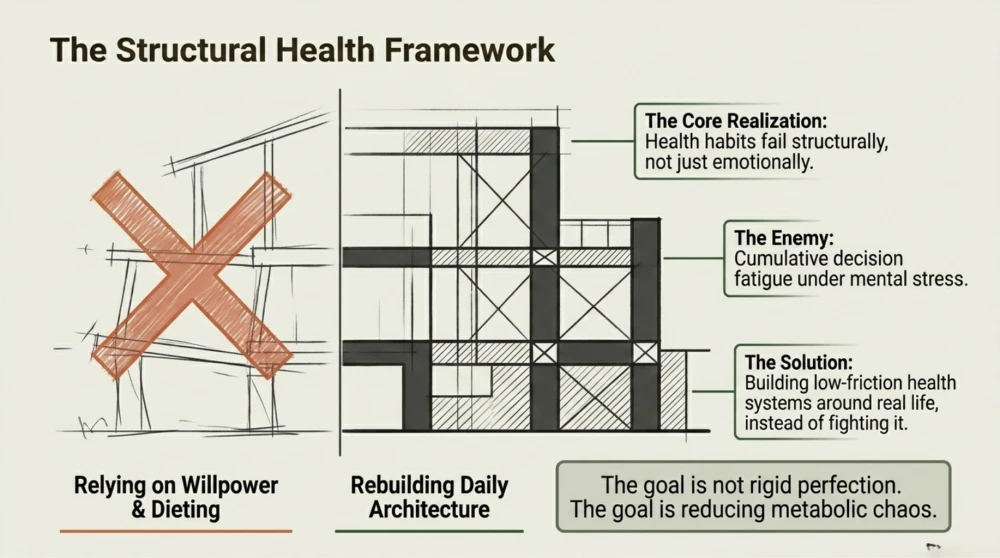
The Most Important Realization: Health Habits Fail Structurally, Not Just Emotionally
One of the biggest mindset shifts people need is understanding that unhealthy habits are often created structurally.
When work schedules continuously disrupt:
- Sleep timing
- Meal rhythm
- Physical activity
- Mental recovery
the body slowly loses biological stability.
This is why sustainable health improvement requires more than motivation alone. It requires rebuilding daily structure in a way that supports metabolic recovery realistically within modern work life.
What Actually Works: Building Health Habits Around Real Life Instead of Fighting It
One of the biggest mistakes many busy professionals make is trying to follow unrealistic “perfect lifestyle” routines. They often attempt highly structured plans that look ideal on paper but collapse within days because they do not match the realities of modern work life. This creates a frustrating cycle.
The individual starts with high motivation, follows strict routines briefly, becomes overwhelmed by work demands, loses consistency, feels guilty, and then eventually stops trying altogether. Over time, this repeated cycle creates emotional exhaustion around health itself.
This is why long-term metabolic improvement requires a completely different mindset. The goal should not be perfection. The goal should be sustainability.
Healthy habits become powerful only when they are realistically maintainable during busy weeks, stressful periods, travel schedules, and mentally demanding work phases.
Why Consistency Matters More Than Intensity
One of the most important realizations for working professionals is that the body responds better to repeated moderate healthy behaviors than occasional extreme effort.
For example, many people wait for the “perfect time” to restart their health routine.
They plan:
- One-hour daily workouts
- Perfect meal preparation
- Strict diet control
- Complete lifestyle overhaul
But busy schedules rarely allow perfect conditions consistently. As a result, the entire plan often collapses quickly.
A much more effective approach is creating systems that remain possible even during stressful work periods.
For example:
- Short but regular exercise sessions
- Simple repeatable meal structures
- Reasonable sleep timing improvements
- Reducing unnecessary dietary chaos
These smaller but sustainable adjustments often create much better long-term metabolic results.
Why Meal Structure Matters More Than “Dieting”
Many busy professionals assume they need a complicated diet plan. But in reality, one of the biggest problems is not always food type alone — it is meal rhythm instability.
When eating patterns become unpredictable, the body continuously struggles to maintain energy balance.
This often leads to:
- Excessive evening hunger
- Late-night overeating
- Frequent cravings
- Energy crashes during work hours
This is why restoring some degree of meal consistency becomes extremely important.
Even simple changes can create meaningful metabolic improvement, such as:
- Avoiding prolonged under-eating during the day
- Maintaining relatively fixed meal windows
- Improving protein intake
- Reducing dependence on ultra-processed convenience foods
The goal is not rigid perfection. The goal is reducing metabolic chaos.
Busy Professionals Need “Low Friction” Exercise Systems
One major reason exercise routines fail is because they require too much energy, preparation, or travel time. After mentally exhausting workdays, the brain naturally resists behaviors that feel complicated or demanding.
This is why sustainable exercise planning should reduce friction as much as possible.
For many professionals, consistency improves dramatically when exercise becomes:
- Simple
- Time-efficient
- Easily repeatable
- Psychologically manageable
This may include:
- 30-minute walks
- Short home workouts
- Strength training 3 times weekly
- Movement breaks during work hours
Importantly, regular movement improves much more than body weight alone.
It affects:
- Insulin sensitivity
- Stress regulation
- Mental clarity
- Sleep quality
- Fat oxidation
This is why exercise should be viewed as a metabolic therapy rather than simply a calorie-burning tool.
Why Sleep Recovery Changes Everything
One of the most underestimated health interventions for busy professionals is improving sleep quality. Many individuals focus entirely on food and exercise while continuing chronic sleep deprivation. But biologically, poor sleep affects almost every major metabolic system.
When sleep becomes inadequate:
- Cortisol levels remain elevated
- Appetite hormones become dysregulated
- Cravings increase
- Insulin sensitivity worsens
- Mental recovery declines
This creates a situation where maintaining healthy habits becomes progressively harder.
Many professionals try to solve fatigue with:
- Caffeine
- Sugar
- Energy drinks
- Frequent snacking
while the real issue is inadequate recovery.
Even modest improvements in sleep timing and duration often produce noticeable changes in:
- Energy stability
- Appetite control
- Mood regulation
- Exercise consistency
The Importance of Mental Recovery and Burnout Prevention
One major problem in modern work culture is that many individuals remain mentally engaged almost continuously. Work no longer ends physically at the office.
Even during “rest,” many people continue:
- Checking emails
- Monitoring notifications
- Thinking about unfinished tasks
- Remaining cognitively stimulated through screens
This creates prolonged nervous system activation without adequate psychological recovery.
Over time, this contributes to:
- Burnout
- Emotional exhaustion
- Reduced motivation
- Stress eating
- Mental fatigue
This is why sustainable health improvement also requires creating periods of genuine recovery where the brain itself is allowed to slow down.
Why “All-or-Nothing” Thinking Damages Long-Term Health Habits
Many professionals unknowingly sabotage consistency through perfectionist thinking.
They believe: “If I cannot follow everything perfectly, there is no point trying.”
This mindset creates repeated cycles of:
- Extreme motivation
- Unsustainable effort
- Work-related disruption
- Complete abandonment of routines
But health habits work very differently. The body responds positively even to moderate improvement maintained consistently over time.
In fact, sustainable moderate routines often outperform aggressive short-term discipline. This is one of the most important mindset shifts busy professionals need to develop.
Why Long-Term Structure Matters More Than Temporary Motivation
Motivation naturally fluctuates. Work stress changes. Energy levels change. Personal responsibilities change. This is why relying purely on motivation rarely works long term.
Instead, health improvement becomes more successful when supported by:
- Structured routines
- Predictable meal systems
- Simplified exercise planning
- Recovery-focused sleep habits
- Reduced lifestyle chaos
This is exactly why structured metabolic approaches usually work better than temporary dieting attempts.
You can explore this broader and more sustainable strategy through the Lifestyle Modification Program.
What I Commonly Observe in Clinical Practice
Many working professionals believe their health problems appeared “suddenly.” But when we carefully review their routines, the transition usually happened gradually over years.
Small disruptions slowly accumulated:
- Reduced movement
- Poor sleep
- Stress eating
- Irregular meals
- Mental overload
Eventually the body started showing visible metabolic consequences through:
- Weight gain
- Fatty liver
- High triglycerides
- Persistent fatigue
- Reduced metabolic flexibility
This is why early lifestyle correction matters far more than waiting for severe disease to appear first.
Key Takeaways: What You Should Remember
- Busy work schedules affect health habits gradually, not suddenly
- Irregular meal timing and chronic stress strongly affect metabolism
- Poor sleep reduces appetite control, recovery, and insulin sensitivity
- Digital overload contributes to mental fatigue and unhealthy eating patterns
- Sedentary behavior significantly worsens metabolic health
- Consistency matters more than extreme short-term effort
- Sustainable routines work better than perfection-based approaches
When Should You Pay Attention to Lifestyle Disruption?
You should take lifestyle disruption seriously if you notice:
- Persistent fatigue
- Increasing belly fat
- Poor sleep quality
- Frequent cravings
- Reduced exercise consistency
- Abnormal metabolic reports
Early lifestyle correction can significantly reduce long-term metabolic risk.
You can book a consultation here:
Book Appointment
Written by Dr. Pankaj Kumar, General & Lifestyle Physician, Dwarka, New Delhi